
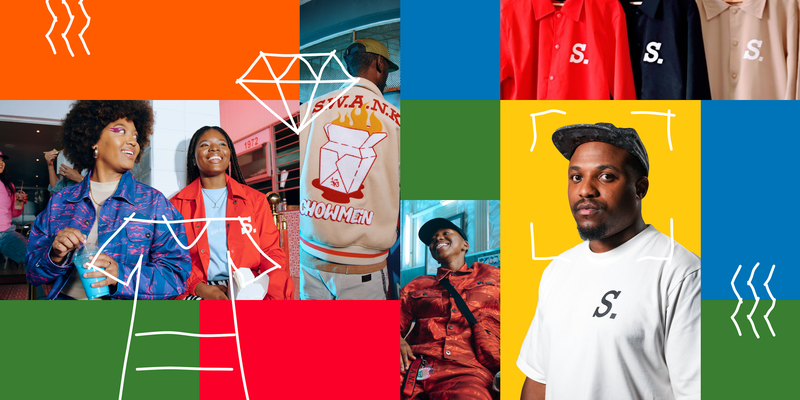
S.W.A.N.K is not an abbreviation. The name was inspired by the founding crew’s swag before it became the Johannesburg streetwear brand S.W.A.N.K Jozi.“We have the dots there because it’s provocative,” says the brand’s founder and creative director, Lindelani Nedoboni.Rooted in local street culture, S.W.A.N.K Jozi uses fashion as a medium for creative storytelling and social commentary, translating South African narratives and global influences into apparel that builds identity, belonging and community.Nedoboni, who grew up in Soweto, conceived S.W.A.N.K Jozi in 2013 as his contribution to the growing streetwear movement. But the brand’s roots go back further, to what Nedoboni describes as “a teenage hustling energy”.“The backstory is just simple – teenagers, a crew, selling rare sneakers and clothes that people couldn’t buy at the mall.”The hustle started in the 2000s. Nedoboni and his crew would source items not available through commercial retailers at the time.“Let’s say skaters were wearing Stefan Janoskis, we used to know where to get those. Like if Soulja Boy was wearing Supras in music videos, we used to know how to get those,” Nedoboni explains.His friends eventually encouraged him to formalise the business, turning a teenage interest in sneakers and clothes into a brand.In 2015, Nedoboni won the Beyond the Lemonade Stand teen entrepreneur competition. He also used his early profits from S.W.A.N.K Jozi to fund his multimedia design studies at the University of Johannesburg.Running the brandNedoboni opened a store at 70 Juta Street in Braamfontein in November 2021. The move from selling sought-after imported items to producing his own products brought a new set of challenges.“It’s less about how fly I’d look in my sneakers and fit.”He had to move from “the cool” to understanding “the business of the business” – making his own products as desirable as the imported items he had once sourced.Nedoboni describes the business as “super cash flow-intensive”. The gap between money leaving the business to place an order and money coming back through sales can stretch to four to six months once production and shipping from abroad are factored in. Larger brands can pre-order stock ahead of a season and promise customers faster delivery.South Africa’s mall-centric shopping culture is a structural challenge for street-level brands, says Nedoboni, but operating from a brick-and-mortar store that’s not in a mall allows him to test the brand’s real pull.He also sees ego as a risk in youth culture-driven spaces. Staying a “student of the game”, he says, has helped him and the brand continue to progress.(Graphic: Kevin Momberg)Beyond JoburgNedoboni is one of the 15 entrepreneurs selected in the second edition of Création Africa, which supports emerging cultural and creative entrepreneurs in South Africa, Lesotho and Malawi. The project is an initiative of the French Ministry for Europe and Foreign Affairs, the Embassy of France in South Africa, Lesotho and Malawi, and the French Institute of South Africa (Ifas).The 15 finalists for Création Africa were chosen from more than 340 applications and will receive mentoring and support aimed at strengthening their businesses and preparing them for growth and investment.The programme, says Nedoboni, gives S.W.A.N.K access to the existing relationships built through Ifas and its wider ecosystem, making it easier to pursue the brand’s international ambitions. Rather than trying to cold-approach international companies, he sees the network as a way to get conversations started.For Nedoboni, growth is not simply measured by scale. Opening additional stores is not automatically beneficial if the systems and profitability needed to support them have not caught up.Growth also depends on selling trust as much as a product. Customers who have previously bought from small, unfamiliar drops are willing to wait for their orders. But when deliveries slip, that trust is put at risk, particularly in an era of social media and cancel culture.That trust and access to new networks are especially relevant to Nedoboni’s five-year vision for the brand. The goal is not simply to grow S.W.A.N.K Jozi, but to “scale and manage the growth within capacity”. DMOur writing about Création Africa is made possible in partnership with the French Institute of South Africa (Ifas). Création Africa is an initiative of the French Ministry for Europe and Foreign Affairs, the Embassy of France in South Africa, Lesotho and Malawi, and Ifas.
CRÉATION AFRICA: From sneakers to spreadsheets — Lindelani Nedoboni’s S.W.A.N.K Jozi journey
Full Article
Original Source
Read the full article at Dailymaverick →KhanList aggregates and links to publicly available news content. We do not host full articles from third-party sources. Always verify important information with original sources.