
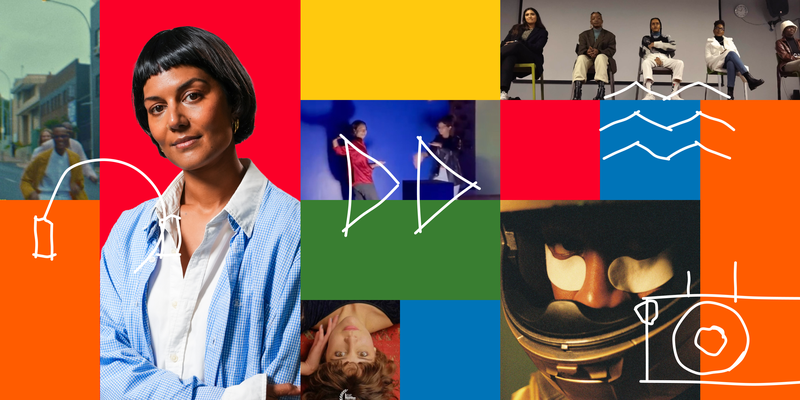
Growing up with what Hallie Haller describes as “parents who would have definitely have been creatives if they’d been born in a different time in South Africa”, Haller was encouraged to pursue their “crazy ideas”. Curiosity, they say, has always outweighed fear, drawing them towards newness, new people and collaboration.“I’m a person who loves to make the things in my head real. I’ve always been like that.”Haller is the founder of the South African chapter of GirlsInFilm, an organisation providing community, mentorship, and industry access for underrepresented creators.Haller credits South African production company FAM Films with helping them make the leap from someone with “wild ideas” to someone able to execute those ideas commercially.It was a more practical concern, however, that led Haller to start Better Yet.“Honestly, tax made me start Better Yet,” they said, half-jokingly.Haller says they realised that having a company could allow them to build something bigger than they could as an individual freelancer.From a creative universe to a business modelWhen Haller entered the Création Africa programme, Better Yet was built around a very different idea. They wanted to take existing South African stories and turn them into new revenue-generating formats, including immersive live experiences, XR (extended reality) and interactive works, merchandise ecosystems and screen adaptations.The programme, however, led Haller to examine whether the idea made sense as a business. Adapting other people’s existing intellectual property at scale would mean licensing and adaptation fees, as well as legal complexities the company was not yet equipped to handle.It was, Haller realised, “a great creative idea, but not a good business idea”.The company has since pivoted towards producing original intellectual property that it owns outright. This way future adaptations, merchandise and profit-sharing arrangements can be built into the business from the beginning rather than negotiated later.Haller’s current focus is micro-dramas: short, serialised vertical videos designed primarily for mobile viewing. Episodes are around 90 seconds to two minutes long, with a full season running for about an hour and released in batches of eight to 10 episodes, or in “paygates”.The format has grown rapidly internationally, but Haller says South Africa does not yet have a dedicated platform or standard buyer for micro-dramas. Better Yet is also deliberately moving away from some of the conventions dominating the global market.Comedy and joyWhile much micro-drama content leans towards romance and horror and is increasingly produced using AI, Haller wants Better Yet to focus on comedy and joy, with human performers at the centre. They argue that AI still struggles to replicate comedy convincingly, but the decision is also philosophical: they want the company to remain creator-led.Better Yet recently signed on Johannesburg-based award-winning commercial director, filmmaker and digital artist Wandile Xaba, described by Haller as a strong entertainer with an ability to speak to the local market.“I really believe in her ability to entertain, and I think to tell a story that’s joyful is something that’s really important to me,” said Haller.(Graphic: Kevin Momberg)At the centre of Better Yet’s model is an attempt to change how creators benefit from the intellectual property they help produce. Haller wants writers and directors to have a share in the future profits and adaptations of their work – something they say is not standard even in traditional television.That ambition has come with a set of challenges. There is currently no established distribution model or standardised costing structure for micro-dramas in South Africa. Haller also says that once a format becomes competitive, pricing can quickly be driven down.The challenge is therefore balancing fair pay for creators with a production model lean enough for the business to survive. For Haller, that balance has to be designed into a project from the story-development stage rather than added after the fact.Thinking strategicallyHaller applied to the Création Africa programme mostly for its business education. Création Africa is a seven-month incubation programme by the French Ministry for Europe and Foreign Affairs, the Embassy of France and the French Institute of South Africa (Ifas), supporting cultural entrepreneurs across South Africa, Lesotho and Malawi. One of the biggest shifts was how Haller thinks about marketing.Coming from a generation saturated by social media, Haller says they became accustomed to thinking about visibility as a marketing strategy in itself. The programme challenged that assumption by forcing them to think more specifically about their audience, buyer and desired outcomes.“Understanding that marketing should have strategic outcomes was a big U-turn in my thinking, as opposed to just trying to be everywhere all the time.” DMOur writing about Création Africa is made possible in partnership with the French Institute of South Africa (Ifas). Création Africa is an initiative of The French Ministry of Europe and Foreign Affairs, the Embassy of France in South Africa, Lesotho and Malawi, and Ifas.
CRÉATION AFRICA: Developing creator-led micro-dramas for African audiences
Full Article
Original Source
Read the full article at Dailymaverick →KhanList aggregates and links to publicly available news content. We do not host full articles from third-party sources. Always verify important information with original sources.