
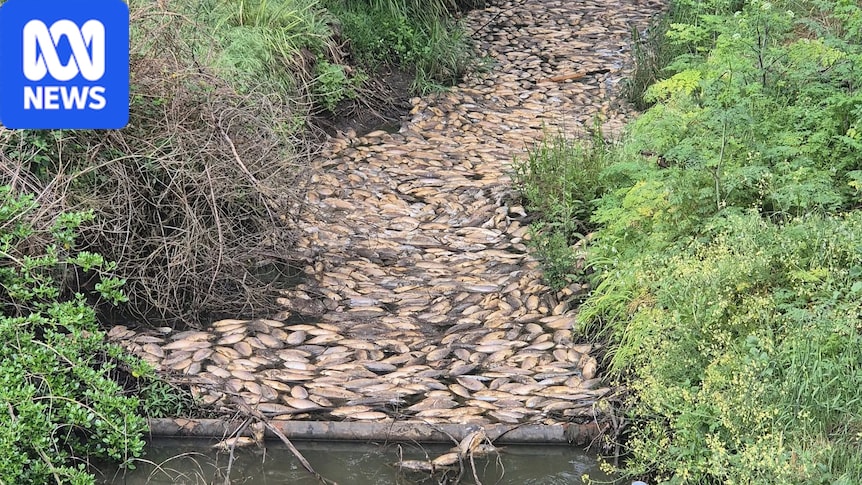
About 40 tonnes of carp have been removed from a creek that runs through a country town in south-west Victoria, after thousands of the pest species of fish died in a mass death event. Authorities say the fish have swum into the Barongarook Creek from the adjoining Lake Colac to spawn, but instead have died in huge numbers due to low oxygen levels in the water.The local shire council has organised to clean up most of the carcasses, with local residents raising concerns about the odour of rotting fish wafting through the surrounding area.Council staff were pictured clearing the dead fish by hand. (Supplied: Roland J Kettle)'Environmental disaster'Long-time Colac resident Pam Cuthbertson said the once thriving lake and its creeks have slowly become overrun with carp since the pest species was introduced in the 1960s.But she said this year is something else entirely."Thousands and thousands all jammed up against each other. You couldn't get a twig between them," Ms Cuthbertson said."This is just a catastrophe, it's an environmental disaster."Pam Cuthbertson is concerned for the health of Lake Colac and its surrounding waterways. (ABC News: Jean Bell)Colac Otway Shire Council said the mass death of the fish was a naturally occurring event, due to low water flows and a lack of oxygen in the water during carp breeding season.The council said an estimated 40 tonnes of carp had been removed from the creek so far.The shire's infrastructure and environment general manager Doug McNeill said the region had not seen a fish kill of this scale since around 2009."There was a thought at the time that the carp had all died," he said."But they do breed in the mud … and we've subsequently had them then re-breed to be in pretty prolific numbers again."Mr McNeill said council had been working with the state government and the Corangamite Catchment Management to tackle the issue.A pile of dead carp on the side of the creek covered in flies. (ABC News: Jean Bell)A truck fitted with suction equipment has been brought in to vacuum thousands of carp carcasses from the creek and reduce odour, which Mr McNeill said had been effective so far.He said there will be some ongoing disturbance through odour and asked residents to be patient as work continues to improve the situation.When the ABC visited the creek on Thursday afternoon, council crews had appeared to have cleared away many of the dead fish from the waterway.Victoria's Environment Protection Agency said it would not be investigating further as the fish deaths did not involve waste or pollution, while the Corangamite Catchment Management Authority said it had no active role in managing this issue.Long-term solutionsVictorian Fisheries Authority manager of recreational fishing Taylor Hunt said authorities were looking at long-term solutions to manage carp numbers."It shines a light on what a wicked problem carp are in our waterways," he said.Mr Hunt warned carp management was not easy and eradication was especially challenging.He said Victoria could learn some lessons from Tasmania, where it took almost 30 years and more than $15 million to functionally eradicate carp from two waterways.Public information signs have been put up along the creek. (ABC News: Jean Bell)"There are things that we can do to reduce carp numbers and not necessarily eradicate them, but get them below a level where they won't have a meaningful impact on our waterways like we've just seen," Mr Hunt said.He said tools could involve screens to block carp entering the creek to spawn, mass catch efforts when the lake naturally dried up, and potentially one day introducing a carp virus to the lake, which was still undergoing testing by the CSIRO."If the virus comes online and is a safe and practical option, we'll add that to the kit bag as well," Mr Hunt said."But let's get on with it while we can."
Council clears 40,000kg of dead carp from creek
Full Article
Original Source
Read the full article at Abc →KhanList aggregates and links to publicly available news content. We do not host full articles from third-party sources. Always verify important information with original sources.