
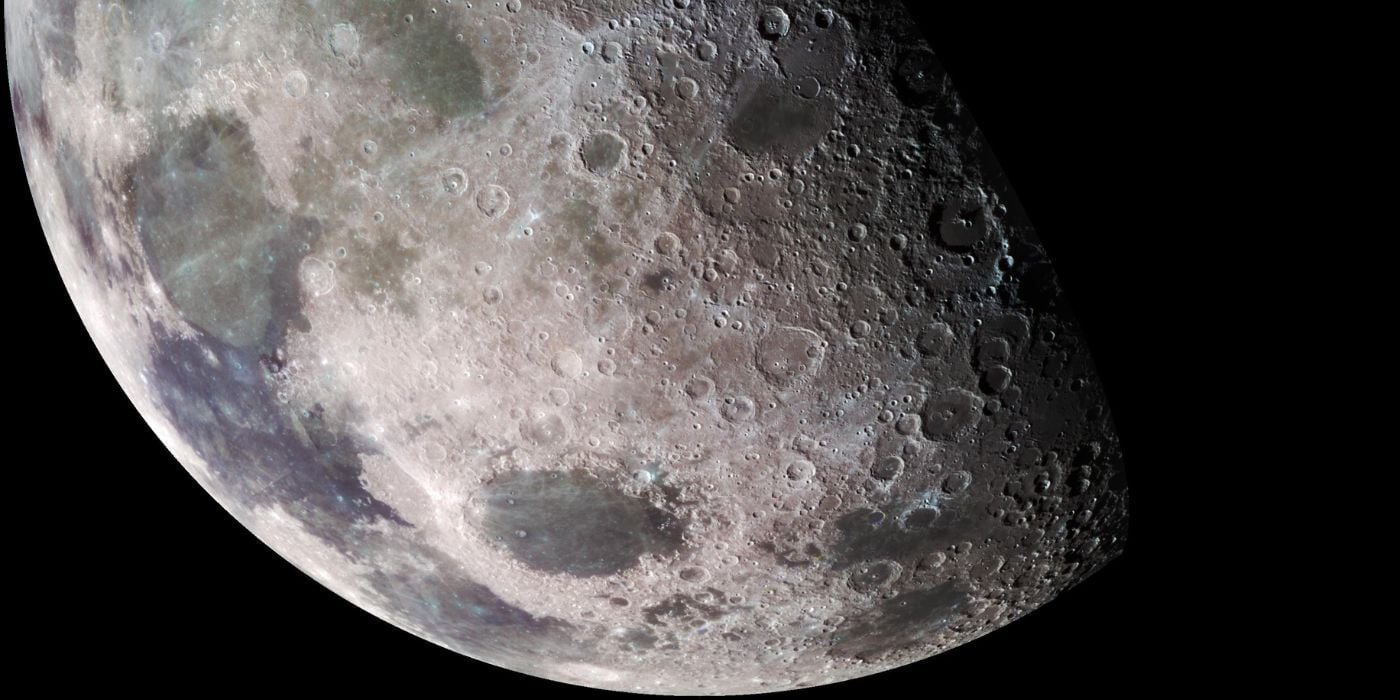
Most of our experience with the Search for Extraterrestrial Intelligence (SETI) has been focused on capturing radio signals that alien species have sent out, whether intentionally or unintentionally. That creates a huge “synchronicity” problem - what if there aren’t any alien civilizations broadcasting radio signals now, but there were a billion years ago? The Milky Way is around 13 billion years old - hoping that we exist at the same time as an alien civilization that happens to be actively messaging is a huge leap of faith. But, according to a new paper available in pre-print on arXiv and submitted to the International Journal of Astrobiology by Lewis J Pinault, as associated researcher at the SETI Institute, and his co-authors, we could take a completely alternative approach to trying to find alien civilizations - by looking for evidence of them in lunar dirt. That idea is not as crazy as it sounds. To be clear, it doesn’t mean that aliens once lived on the Moon. Or anywhere in the solar system for that matter. But, the moon is a really, really good garbage collector. The idea proposed in the paper is, instead of looking for simple radio waves, we should look for physical artefacts that could only have been created by intelligent aliens, and the Moon is a great place to look for them. First, let’s talk about what “artefacts” in this case actually means. The paper discusses two different types of particles. One is an Arkhipov Particle, named after Ukrainian astronomer Alexei Arkhipov, who first floated this idea in the 1990s; these are tiny pieces of unintentional industrial debris. If an alien civilization decides to build a Dyson swarm, some parts of it will inevitably be destroyed over time. YouTube Video describing the SETI institute’s search for “artifacts”. Credit - SETI Institute YouTube Channel Fragments from that destruction could be pushed out of the star system that was hosting that mega-structure, and they could eventually make their way to our own Solar System. This isn’t as far-fetched as it sounds, as the Sun rotates the entire way around the Milky Way once every ~230 million years - and the Milky Way itself is around 13 billion years old. So our own solar system has traveled through much of the galaxy, repeatedly, already. The second type of particle is known as a Bracewell Particle, named after physicist Ronald Bracewell. These are intentionally sent to other solar systems - essentially they act as “smart dust”. And they might very well have ended up on the Moon at some point over the last 13 billion years or so. But why the Moon? Earth’s a much bigger target, right? The Moon has several advantages in terms of preservation that the Earth doesn’t. First, it doesn’t have an atmosphere, so particles aren’t vaporized before they even hit the surface. Second, it doesn’t have any plate tectonics or water cycle, so any particles that do hit the surface aren’t immediately trapped under a mountain or washed away into an ocean. And third, it experiences “impact gardening”, whereby pieces of micrometeroids hit the surface and churn the top layer of soil. This allows microscopic pieces of technology to become buried under up to a few meters of regolith, protecting them from cosmic rays that might otherwise destroy them. Fraser talks about our search for technosignatures. The journey to the Moon itself is dangerous though. As these technological materials are traveling through space they’re subjected to cosmic rays and particles of dust shooting through interstellar space alongside them in a giant cosmic shooting gallery. However, the paper notes that grains made of “refractory material” such as advanced ceramics, graphene, or titanium-tungsten superalloys can hold up against the onslaught for anywhere from 100 million to 1 billion years. Even if they do, they still have to survive entry into the solar system itself. They would pick up speed as they got caught by the Sun’s gravitational pull, eventually hitting a relative velocity of 42 km/s once reaching 1AU - the average distance of the Earth from the Sun. Hitting the Moon’s surface at any speed over 5 km/s results in certain vaporization, though, so the particles would have to slow down in advance. According to the paper, radiation pressure from the Sun itself might be enough to do that for grains that are a specific size and density. Instead of continuing to accelerate inward toward the Sun, the particles are slowed to a speed where, when they eventually impact the lunar surface, they will still be recognizable. Fraser answers the question of what would happen if we find a technosignature tomorrow. What kind of form those “recognizable” chunks would take is still debated though. It could be micron size grains of advanced materials, or they could potentially even get caught in the agglutinates, the tiny glassy droplets of material that are created during the flash-melting events caused by impact gardening. No matter what their form, finding these technological materials would make looking for a needle in a haystack look easy. The authors note searching through one cubic meter of lunar regolith, which equates to 1.5 tonnes of dirt, would require searching over a trillion micron size grains. There’s no way a manual process can effectively do that. Their solution, unsurprisingly, is to turn to AI. Running the regolith through a high-resolution scanning electron microscope could feed images directly into a computer vision model, including one called YOLO-ET, which the research team had used in previous papers. Any aberrant particles could be automatically flagged for closer inspection, which could include some time at a Focused-Ion-Beam (FIB) facility or being subjected to nano-CT scanners. Even if these experiments result in nothing - or a “null value” as scientists like to say - that still provides valuable statistical information. Calculations show that, if we don’t find any hint of technology in one cubic meter of lunar soil, that rules out scenarios where Sun-like stars in the Milky Way have dispersed more than 0.1 Earth masses of artificial dust over the entire history of the galaxy. That may sound like a lot, but when you’re talking about potential Kardashev Level II civilizations, 10% of the Earth’s mass is only a fraction of what they’re working with. Fraser talks to Dr. Jason Wright about the search for technosignatures. Also, a null result in one cubic meter of regolith means no civilization was intentionally sending out probes at a rate of more than 0.4 kg per billion years. That might not sound like much - and admittedly in this case it isn’t - but at least it’s a starting point to put some constraints on the potential existence of advanced alien civilizations. Given the huge impact finding even one such civilization would have, it’s not likely we’ll stop looking anytime soon. And as the Moon becomes more and more of a focal point of our space exploration efforts, maybe someone will take the time to try to sift through a literal tonne of dirt to find evidence that might answer one of the longest-standing questions of humanity - are we alone? Learn More: SETI Institute - Researchers Propose Searching the Moon for Microscopic Technosignatures L.J. Pinault et al - Micron-Scale Technosignatures: How a Cubic Metre of Lunar Regolith May Begin to Constrain the Number of Past Technological Civilisations in the Galaxy UT - Alien Artifacts Could Be Hidden Across the Solar System. Here's how we Could Search for Them. UT - A Brief-ish History of SETI. Part IX: What Have We Found?
Could the Clues to Ancient Alien Civilizations Be Hiding in a Bucket of Moon Dust?
Full Article
Original Source
Read the full article at Universetoday →KhanList aggregates and links to publicly available news content. We do not host full articles from third-party sources. Always verify important information with original sources.