
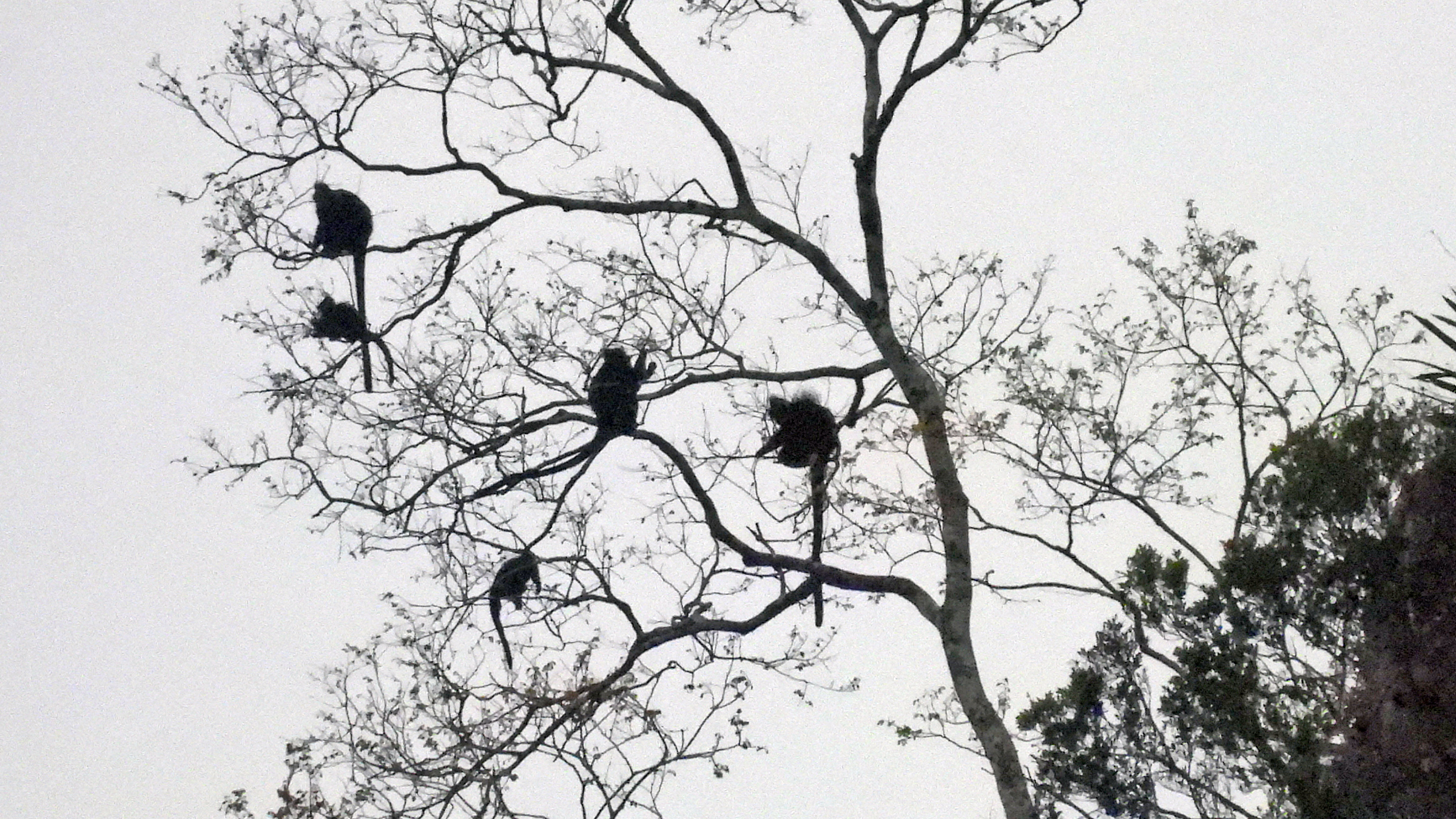
A new-to-science species of monkey has recently been proposed in the Vietnamese Journal of Primatology: the short-tailed langur, or Trachypithecus brevicaudus.The description is based on analysis of photographs of monkeys in the Annamite Mountains of Laos with unusually short tales.Although other new-to-science primate species have initially been described on the basis of photographs, an independent expert interviewed by Mongabay says he doesn’t believe the data yet support the declaration of a distinct langur species.The next stage for the researchers is to collect droppings to use in genetic analysis, and to search for remains in nearby villages. There is no body. No genetic evidence — yet. There are just photos, but some scientists say those photos show a distinct enough primate to declare it a new species: the short-tailed langur, or Trachypithecus brevicaudus. The proposed species was described in the Vietnamese Journal of Primatology and lives in the Annamite Mountains of Laos. “A photograph of a langur, published by the Saola Foundation, caught my attention because the animal’s tail is noticeably shorter than that of any other species within this group of limestone langurs,” said Tilo Nadler, lead author of the paper and a wildlife consultant for the Vietnamese government and various NGOs. This photo led Nadler and colleagues to investigate. They traveled to the area, a remote set of limestone karsts in Bolikhamxai province in central Laos, and took their own photos. “The first time I observed a group of these langurs, it was immediately clear to me that they were different from all the other limestone langurs I had previously encountered and knew well,” Nadler told Mongabay in an email interview. “It was a very exciting experience.” Male short-tailed langur of a group. Image by Tilo Nadler. But not all scientists agree that these photos prove a new-to-science species. “It could well be a new species, but I think the data that have been presented do not give sufficient support for this,” said primate expert Vincent Nijman, director of EcoVerde Global Consulting, who wasn’t involved with the paper. But Nadler said the encounter, and photos, proved his hunch: this wasn’t a one-off case of an animal that lost part of its tail, but a whole population of langurs with shorter, thicker tails. To the untrained eye, the tail of the short-tailed langur still looks quite long, but it’s noticeably shorter than other related species, according to Nadler. (Hence the proposed name: brevicaudus means “short tail.”) “These animals possess a shorter and thicker tail compared to closely related species of limestone langurs from the southern group — such as the Lao langur (Trachypithecus laotum) and the Hatinh langur (T. hatinhensis),” Nadler wrote. He added he tried to scour local villages for any specimens that may have been hunted, to take back for genetic testing, but was unable to find any remains. A future expedition plans to search for remains more thoroughly in local villages and collect the monkey’s droppings to use in genetic analysis. Comparison of tail lengths of the limestone langurs of the southern group: A – short-tailed langur, B and C – Hatinh langur, D – Hatinh langur morphe ebenus, E – Hatinh langur morphe ebenus, F – Lao langur. Images by Tilo Nadler (A, B, C, E, F) and Roland Männel (D). Nadler said he’s not the first scientist to describe a new primates based only on photos: the highland mangabey (Rungwecebus kipunji) from Tanzania in 2003, and the Arunachal macaque (Macaca munzala) in 2005, and white-cheeked macaque (Macaca leucogenys) in 2015, both from the Himalayas, were all first described from just photos, with DNA to come later. Nijman agreed that a species can be described using just photos and based on a single characteristic — in this case the tail. But he said he’s not convinced by the paper’s findings, arguing that the tail measurements as currently done still show some potential overlap with other species. “The Hatinh langurs (male and female) with the shortest tails have as short a tail as the new species with the longest tail,” Nijman said via email. As for thickness, “they were not able to quantify this,” Nijman wrote. Whether a new species or not, it was first photographed by Rob Timmins, the technical director of the Saola Foundation, in 2024. The Saola Foundation is currently searching for the saola (Pseudoryx nghetinhensis), a species of bovid often called the Asian unicorn, in the Annamite Mountains. Lorraine Scotson, CEO of the Saola Foundation for the Conservation of the Annamite Mountains, said in an email interview that the group wasn’t involved with Nadler’s research, but that “a new primate is significant news, and we’d love to see this species get the wide attention it deserves.” The typical limestone forest consists mainly of thin-trunked trees and bushes. These are the feeding grounds of leaf-eating langurs. Image by Tilo Nadler. The Annamite Mountains are a biodiversity hotspot, housing dozens of species found nowhere else, including the giant muntjac (Muntiacus vuquangensis), the Annamite striped rabbit (Nesolagus timminsi), two species of gibbon, and the Laotian rock rat, or kha-nyou (Laonastes aenigmamus). Three percent of the world’s land-based vertebrates are found in the Annamite Mountains, which likely hosts many undescribed species. Not long ago, the karst-dwelling monkey was the victim of heavy hunting, Nadler said. “In the past, these langurs were hunted extensively, particularly in connection with the cultivation of hidden poppy fields used for opium production,” he said. “However, poppy cultivation has ceased due to legislation and strict enforcement, and with it, the hunting has also come to an end.” Still, many mysteries remain. Chief among them: how many short-tailed langurs are there? Nadler said their range is “unclear,” with only two populations currently known. But he added, “there are other, extremely inaccessible limestone massifs where further populations might exist.” Next year, the Saola Foundation plans to launch a new program with this proposed new species as its flagship animal to conserve these unique limestone karsts. “Having been geographically isolated for millions of years, this karst complex habitat is likely to host many other endemic species of the Annamites Bioregion,” Scotson said, “and quite possibly some of them still undescribed to science.” Banner image: A group of short-tailed langurs consisting of five adults (three in the photo) and two juveniles, approximately 1.5 to 2 years old. Image by Tilo Nadler. Greater Mekong proves an ark of biodiversity, with 380 new species in a year Citation: Nadler, T., Vangkhou, V., Menner, J., & Phan, J. (2026). A new primate species from Laos – genus Trachypithecus. Vietnamese Journal of Primatology, 4(1), 1-12. Retrieved from https://static1.1.sqspcdn.com/static/f/1200343/28717216/1782414311170/Vietnamese_J_Primatol_Vol_4-1_2026.pdf?#page=3 Credits Topics
Could a short tail mean a new monkey species in Laos? Some scientists think so
Full Article
Original Source
Read the full article at News →KhanList aggregates and links to publicly available news content. We do not host full articles from third-party sources. Always verify important information with original sources.