
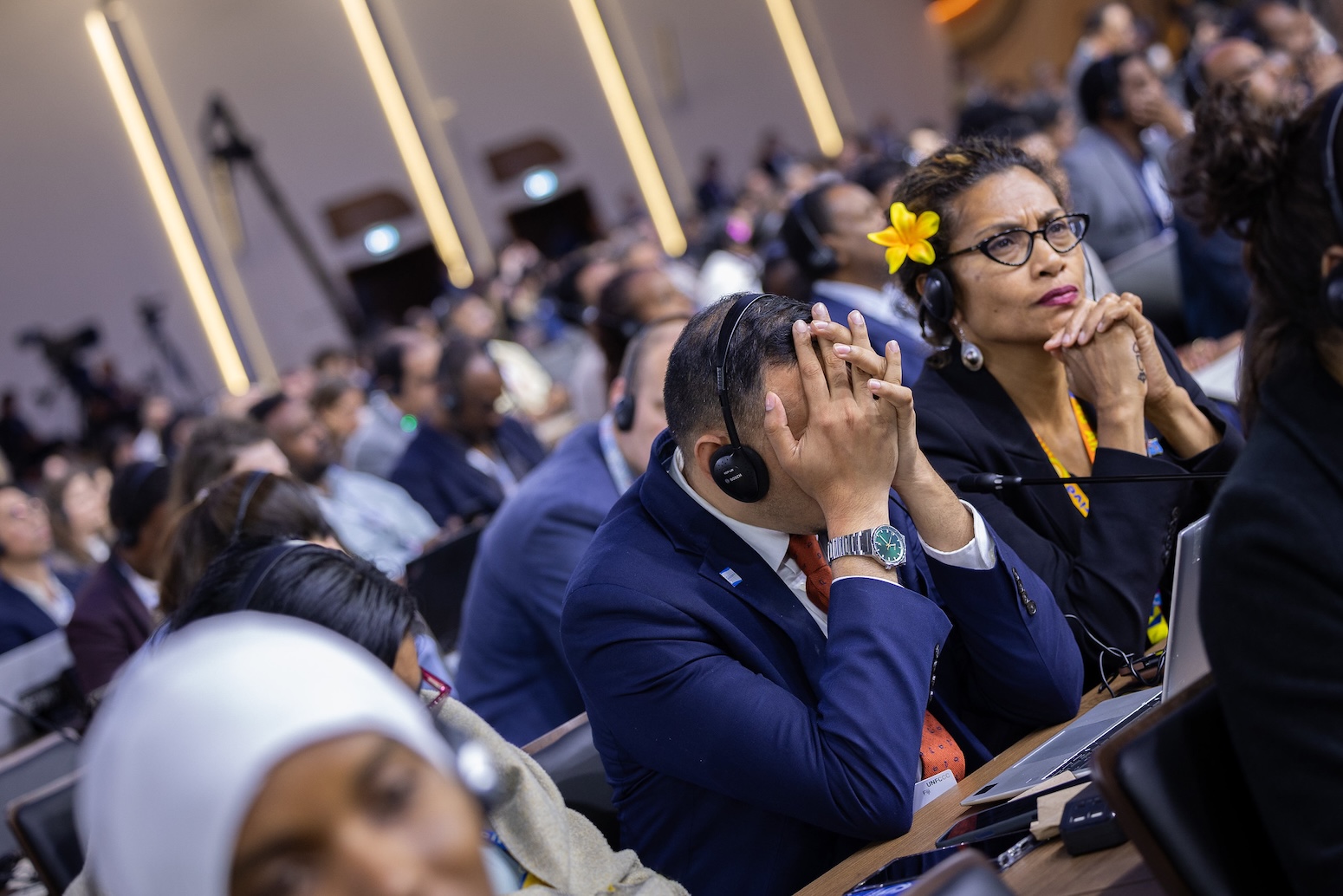
The COP31 climate talks in Antalya, Turkey, failed to agree on a “pact” that – despite making no clear reference to fossil fuels or adaptation finance – had contained strong signals for oceans. The “Antalya pact” took up much of the two weeks of negotiating time in Turkey, only to be rejected during the closing plenary by the EU, the UK and several climate-vulnerable countries. Several countries expressed their regret during the plenary that significant work on advancing ocean-climate action would be lost. The COP ran nearly 50 hours over time, but did not end with substantive outcomes on several key topics. For the second year in a row, negotiations on agriculture and food security broke down and will now have to resume next year. Food-systems advocates were, however, heartened by the explicit inclusion of “agroecology” in a decision within the “just transition work programme”. Ocean-conservation groups noted an increased focus on ocean-climate links at this year’s COP, but said COP31 did not live up to its promise of being a “blue COP”. There was also scant new funding for food systems and nature, with just a handful of small pledges to ocean initiatives and two newly announced contributions to the Tropical Forest Forever Facility. Here, Carbon Brief analyses all of the key outcomes for food, forests, oceans and nature at COP31 – both inside and out of the negotiating rooms. (See Carbon Brief’s coverage of food, forests, oceans and nature at COP30, COP29, COP28, COP27 and COP26.) Formal negotiations Cover decision Agriculture and food security Article 6 Just transition work programme Adaptation Trade Climate and nature ‘synergies’ Around the COP Action agenda Ocean Deforestation Food systems and water Methane Biofuels ‘Big ag’ influence Formal negotiations Cover decision The final draft of a COP31 “cover decision” was rejected by at least 32 countries during a chaotic – and, at times, acrimonious – closing plenary in Antalya. Other recent COPs have issued cover decisions, setting a firm precedent. However, many parties remained unhappy about the existence of the cover decision, the process by which it was put together and the impact it had on time for other negotiations. Ultimately, parties did not find consensus on the text, particularly around the removal of any reference to fossil fuels and the lack of concrete climate-finance targets. The cover text was one of the places in the negotiations where ocean advocates were hoping to see ocean-climate linkages highlighted. Marine Lecerf, head of international policy at Ocean & Climate Platform, told a press huddle: “What we’re really asking for right now is to make sure we can recognise ocean-based interlinkages…We’re not asking for a new mandate. We are asking for acceleration of the work that is already undertaken.” The first draft of the cover decision, published on 16 November, was a compilation of all the issues that parties had put forward for inclusion. It was accompanied by a short “presidency note” explaining that all elements were still in play, including whether or not they should appear in a final text. This lengthy first draft had 21 references to the ocean, including recognising the impacts of climate change, support for ocean-observing systems, encouraging parties to strengthen ocean-climate action and a multi-year plan for the “ocean and climate change dialogue”, which occurs annually at the Bonn intersessional meetings in June. Regarding that draft, Steven Guilbeault, former environment minister of Canada, told Carbon Brief: “I don’t see why the elements that are in the cover decision right now on oceans should be controversial or problematic to any nations. If you’re serious about fighting climate change, there’s nothing in this text regarding oceans that should be problematic for you.” (Earth Negotiations Bulletin reported that Russia opposed mentions of the ocean in the cover text during the ocean ministerial consultation.) The next iteration of the text, on 19 November, retained many of the ocean elements, albeit with less detail than the first draft. The second text also removed references to post-2028 ocean work and a proposed high-level ministerial ocean dialogue. In the end, oceans had 19 mentions in the rejected Antalya pact. Lynda Tabuya, Fiji’s climate minister, at the closing COP31 plenary. Credit: IISD/ENB – Mike Muzurakis. During the final plenary, Fiji’s Dr Sivendra Michael – co-chair of the ocean and climate change dialogue – appealed to the COP31 president to “humbly consolidate” the consensus on ocean as a “standalone ocean decision” and “directly submit” ten paragraphs with no objections in text as a “way to preserve” work done. Lynda Tabuya, Fiji’s environment and climate change minister, said: “The ocean-climate nexus is undeniable. We, the people of the Pacific, are deeply indebted, as the ocean is our home, our identity and it is what connects us. There is no climate action without ocean action. We hope this is not lost today and that parties will please consider keeping the ocean text alive.” Other aspects of the natural world garnered significantly less attention in the cover text. The final decision failed to mention the Brazil-led roadmap on deforestation, although it was “welcome[d]” in the initial draft. (See: Deforestation.) Mentions of the “critical role” of forests in carbon storage, food security, biodiversity and community adaptation were also stripped from the text between the first and second iterations. The final Antalya pact – that was rejected – did, however, retain wording on deforestation agreed by countries in the global stocktake at COP28 in Dubai. Language on deforestation included in the final, rejected draft of the COP31 cover decision. Source: UNFCCC. The same draft also “recognises” the role of nature-based solutions and ecosystem-based approaches as “essential climate solutions” – although many experts reject the former term and warn that its vagueness leaves it open to deliberate misuse. The final draft cover decision “emphasised the importance” of nature, forests, the ocean and other ecosystems as “natural infrastructure for resilience”, while “recogni[sing] that they play a critical role as sinks and reservoirs of greenhouse gases”. Experts, however, were concerned that this language preceded a paragraph “welcoming” carbon dioxide removal, even if it “stressed” that these methods – that include tree planting – “should ensure environmental safeguards and respect the rights of Indigenous peoples”. The final cover decision that was rejected had paragraphs on oceans and forests as sinks, as well as carbon dioxide removal. Source: UNFCCC. None of the iterations of the rejected cover decision mentioned COP17, the biodiversity summit held in Armenia, which concluded just 10 days before COP31 started. Nor did they mention the Kunming-Montreal Global Biodiversity Framework (GBF), a landmark pact sealed in 2022 to reverse biodiversity loss by 2030. When Carbon Brief pointed this out to Guilbeault – a key architect of the GBF – in an interview on 17 November, he vowed that he would try to make the case to ministers to get these aspects added in. One observer told Carbon Brief that the “toxic” nature of discussions over the need for closer “synergies” between climate and biodiversity summits could explain the lack of mentions in the cover decision. Despite this, they said the rejected pact did “underline” the “urgent need to address, in a comprehensive and synergetic manner, the interlinked global crises of climate change, biodiversity loss, desertification and land and ocean degradation”. Adopting such language would have represented positive progress, the observer added. Although the first draft of the cover decision referenced “food” twice – in the context of food security – both of these instances were removed in the subsequent draft. The rejected final cover decision draft mentioned “food security” four times. However, observers told Carbon Brief that a mention of “food” or “food systems” in the cover decision was not a priority for them. Teresa Anderson, global climate-justice lead at ActionAid, said: “What we often find is that getting references or language to things in the cover decision doesn’t really play out as impacts on the ground and it’s more effective to push a meaningful agenda in a negotiation space.” Agriculture and food security For the second year in a row, negotiations on the Sharm el-Sheikh joint work on agriculture (SJWA) collapsed without parties reaching an agreement. SJWA is where formal negotiations around climate change and agriculture take place under the UNFCCC. Part of SJWA’s mandate is to synthesise information about work being done in the agricultural space – under both the UNFCCC and other international bodies – in an annual report. SJWA also held two workshops – one on holistic approaches to agriculture and one on “means of implementation”, usually taken to mean finance – where countries and other partners could share their experiences, as captured in summary reports. At COP31, parties were meant to discuss the conclusions of these reports and, time permitting, decide on the future of the agricultural workstream under the UNFCCC. (The four-year mandate of SJWA was set to end at COP31.) Work “moved very slowly” in the first week, said Oliver Camp, senior policy and implementation specialist at the Global Alliance for Improved Nutrition. He added: “It took a really long time to get into any substantive conversation.” Ahead of the summit, many observers were hopeful of agreeing a text that recognised agroecology as beneficial for humans, climate and biodiversity. However, in the first negotiating session, on 10 November, the Arab group expressed its view that fertilisers are vital for food security and fertiliser exports are being impacted by the EU’s carbon border adjustment mechanism (CBAM). Therefore, it said, the agriculture talks needed to discuss CBAM and other trade measures. Teresa Anderson, global climate-justice lead at ActionAid, called this a “total curveball” in the negotiations. She told Carbon Brief: “Everybody’s faces just dropped…Suddenly we knew that the chances of agroecology having a chance had been pretty elegantly spiked by putting in this really complicated political issue into the middle of the agriculture discussions.” Other observers also expressed frustration to Carbon Brief that the group had brought CBAM into the negotiations, noting that trade measures are being discussed elsewhere in the COP. (In the end, trade measures were not included in any agreed elements of COP31.) At the end of this session, parties were asked to submit their views in writing for consideration, with the like-minded developing countries (LMDCs) proposing an extension of SJWA to COP32. Another major point of contention in the room was what, exactly, a draft text should cover. The EU – along with Canada – said that the discussion should focus on the commonalities in countries’ positions, rather than the differences. Carbon Brief understands that opposition to this came from the G77 and China, along with the Arab group and the LMDCs, who said that areas of disagreement needed to be addressed through negotiation. At the same time, said Camp, “there are a few fundamental rifts” around the scope of the work being done in SJWA itself. He told Carbon Brief: “[There is] this idea that work on agriculture and food security should be primarily focused on adaptation, which is a view held generally by India [and the] G77 and China. Whereas others think it should definitely be led by adaptation, but that there are mitigation co-benefits and that we could take a more comprehensive and holistic view to seek out those co-benefits.” A draft text circulated on 12 November – after the scheduled start of the negotiations that evening – which left many parties unsatisfied, with several stating that elements of the text crossed their “red lines”. The draft presented parties with four options, including “no text”. Options for SJWA presented in a draft text on 12 November. Source: UNFCCC. Although various parties objected to many parts of the proposed text – including agroecology (opposed by India), CBAM (opposed by the EU) and “food systems” language (opposed by the G77) – the underlying issue was a lack of finance and linking agriculture to mitigation targets, observers told Carbon Brief. Marie Cosquer, advocacy analyst at Action Against Hunger, said: “The main issue is not bad-faith negotiating; it’s the fact that, across the UNFCCC, the countries that have a climate debt are not paying it…Unless they move on finance, there is nothing in this negotiation for global south countries.” With no sight of agreement on the horizon and the scheduled negotiating time drawing to a close, parties suggested that the negotiations end with a procedural text. The co-facilitators put such a text forward on 14 November. This final text says only that parties “continued consideration” of SJWA and have “requested the subsidiary bodies to continue consideration” of SJWA at the mid-year intersessional meetings in Bonn. The subsidiary bodies are then “requested” to report back at COP32 in Ethiopia. Camp told Carbon Brief: “A lot of the negotiations were more at a kind of technical level about what should be discussed – mandate, scope, modalities – and so getting into anything substantive, particularly about food systems actions, took a long time. In the case of the food negotiations, that was rather problematic, because they ran out of time and ended up kicking all of the substantive discussion to Bonn next year.” Article 6 Carbon markets – particularly those relating to forests – were not expected to be a key priority at COP31. However, negotiations at COP31 on carbon-trading under Article 6 of the Paris Agreement reopened many familiar arguments over how tightly such activities should be regulated. Beatriz Granziera, senior policy adviser at The Nature Conservancy (TNC), told Carbon Brief: “Discussions repeatedly came back to familiar trade-offs: practicality versus conservativeness; flexibility versus oversight; and how to scale much-needed participation and investment while maintaining environmental integrity.” Agreement was, ultimately, reached on both bilateral trading under Article 6.2 and the international carbon market under Article 6.4. Carbon-trading between countries under Article 6.2 is only subject to light-touch rules, such as reporting on the use of the process and a “technical expert review” of national reports. Across 16 national reports checked so far, these reviews found 543 “inconsistencies”, 115 of which were “significant”. None of the reports were found to be without issue. An initial draft text at Antalya “note[d these issues] with concern”, adding that “many…are significant” and relate to “environmental integrity” – in other words, whether or not emissions are actually being cut. It asked parties to address these issues “at the earliest opportunity”. However, this entire paragraph disappeared in the final agreed text. Instead, the decision “takes note” of the information in the technical reports, without asking for any response. Given its confidentiality provisions, campaign groups have long described Article 6.2 as a “wild west” for carbon-trading and the COP31 outcome does nothing to tighten the rules. Separately, parties were unable to reach agreement at COP31 on how to fund the processes needed to run Article 6.2. Instead, they agreed to continue discussions next year, requesting a technical paper on how “fees or other funding arrangements” would work. On Article 6.4, negotiations began against a backdrop of calls for a “course correction” on the way the international carbon market is operated. This came in an open letter from the Project Developer Forum and the International Emissions Trading Association (IETA), saying market rules were too “conservative”. Andrea Bonzanni, senior director at IETA, told Carbon Brief that the “current version of [the market] is failing to attract investment in carbon projects”. The requests in the open letter appeared in early draft text, after being taken up by the LMDCs and others. A 14 November draft “request[ed]” the supervisory body to “assess the cumulative impact” that its rules and standards have on the “feasibility” and “cost” of carbon-credit schemes. It said this was to avoid “excessive compounding of conservative adjustments”, in what amounted to asking that the rules for the Article 6.4 market not be too stringent. Draft text on Article 6.4 published on 14 November. Source: UNFCCC. Isa Mulder, at Carbon Market Watch, told Carbon Brief that this looked like market proponents “chipping away at the standards that have been set out”. She added: “The goal [of Article 6] was to enable higher ambition, not to enable [carbon-trading] activities.” However, after pushback from the EU and others, the final text adopted at COP31 no longer asks for a formal assessment of the “cumulative impact” of the rules. Instead, it asks that the supervisory body “take into account” the way different standards “operate together” when making or revising provisions. With those rules set for a review starting in 2028, Granziera told Carbon Brief: “Ultimately, the debate [at COP31] reflected different views on what is needed for Article 6 to deliver more effectively as a tool for achieving the goals of the Paris Agreement, which will likely come back to light in 2028.” Despite increasing scrutiny, many countries highlighted their domestic progress on carbon markets, joined coalitions and announced deals at COP31. Singapore, in particular, wanted to be seen as a key hub for Article 6 markets – featuring sessions on carbon markets at its pavilion and announcing bilateral Article 6.2 projects with Peru. COP31 also held a ministerial roundtable on “growing” high-integrity carbon markets to mobilise private finance for climate action. A ministerial roundtable on growing “high-integrity” carbon markets. Credit: Kiara Worth / UNFCCC / Flickr Co-chaired by Kenya and the UK, the meeting saw Colombia, Ghana and Peru sign on to the Antalya statement endorsing carbon markets and a “playbook” with “policy levers to grow demand” for them, taking the number of signatories up to 17. Despite limited signatories, Singapore’s environment minister, Grace Fu, called the Antalya statement “a key outcome of COP31”. (At the COP16 biodiversity summit in 2024, Peru declared that carbon offsets were “not a financial solution”. Its call for additional scrutiny of biodiversity offsets was included in the COP17 finance agreement.) At the forest leaders’ summit on 11 November, Guyana outlined that “jurisdictional forest carbon markets” – where carbon offsets are generated at an entire national or subnational scale – are now its “principal pathway”. Federica Dossi of Carbon Market Watch called Guyana’s approach “very problematic”, pointing to a recent Carbon Pulse investigation where a single error in a spreadsheet led to 3.9m excess credits. Dossi told Carbon Brief it is “extremely hard” to ensure that forest-based carbon credits deliver lasting carbon removals and do not “cheat nature in the long run”. Towards the end of the summit, 45 scientists signed an open letter saying that the Article 6 rules “must be consistent with the science” and “still fall short” of what environmental integrity requires. The statement says: “They allow temporary carbon storage in forests, soils and other ecosystems to be credited against fossil-fuel emissions that will affect the climate for thousands of years. This undermines the critical role of ecosystems in stabilising the carbon cycle, which depends on ending both fossil fuel use and deforestation.” Just transition work programme Discussions on how to create a new “just transition mechanism” (JTM) proved one of the most controversial aspects of COP31 and were, ultimately, deferred to COP32. Last year, the decision to create the just transition mechanism (JTM) – also known as the Belem-Antalya Mechanism (BAM) – was a key “legacy” of COP30. In Antalya, parties were expected to agree on the form and functions of the mechanism under the “just transition work programme” (JTWP), to allow it to start working. Negotiations initially got off to a constructive start, with general consensus emerging on a two-tier structure for the mechanism, as well as continuation of the JTWP. However, a draft text prepared at the end of the first week in Antalya was roundly criticised by civil society, who labelled it “hollow” and “watered-down”. Over the second week, there were disputes over who would set up and run the mechanism, the involvement of non-party stakeholders and how it would be financed. Speaking in a packed press huddle on 20 November, Kirtana Chandrasekaran, from the Global Campaign to Demand Climate Justice, said that the global north had “torpedoed” work on the JTM. Civil society hits out at ‘terrible COP’ that is ‘abject failure’ As we await new draft texts for the cover decision, just transition work programme, global goal on adaptation and more at COP31, civil society has just held a hectic press huddle to condemn the lack of process here in Turkey.… Read more on CB Connect → Late on 21 November, an unbracketed text was published. It decided that a phased approach would be taken, with a view to the mechanism being adopted at COP32 in Ethiopia in November 2027. Beyond the mechanism, parties discussed a review of the JTWP and the key messages that emerged from the fifth and sixth dialogues held in 2026. The fifth focused on agriculture and ocean-based climate action, with the final JTWP text noting that these are both “integral to nationally determined just transition pathways”. Key messages from the dialogue included the role of women in agriculture and food production, the potential for agroecological and agroforestry approaches and the opportunities presented by transitions in agriculture aligned with the Paris Agreement. In a statement, Teresa Anderson the global lead on climate justice at ActionAid, criticised the delay to the JTM, but added: “At the same time, however, smallholder farmers around the world can celebrate that the just transition negotiations took the landmark step of endorsing agroecological farming approaches. “Climate talks have sent a powerful signal that farmers deserve support to transition to agroecology, a people-centred climate solution that works with nature instead of against it.” Additionally, critical minerals were referenced in a COP decision for the first time within the final JTWP agreement. In a statement, Angela Asuncion, Asia-Pacific coordinator and transition-minerals focal point at the Resource Justice Network, welcomed this inclusion as a “notable step”, but added that the “decision by parties to eliminate human rights due diligence across critical mineral supply chains is unacceptable”. Ultimately, the JTWP text was gavelled through during the closing plenary. Further work on the mechanism is expected over the coming year, ahead of it being launched in Ethiopia at COP32. Adaptation Finance dominated the negotiations on adaptation at COP31 – in particular, efforts to specify that tripling adaptation finance meant $120bn by 2035. This followed a “call for efforts” to triple adaptation finance by 2035 that was agreed last year at COP30 with very limited detail. It was debated in the global goal on adaptation (GGA) and the climate finance “work programme”, as well as the proposed “cover decision”. Broadly, developing countries wanted to discuss the target under the GGA, while developed countries wanted to discuss it in the climate finance work programme. This would place the tripling goal within the broader $300bn target for 2035 – meaning adaptation finance could come from a wide variety of sources. Despite the $120bn figure being included in early draft texts under the GGA, ultimately, it did not appear in the final decision, nor in either the climate finance work programme or the cover text. Also within the GGA, parties worked to establish an expert task force that could refine the set of 59 “indicators” agreed at COP30 in Belém. These are the metrics that countries will use to assess their progress in adapting to climate change. They cover topics including water, food, health, ecosystems, infrastructure, livelihoods and culture. For example, they include indicators assessing progress on “attaining climate-resilient food and agricultural production and supply and distribution of food”. The final text, gavelled through during the closing plenary, “agrees” that six experts will be nominated per UN regional group, in addition to three experts nominated by the LDCs and three by small island developing states. Other adaptation items included the transition of the “adaptation fund” to serve the Paris Agreement. In doing so, it will be able to access 5% of the revenues generated by the agreement’s Article 6.4 carbon market. This process has been held up due to disagreements over the makeup of the board, as it was expected to have quotas for “developed” and “developing” nations instead of “Annex I” and “non-Annex I” nations, as it has done in the past. At COP31, parties agreed that the board would have specific places for each UN UN region, rather than the quotas it had previously. This made the adaptation fund a “bright spot” of the negotiations, Joe Thwaites, international climate finance director at Natural Resources Defense Council, told Carbon Brief. Finally, “matters relating to the LDCs”, an agenda item where parties discuss support and adaptation planning for the 44 LDCs, ended with a decision to establish an implementation platform. Trade After the creation of three annual “dialogues” on trade within the COP30 Belém “global mutirão” decision, the topic was not expected to feature on the official agenda, even if it was likely to come up in other negotiating tracks. But, in the end, the rejection of not only the cover decision, but also agreements on “response measures” and agriculture, meant that trade was entirely missing from the COP31 outcome. (A request from the African group to add trade to the COP31 agenda was also rejected.) Trade and climate featured strongly in the first “reflections” text on a cover decision, which was a compilation of suggestions from parties.Paragraph 119 of the first draft “call[ed] on” developed countries to “phase out unilateral…trade-restrictive measures” by the end of 2027. Commonly cited examples of what this might refer to include the EU’s carbon border adjustment mechanism and deforestation law. First draft of the COP31 cover decision. Source: UNFCCC The phase-out call was, as observers expected, cut from the second iteration of the cover text. In the end, with the “Antalya pact” failing, none of the references to trade survived the conference. In the closing plenary, Russia, Venezuela, Brazil, Iran, Kenya – with the Arab and African groups – lamented how the issue of trade was treated in the talks. Russia’s representative remarked that “climate policy should not turn into trade policy by other means”, calling customs tariffs on “green” supply chains – whether for food or cobalt – “old colonial distribution of labour under a new green banner.” Ghana and Kenya both flagged the lack of “firm treatment” of trade measures and hinted that it would be a priority for them at COP32. Kenya’s delegate said: “Unilateral trade measures are only noted. African economies bear their costs, while the decision merely notes their views.” At UN climate talks, “response measures” is a forum for discussing the effects of carbon-cutting policies on countries. They are particularly relevant for nations where controls on emissions or deforestation pose a risk to communities and the economy. In recent years, the forum has been where trade and climate issues have been discussed. COP30 in Belém established a two-day “global dialogue” on response measures each year from 2026-29. The first was in Bangkok from 21-22 September 2026, focusing on economic diversification and on how to manage impacts on vulnerable populations. COP31 also conducted its first annual ministerial high-level round table on response measures on 17 November. Credit: Kubilay Ciftci / UNFCCC / Flickr During discussions, parties noted that food security was considered “essential” for economic diversification to “absorb shocks”, including those arising from climate-change measures. They also suggested ways to reduce dependence on fertiliser imports and strengthen agricultural value chains by “restricting exports” of unprocessed crops. In Antalya, however, key disputes emerged. The first was on what activities the forum would undertake in 2027. The next was on whether – and how – response measures would inform the second “global stocktake”. One option, supported by G77 and China, “decide[d]” that all of the outputs of the forum – dialogues, workshops, technical reports and case studies – would serve as substantive inputs to the stocktake. This option “urged” that the cross-border impact assessment be conducted “before and during” the stocktake, including metrics such as inflation, trade flows, household income, employment and debt. During the final plenary, the EU told delegates it objected to adopting the decision on response measures, on the grounds that it “contains provisions that are highly problematic”, as well as “the lack of recognition of the best available science”. This was supported by Canada and the UK, with the latter adding: “We cannot accept any outcome that seeks to undermine and unduly influence the next global stocktake.” Brazil and Saudi Arabia both expressed their disappointment with the rejection of the text.Brazil said that the draft “excludes the voices of developing countries, the very countries that struggle to address the social and economic impacts of mitigation measures”. It asked for a formal note that the role and mandate of the forum were being “undermined”. Climate and nature ‘synergies’ To the dismay of many countries, negotiations on the need for “synergies” between the three Rio conventions of climate change, biodiversity loss and desertification and land degradation ended with the adoption of just a one-line text. The text simply states that, during negotiations under this item – known as “cooperation with other international organisations” – there was an “exchanges of views” and an agreement to “continue consideration at the next session”. The agreed text for the “cooperation with other international organisations” agenda item. Source: UNFCCC. On 10 November – the second day of COP – ENB reported that Russia, supported by the Arab group, “opposed continuing the discussion” on Rio synergies. Speaking on the behalf of 14 small island developing states in plenary on 14 November, Fiji said it was “deeply disappointed” by the outcome. It told delegates: “We came to Antalya ready to advance cooperation across Rio conventions and to foster synergies in national implementation. That is what all parties agreed to do when we left Bonn. We did not do that. Not because the issues were too difficult, but because we were never permitted to discuss them in the way we intended to do so. “At the very first informal consultation, before a single substantive proposal had been heard, the intention to invoke ‘rule 16’ was announced by one group of party [sic]. We offered repeatedly to address any and all concerns. That offer was not taken up. Substantive discussion was blocked from the very first hour to the last.” The EIG, Panama for the Independent Alliance of Latin America and the Caribbean (AILAC), the UK for the Umbrella group and the EU all expressed similar disappointment. Rule 16 says that, if discussions on an agenda item are not able to be completed, the item will automatically be on the agenda of the next session. However, it is meant to be invoked when parties have tried to find agreement but failed, rather than right at the beginning of discussions. An observer told Carbon Brief that the Rio synergies discussion has become “toxic”. At COP30, the Brazilian presidency had hoped to produce a first-of-its-kind ambitious synergies outcome on how political action on climate change and nature loss can be better coordinated. However, discussions were blocked by Saudi Arabia. At the time, Dr Osama Faqeeha, deputy environment minister for Saudi Arabia and chief adviser to the COP16 desertification presidency, told Carbon Brief that the nation did not support any action that might lead to “dissolving the conventions”. Around the COP Action agenda Many issues that were intensely negotiated at COP31 also featured in the “action agenda”. This is the part of the UN climate process that involves mobilising real-world climate action from non-state actors, including businesses, investors and civil-society groups. It also covers voluntary actions taken by groups of countries beyond the COP negotiations. With Australia overseeing negotiations, the action agenda was instead a priority for the Turkish presidency, which used COP31 to launch a variety of new projects and “compacts”. Delegates resting by a wall with the COP31 slogan “dialogue, consensus, action”. Credit: IISD/ENB – Mike Muzurakis. Last year, the Brazilian presidency consolidated hundreds of existing climate initiatives – including many launched at previous COPs – into a streamlined set that could be supported and tracked under the action agenda. This included setting out more than 120 “plans to accelerate solutions”, to advance everything from sustainable fire management to expanding the use of agroecology and agroforestry. Tracking by the UNFCCC found that 104 of these plans had seen progress over the past year. By the end of COP31, the total number of plans had increased to 136, with new ones including a commitment to early warning systems. Crucially, the plans were structured to align with the global stocktake outcomes from COP28 – such as halting and reversing deforestation and attaining climate-resilient food production – that all nations agreed on. In this way, the revised action agenda is intended to explicitly support negotiated outcomes. Turkey announced 10 “priority themes” for the COP31 action agenda, including zero waste, oceans and seas, food safety and Rio synergies. With negotiated outcomes failing to materialise on many of these subjects, observers turned to the action agenda for signs of progress. Oliver Camp, senior policy and implementation specialist at the Global Alliance for Improved Nutrition, told Carbon Brief at the beginning of the second week: “A lot of last week was about the climate action agenda…and thinking about how all of these things can help countries to speed up what they’re doing at home. And I’m inclined to believe that that is happening – that there are countries taking action and coming here to showcase what they’re doing. “Maybe there’s a bit of a divergence between what’s actually happening on the ground and where we can get to in negotiated outcomes – which might not feel great when we’re following the negotiations – but it’s actually really important that there’s good stuff happening on the ground.” Ocean Ocean advocates had several outcomes to celebrate at COP31 – and also some disappointment. Before the summit started, observers – and many parties – were hopeful of securing a strong outcome for the ocean, especially in light of the pre-COP meeting held in Pacific island states. A letter sent to the COP31 presidencies on 8 October – signed by the African group, the EU (along with its member states) and 24 other countries – called for the COP to “move sustainable ocean-based climate action from recognition to implementation”. It said that such a move should be “backed by a clear political signal, a coherent plan for integration into the Paris Agreement ambition cycle and its existing means of implementation”. Throughout the summit, Pacific islanders were very vocal in their displeasure with how the negotiations were going, particularly around the removal of references to fossil-fuel phaseout in the cover decision and the lack of urgency around the newly confirmed “inevitable” overshoot of 1.5C. At a side event attended by Carbon Brief, Peter Thomson, the UN secretary general’s special envoy for the ocean, said: “The majority of this planet is the ocean and the majority of the ocean is in the Pacific and the stewards of that ocean – or the majority of it – are Pacific island countries. We have that responsibility.” Analysis published by the World Resources Institute (WRI) on 15 November found that 95% of coastal and island countries included “at least one ocean-based action” in their national climate plans. However, it added that “more than 60% of ocean-commitment implementation depends on receiving some form of external support”. Two days later, on the “ocean, seas, nature and land use” thematic day, ministers from France and Brazil announced the launch of the “Blue NDC Challenge implementation task force” at a side event. They also welcomed 10 new countries as members of the Blue NDC Challenge – a group launched at the UN Ocean Conference in Nice, France, in June 2025 to “advance ocean-based climate action”. The same day, the COP31 presidency published the “Antalya ocean and seas compact”, a high-level declaration that it said drew on feedback from parties and discussions at several events, including the UN General Assembly and the Pacific pre-COP. The document highlights the impacts of climate change on the ocean, recognises the ocean’s importance in climate action and invites parties to strengthen their ocean work. The Antalya ocean and seas compact. Source: COP31 presidency. Dr Tom Pickerell, global ocean programme director at WRI, told Carbon Brief: “It was more of a platform for collective ambition and political alignment, rather than any targets or finance coming through. We wouldn’t say no to it, but if we’d left just with that, it would have been a little bit sad.” Also on the ocean thematic day, the UK government announced a new £20m ($26.2m) funding commitment to marine protection. This comprised £11.8m ($15.5m) to the Global Fund for Coral Reefs and £9m ($11.8m) to the Global Ocean Accounts Partnership, which helps countries measure their progress towards sustainable ocean development. Meanwhile, Australia committed $10m to the “Unlocking Blue Pacific Prosperity” initiative, which “seeks to achieve sustainable management of 100% of the Blue Pacific while advancing the region’s collective 30 by 30 ocean-protection ambition”. Towards the end of the summit, the “high-level climate-resilient coral reef commitment” gained six new signatories: Colombia, Haiti, Jamaica, Niue, Samoa and Tuvalu. These governments “commit to protect[ing] reefs identified as having greater potential to persist through climate change”, according to a press release announcing the new countries. In the formal negotiation rooms, ocean groups were closely following discussions around the cover decision, hoping to see the ocean featured prominently there. (See: Cover decision.) Draft versions of the cover decision “invite[d]” the development of a multi-year plan for future ocean and climate change dialogues – to be called the “Antalya ocean current”. It also asked for the results of these dialogues to be summarised, along with the “best available science” on the ocean, in a synthesis report that would act as an input to the second global stocktake. However, the cover decision was rejected during the closing plenary. Multiple parties used their interventions during the plenary to express their regret that the work that had been done on the ocean and climate change in the cover text would not move forward. Pickerell told Carbon Brief that, while “it wasn’t a ‘blue COP’ after all”, there were still positive takeaways for the ocean. He said: “We’ve left with maybe nothing in writing, but I think we have left with genuine momentum. There does seem to be this shared ambition, to move beyond just the recognition of the ocean…There’s lots of opportunities to take this forward.” Deforestation COP31 was relatively quiet regarding forests, compared to last year’s summit in Belém. The presidency held a forest leaders’ summit on 11 November, which was attended by the presidents of Brazil, the Democratic Republic of the Congo and the Republic of the Congo, along with the prime ministers of the Netherlands and Norway. Delegates applauded Brazil’s reelected president Lula at the forest leaders’ summit. Credit: UNFCCC Much of the summit dwelled on the Brazil-led Tropical Forest Forever Facility (TFFF). Delegates speculated that the summit would yield major new pledges for the fund. However, only $88m from philanthropies emerged as new contributions at the event. Several countries reiterated past and recent pledges. Aruna Chandrasekhar 12 November 2026, 14:19 GMT Forest funding pledges fall short Plenary Akdeniz was ringing with applause and chants of “Olé, olé, olé, olé, Lula, Lula!” as Brazil’s president approached the stage for the forest leaders’ summit yesterday evening. Lula – who told the crowd he had lost his voice –… Read more on CB Connect → At the summit, Jonas Gahr Støre, Norway’s prime minister, said: “I am hopeful we can reach our collective goal of mobilising the initial $10bn and to increase from there through next year and, with this, Norway is ready to contribute up to 20% of that total.” Norway’s “up to $3bn” loan to the fund is conditional upon it hitting the $10bn mark by the end of 2026. At the same time, Støre acknowledged that “it will take some time before payments reach the tropical forest countries and the key people who we want to support”. In a 19 November press huddle, John Verdieck, director of international climate policy at The Nature Conservancy, told reporters that “hopefully” the deadline would be extended. Another commitment came at the Association of Southeast Asian Nations summit in Manila on 15 November, where Canadian prime minister Mark Carney pledged “an initial contribution of up to” $393m over four years to the TFFF. This means the fund has – so far – mobilised $8.2bn from different international partners, mostly as conditional loans. This leaves it $1.8bn short of a $10bn target for public and philanthropic capital for this year. Political economist Max Alexander Matthey told Carbon Brief that less capital to invest and fewer risks taken will “lead to a fund that will not be able to deliver on the initially promised $4 per hectare” of protected forest in participating countries, even in a best-case scenario. Although significant attention was paid to the fossil-fuel roadmap at COP31, far less focus was given to the deforestation one. Chris Dragisic, managing director for global policy at the National Audubon Society, told Carbon Brief that, nonetheless, there were “a couple of countries” that committed to producing national forest roadmaps. She added: “Many others have said, ‘we have a national strategy already’, and they’re looking at this really as an option to accelerate progress…What, for me, is the more interesting thing is that the roadmap recatalysed political will across the board for forests, where these had fallen a little bit off the political radar.” Just before COP31, Brazil released its own national deforestation roadmap, which set out four main areas of action in order to “halt and reverse” forest loss and degradation by 2030: Conserving and sustainably using forests. Restoring forests. Combatting illegal deforestation and wildfires. Reducing legal vegetation clearing. Other forest-related commitments made at the summit included Bolivia and Indonesia joining the Forest & Climate Leaders’ Partnership and Brazil’s announcement that it is working on an Indigenous peoples’ roadmap. The COP31 presidency also launched the voluntary “Antalya action plan” on global wildfires, which, it said, would help a “community of countries” to “cooperate on prevention, early warning, landscape resilience and access to resources”. On the penultimate scheduled day of the summit, more than 100 organisations – including Indigenous groups, civil society and research institutions – signed an open letter calling on countries to take the work of the deforestation roadmap forward. It also called for an “international convening” on deforestation to occur in 2027. Food systems and water A number of initiatives relating to food and water were launched during COP31. “Food security” – including transforming agriculture and focusing on water and drought – was one of the priority themes in the COP31 presidency’s “action agenda”. (See: Action agenda.) Despite this, only a few prominent announcements arrived during the summit – much fewer than in previous years. On 9 November, when the daily COP theme centred on food, agriculture and health, thinktank Clim-Eat launched a report on the reform of agricultural subsidies. This noted that governments spend approximately $840bn annually on support and subsidies for agriculture, a sector which contributes to climate change and environmental degradation. The report also outlined ways to move these subsidies towards payments supporting soil health, public infrastructure and increasing farm incomes in a more targeted way. On 10 November, the UN Food and Agriculture Organization (FAO) launched a platform aimed at helping countries boost alignment in managing food security, water and climate action, called the “turquoise nexus initiative“. Led by Turkey, it will exist within the FAO’s “food and agriculture for sustainable transformation” (FAST) partnership, which was launched at COP27 in 2022. The FAST partnership is designed to boost climate finance for the transformation of food systems, while also supporting efforts on adaptation and other issues. İbrahim Yumaklı, Turkey’s agriculture minister, said the “turquoise” platform would be used to strengthen existing initiatives, rather than create new ones. It will also “advance” a focus on water in the food “agenda”, said Mark Smith, director general of the International Water Management Institute. İbrahim Yumaklı, Turkish minister of agriculture, at the launch of the turquoise nexus initiative in Antalya, Turkey on 10 November. Credit: Earth Negotiations Bulletin On 11 November, Ethiopia joined a group of eight other nations in the Alliance of Champions for Food Systems Transformation (ACF), which was launched at COP28 in 2023. This sent a “powerful signal that food systems belong at the heart of climate action”, given that Ethiopia is due to host COP32 next year, said Emma Williams, the head of the ACF secretariat, in a statement. On 12 November, the not-for-profit True Animal Protein Price Coalition launched a declaration on the “transition towards sustainable, diversified and low-emitting food systems”, which aims to bring emissions from food systems “in line with the 1.5C goal”. The Central African Republic, Jordan and a group of 21 Pacific island nations endorsed this declaration. Maryam Rezaei, food-systems lead at ODI, said questions remain about how all of these initiatives can help governments to “overcome the institutional and financial barriers to reform”. She told Carbon Brief: “We need to be more demanding about what these initiatives actually change in national policies, investment decisions and, ultimately, people’s lives. “There is real value in cooperation outside of the negotiating rooms. But we should be careful not to confuse the growing number of initiatives with progress.” Methane Cutting emissions of methane, a potent but short-lived greenhouse gas, appeared to have a renewed push at COP31. This is partly due to the recent confirmation of an “inevitable” overshoot of the 1.5C global temperature target. Chief of the UN Environment Programme (UNEP), Inger Andersen, referred to this at a COP31 methane event: “[Methane] leaves the atmosphere quickly, so cutting its emissions is our emergency brake to slow warming.” It is “one of the fastest, cheapest and most effective ways to check global heating in the near-term”, said UN climate chief Simon Stiell, at a 12 November event on non-CO2 greenhouse gases. New private funding of $480m was pledged for action on methane and other “super pollutants” at this event. Nine of the 159 countries who backed a 2021 global methane pledge reaffirmed their aim to reduce methane emissions by at least 30% by 2030 at the event, which was co-hosted by Brazil, China and the UK. Belgium, Canada, France, Germany, Indonesia, Micronesia, Norway, the Netherlands and the UK endorsed this “ministerial declaration”, committing to accelerate action towards the 2030 goal. Separately, Australia endorsed a COP30 statement on reducing methane emissions from fossil fuel production. Australia’s National Farmers’ Federation welcomed that the COP co-host nation did not endorse this declaration. In a statement, the group said the Australian government “reaffirmed” that its initial backing of the pledge “does not impose a domestic methane target or obligations on Australian farmers”. (Australia is a major producer of beef cattle, which is the biggest source of global livestock methane emissions.) On 11 November, the daily COP31 theme centred on “zero waste”. Emine Erdoğan, the Turkish first lady and chair of a UN advisory board on waste, launched a “global zero waste alliance”. One of the alliance’s stated “priority areas” is food and organic waste. (Research has shown that food loss and waste accounts for up to half of all food-systems emissions.) This aims to “build a strong foundation for cooperation where countries learn from one another” on cutting waste, said Erdoğan at the launch event, which was a “high-level meeting” of spouses of heads of state and government. Other attendees who backed the initiative included the spouses of leaders from Brazil, the Maldives, Mozambique, Pakistan and Uzbekistan. The first lady of Turkey, Emine Erdoğan, at the launch of the global zero waste alliance at COP31 on 11 November. Credit: Kiara Worth / UNFCCC / Flickr Also on 11 November, a group of food waste NGOs released a declaration and call to action for countries to step up efforts to reduce food waste. On 13 November, the non-profit Ikea Foundation announced that it would fund two new projects aiming to tackle food waste. COP31 needs to be a “turning point” on action to reduce waste, said Dr Amani Maalouf, a senior researcher at the University of Oxford, in a statement, adding: “It must become an implementation agenda backed by reliable evidence, dedicated financing, measurable methane reductions and meaningful support for the communities most affected.” At the beginning of the second week of COP31, Barbados’ prime minister, Mia Mottley, launched a petition calling to “reduc[e] methane emissions to near zero”. In spite of the COP31 focus on the topic, the Guardian reported before the summit that Turkey has some of the “world’s worst landfill methane leaks”. Biofuels Compared to last year’s hosts Brazil, Turkey is a small producer of biofuels, but it still has significant capacity. In the first week of the summit, Devex reported that the COP31 venue was being powered by “3m litres of biodiesel”, despite Turkey “positioning electrification as the central pillar” of its agenda as COP co-president. The story cited research showing that biodiesel is “80% worse for the climate than fossil fuels” due to land-use change. Turkey’s energy regulator chief, Mustafa Yilmaz, defended using biodiesel to power the talks, saying that it was a “renewable fuel option that provides significant environmental and economic gains, especially through the utilisation of waste vegetable oils”, per the story. However, it is still unclear what feedstocks were used to make this biodiesel and whether this was used cooking oil – used extensively in Turkey to make biodiesel – or canola, safflower, soya and camelina oil, as pictured on a potential supplier company’s website. On 6 November, the India-led Global Biofuels Alliance (GBA) announced that Papua New Guinea was joining the coalition as a full member. The statement describes the country’s accession as “a historic expansion of the GBA’s footprint” into the Pacific. It adds that the Papua New Guinea and GBA are “co-launching a roadmap…to protect domestic carriers against international aviation carbon levies”. According to a DeSmog investigation, chief executives of biofuels trade groups attended COP31 “in large numbers”, with companies and trade groups from the US and Brazil accounting for more than one-third of the bioenergy representatives at the conference. (See: ‘Big ag’ influence.) ‘Big ag’ influence At COP30 last year, held in the agricultural powerhouse Brazil, observers and media closely tracked signs of agribusiness-related greenwashing or lobbying. This focus was less prevalent in Turkey, despite the country still being a major agricultural producer. DeSmog analysis found that 260 lobbyists from food and agriculture companies attended COP31 – a decrease from the 302 identified at COP30. This included 71 delegates from the meat and dairy sector – which, the outlet noted, is higher than the number of delegates from drought-hit Honduras. DeSmog added that the number of fertiliser lobbyists increased 45% since last year, while the extent of food and agriculture delegates attending the talks on country badges increased from 5% in 2022 to 44% in 2026. Alongside agribusiness, lobbyists from other sectors were also identified at COP31. More than 100 companies and industry groups linked to fossil fuel and other polluting industries sent delegations to Antalya, according to analysis by Kick Big Polluters Out, a coalition of environmental organisations. Elsewhere, the Center for International Environmental Law found that a “record” 700 carbon capture and storage lobbyists attended the summit. CB Live: Carbon Brief journalists discuss key COP31 outcomes Revealed: Russia, Saudi Arabia and Australia are largest CO2 exporters of all time COP31: How Ed Miliband answered Carbon Brief readers’ questions
COP31: Key outcomes for food, forests, oceans and nature at the UN climate talks in Antalya
Full Article
Original Source
Read the full article at Carbonbrief →KhanList aggregates and links to publicly available news content. We do not host full articles from third-party sources. Always verify important information with original sources.