
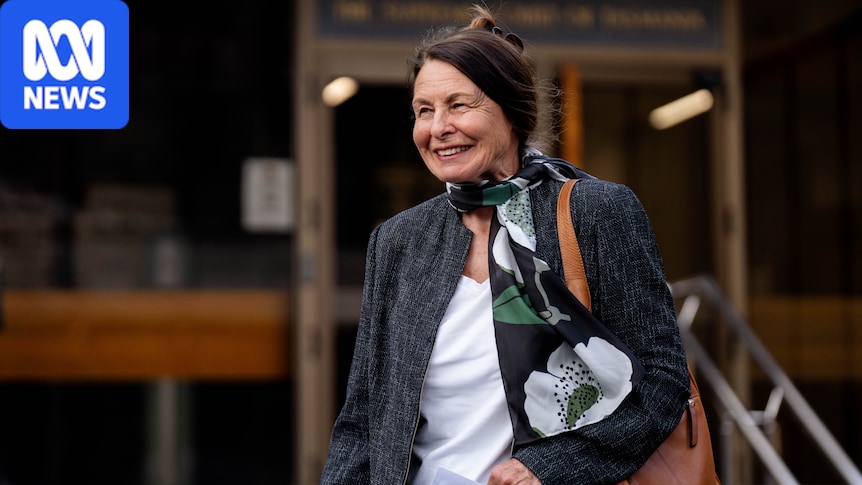
Convicted murderer Susan Neill-Fraser has given her first interview since a parole condition preventing her from speaking about her case was lifted, saying she "can't remain quiet" as she continues her fight to clear her name.Neill-Fraser, now 72, was convicted in 2010 after a jury found her guilty of murdering her partner, Bob Chappell, 65, on board their yacht, the Four Winds, which was moored off Hobart on Australia Day 2009.Mr Chappell's body has never been found. Nor has the murder weapon.Neill-Fraser appeared on an episode of Channel Nine's 60 Minutes program last night.When asked how she felt about "finally telling Australia your side of the story", Neill-Fraser said:"I am nervous but I am very determined. Sitting with a wrongful conviction is like having an infected thorn in your mind; it's there all the time."She also said she had "probably put myself at risk doing this program"."But you can't remain quiet about this sort of thing."Susan Neill-Fraser and Bob Chappell were a couple for about 20 years. (AAP/Supplied)Neill-Fraser told journalist Amelia Adams she felt her life was at risk, and that she feared her fight to clear her name could also lead to her parole being revoked."There are huge vested interests in keeping this quiet and I'd like to say now I'm not depressed and I'm not suicidal, and if I'm found to have suicided, I have not."There was no further information provided about what she meant by the "huge vested interests".After serving 13 years of her 23-year sentence, Neill-Fraser applied for and was granted parole in 2022.A condition that prevented her from speaking to the media about her case was lifted last month.Susan Neill-Fraser was granted parole in 2022. (ABC News: Luke Bowden)Since she was first charged, Neill-Fraser has continued to profess her innocence.Two appeals — one in 2012 and another in 2021 — against her conviction failed, and she also failed in a bid to have her case heard by the High Court.Mr Chappell's death was also examined by a coroner, who concluded in findings handed down in 2014 that Neill-Fraser murdered Mr Chappell.Adams said Neill-Fraser was "assembling a new legal team to pursue other avenues to quash her conviction".Susan Neill-Fraser was convicted of murder in 2010. (Supplied)Academic has 'no doubt' Neill-Fraser could clear her nameFlinders University academic and researcher Bob Moles was also interviewed by Channel Nine.Dr Moles told the program he had "absolutely no doubt at all" that Neill-Fraser would be able to clear her name if certain evidence was presented to the court.He said this was because of three issues that were not part of the previous appeals:A theory given to the jury at trial by then-director of public prosecutions Tim Ellis SC about the murder weapon, which Dr Moles said was not based on evidence heard at trial.A DNA sample found on the deck of the Four Winds that was matched to then-15-year-old homeless girl Meaghan Vass combined with a statement Ms Vass made during an interview with 60 Minutes in 2019 that she went on board the Four Winds with two males and vomited on the deck after she saw one of them murder Mr Chappell.Photographs shown to the jury of the Four Winds dinghy that had been tested for blood using luminol, which Dr Moles said "was totally meaningless"."If they were presented to the court I am absolutely confident that if the court was doing its job properly it would have no hesitation in setting aside the conviction," Dr Moles said.Ms Vass, who told the trial she had never been on board the yacht, was a witness in Neill-Fraser's second appeal.Her evidence during the 2021 appeal hearing was contradictory.On the first day, she told the Court of Criminal Appeal she had been on the yacht with three men, at least one of whom assaulted Mr Chappell.On the second day, under cross-examination, she changed her story, saying she had never been on the yacht.Neill-Fraser's lawyers eventually decided to relieve her and abandon her evidence.When applying for leave to allow the second appeal, Neill-Fraser's lawyers called an expert witness about the luminol testing of the dinghy, but this evidence was not part of the appeal itself.In her summary of the crown case at trial, one of the appeal judges, Helen Wood, said: "The state did not rely to any significant extent on the luminol reaction in the dinghy."Susan Neill-Fraser has appealed against her conviction twice, but was unsuccessful. (ABC News: Maren Preuss)Neill-Fraser and the lies she told policeNeill-Fraser told Channel Nine she and Mr Chappell, who had been together for about 20 years, "were really like an old married couple" who had a "very peaceful and wonderful life".During Neill-Fraser's 2010 trial, the court was told she lied when she told officers she had gone to Bunnings on the afternoon of January 26, 2009, and she lied when she said she had stayed home that night.The prosecution argued these lies were probative of guilt.Neill-Fraser was asked about both of these inconsistencies by Channel Nine. She said she thought she had gone to Bunnings that afternoon."I don't know but I think I had transposed the days. I look back through my statements and I see that I told them half a dozen different things," she said."I'd never lost my memory before, I didn't understand what was happening … I can't to this day account for it."A jury found Susan Neill-Fraser murdered Bob Chappell on board their yacht, the Four Winds. (AAP)Neill-Fraser also told Channel Nine she "did tell one lie" but not in the sense of "trying to avoid responsibility for doing something wrong".That lie was her telling police she stayed at home all night when in fact she went to Marieville Esplanade in Sandy Bay.Neill-Fraser told Channel Nine she went there because she was worried about the mental health of one of Mr Chappell's daughters."I came down because I knew that there was a possibility she might have come down and be on the beach distressed and disorientated," she said.She said she did not tell police about this because "I think it would have caused a lot of family issues".Police Association calls for end to 'sustained' campaignThe Police Association of Tasmania released a statement this morning, calling for "an end to the sustained public campaign seeking to undermine the integrity of Tasmania Police, forensic specialists, prosecutors and the broader justice system in relation to the conviction of Susan Neill-Fraser".The Police Association of Tasmania says Neill-Fraser's conviction "has been subjected to extensive legal challenge and remains intact". (Tasmania Police)The association said her case had been "one of the state's most scrutinised criminal investigations"."Throughout that time, the conviction has been tested, challenged and examined through the courts and remains a lawful conviction," association president Shane Tilley said."The Police Association has the utmost confidence in the talented, professional and experienced police officers who investigated this matter," Mr Tilley said."We have the same confidence in the forensic specialists, prosecutors and all those involved in the administration of justice throughout this matter."For years, police and prosecutors have been the target of criticism, accusations and conspiracy theories advanced by a vocal campaign determined to rewrite the findings of the courts."The question must now be asked: at what point does the finger-pointing stop being directed at police, prosecutors and the justice system, and turn instead toward the person who was convicted by a jury and whose conviction continues to stand?"Shane Tilley says the police association "has the utmost confidence in the talented, professional and experienced police officers" who investigated Bob Chappell's murder. (ABC News: Luke Bowden)Since a law change in 2015, a convicted person in Tasmania can apply for a second or subsequent appeal if there is "fresh and compelling" evidence."Unless and until such fresh and compelling evidence is produced, tested and accepted by the courts, the time has come to put this matter to bed," Mr Tilley said.Tasmania's Police Commissioner, Donna Adams, said in a statement that "Tasmania Police continues to have full confidence in both the original and subsequent police investigations in this matter".Donna Adams says Tasmania Police has full confidence in the original and subsequent investigations into Bob Chappell's murder. (ABC News: Maren Preuss)Channel Nine said it contacted Mr Chappell's son, Tim, who declined to speak to the program."Because he says due process has been followed and that Sue's ongoing campaign to prove her innocence is causing the Chappell family serious distress," reporter Amelia Adams said.When the parole board published its reasons for granting Neill-Fraser parole in 2022, it gave some insight into the Chappell family's anguish, saying "the burden of [the family's] grief" had "been made more onerous by the ongoing media interest in [Mr Chappell's] death and focus on [Neill-Fraser]."
Convicted killer Susan Neill-Fraser says she'll keep fighting to clear her name
Full Article
Original Source
Read the full article at Abc →KhanList aggregates and links to publicly available news content. We do not host full articles from third-party sources. Always verify important information with original sources.