
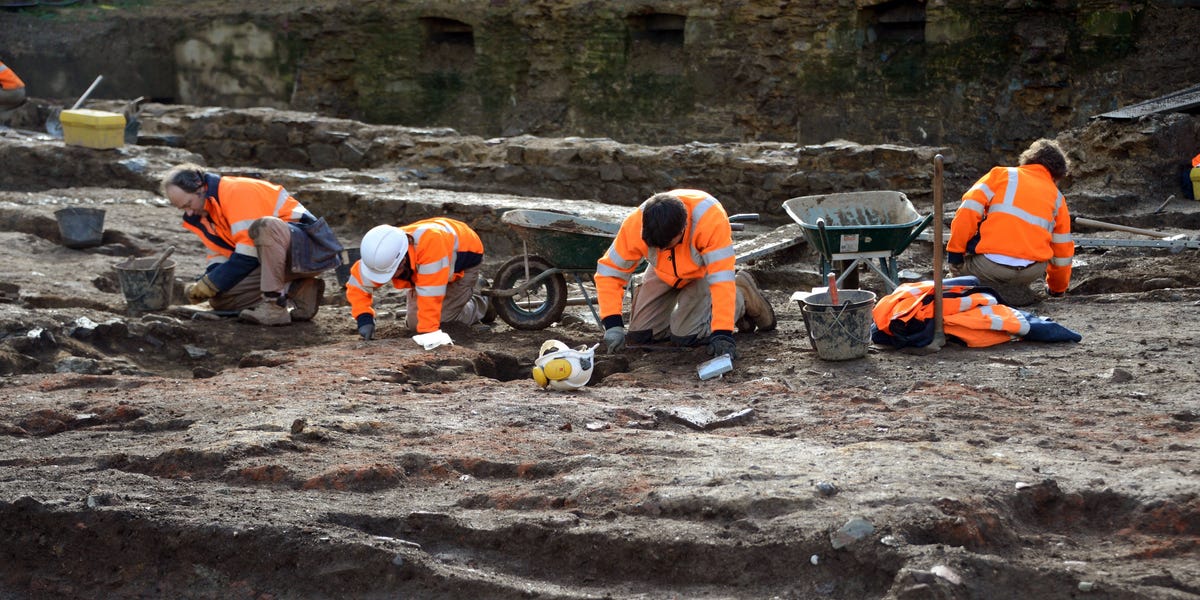
3 min readHere’s what you’ll learn when you read this story:Ahead of construction on a residential home, archaeologists explored a site on the g southeast of Paris.The team found three distinct stages of occupation at the small site, showing habitation from the late Iron Age through the Middle Ages. Multiple excavated buildings prove this was once a densely populated hillside. A popular French hillside may have proven even more popular in the first century B.C.E. than it is today. Known as Montbellant Hill (located in Tonnerre, southeast of Paris), the region seems to have once been home to an entire city, according to a recent discovery by archaeologists with the French National Institute for Preventive Archaeological Research (Inrap). The find offers fresh insight into bygone urban development practices.In a translated statement from the institute, the team wrote that they had discovered groupings of buildings at Tonnerre, complete with multiple cellars and workshops. Evidently, a Gallic fortress from the late Iron Age in the first century B.C.E. preceded Roman-era occupation and habitation.The new discovery at the site—which is no longer abandoned, as excavation occurred prior to construction on a new residential home—pairs with a 2024 excavation located just 160 feet away that also recovered pieces of ancient Tonnerre. Together, they show that the site once featured a tightly packed, heavily organized hillside full of sought-after real estate.“The location of several buildings on the steep slopes of Montbellant Hill testifies to a dense and constrained occupation,” the Inrap experts said.Within the excavation site (which is just 8,000 square feet in size), experts believe they have uncovered evidence of various phases of occupation. Residency started in the first century B.C.E., when the Gallic people used the site as an oppidum, or fortress. Then, the Romans took over and reshaped the area—sometimes building directly over remains, and other times adding to the density. The site continued to prove popular through the medieval era, but eventually 1,500 years of continuous occupation appeared to wane.Pottery and coins found at the site showed that an organized community resided on the hilltop even before the Romans took over. Evidently, the hill’s steep slope provided a much sought-after location, albeit one that required careful planning to wedge in all of the inhabitants.A large medieval structure that once comprised multiple rooms—included a cellar that the team said still contained a “beautifully made stone staircase,” and which intersects ancient pits—represents the most intriguing find so far. Excavations also revealed a slightly elevated Roman-era cellar nearby.In a separate find, the team uncovered a room with a vaulted entrance that, at some point, collapsed into a pit. Excavations exposed wedge-shaped stones that once formed the archway, and iron fittings still tucked between stones served as evidence of a wooden door that would have marked the entrance.The site also revealed Roman-era settlements—some with the walls still standing—and one structure with a courtyard. Discoveries of metallurgical slag point toward a metalworking workshop operating there during the Roman era.The Inrap team said that further excavations will fully expose the structures, possibly revealing additional building functions. From the Gallic Iron Age to the Roman era right through the Middle Ages, Inrap experts hope to illuminate the shifting history of the lost city of Tonnerre.Tim Newcomb is a journalist based in the Pacific Northwest. He covers stadiums, sneakers, gear, infrastructure, and more for a variety of publications, including Popular Mechanics. His favorite interviews have included sit-downs with Roger Federer in Switzerland, Kobe Bryant in Los Angeles, and Tinker Hatfield in Portland.
Construction Was Ready to Begin on a Family Home. Then Archaeologists Found a 2,000-Year-Old City.
Full Article
Original Source
Read the full article at Popularmechanics →KhanList aggregates and links to publicly available news content. We do not host full articles from third-party sources. Always verify important information with original sources.