
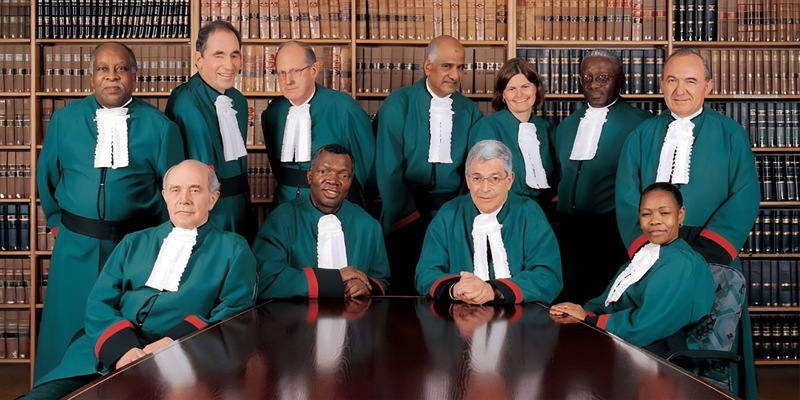
“We were often disparagingly called the judges in the green gowns, often not regarded as real judges.”Retired Constitutional Court Justice Albie Sachs remembers how the distinctive green robes of South Africa’s highest court initially attracted criticism.But, as he told Daily Maverick, the bottle-green robes that came to identify the judges emerged from a much bigger question confronting the founding judges three decades ago: what should a completely new Constitutional Court look like?Traditionally, judicial robes had been black or red, colours associated with the established judiciary.“I think it was black gowns for criminal matters and red gowns for civil matters,” Sachs recalled.But the founding judges wanted their court to look different.“We wanted to distinguish ourselves from the existing judiciary, so I think fairly quickly we came up with the idea of green,” Sachs said.“It’s a warm colour. It’s got an organic feel to it.” Albie Sachs swearing to uphold the Oath of Office in 1995. (Photo: The Albie Collection) At the beginning, Sachs recalled, they started with nothing.“We had no building, no robes, no rules, no library, no books, nothing. We could invent ourselves, which was quite wonderful.”At one of the first meetings of the new court, its president, Arthur Chaskalson, began distributing the enormous list of jobs required to create a functioning institution.Laurie Ackermann took on the creation of a library. Ismail Mahomed was assigned the rules of court. Kate O’Regan was asked to investigate something still novel enough to need explaining – personal computers and what they might mean for the judges.“And at the end, only two people were left with nothing, and that is Yvonne Mokgoro and myself,” Sachs recalled.Chaskalson gave the two judges R10,000 and asked them to take responsibility for the décor of the court’s temporary accommodation.But “décor” came to mean considerably more than choosing furniture.It included the appearance of the court — and the appearance of the judges themselves.One of the first questions was whether Constitutional Court judges should wear gowns at all.Former Chief Justice Arthur Chaskalson (centre) and Justices Johan Kriegler (left) and Albie Sachs (right) at the Constitutional Court in January 2002. (Photo: Robbie Schneider) “Gowns are pompous,” Sachs said. “They separate you off from the general public.”The new judges were already dispensing with some of the conventions associated with the old judiciary. They decided, for example, that they would not be addressed as “My Lord”, “My Lady” or “honourable”.But they eventually concluded that there was a case for retaining judicial robes.One reason, Sachs said, was “uniformity in the good sense of equality”. Beneath the same gown, the individual judge became almost anonymous.“We decided that a degree of formality and equality through the gown would be something worthwhile.”What they did not want was simply to reproduce the appearance of the judiciary that had preceded them.“We definitely wanted to distinguish our court,” Sachs recalled – a brand-new institution, chosen in a new way to uphold a new Constitution.(All graphics: Kevin Momberg)Turning an idea into five metres of green clothThen someone had to make the gowns.Sachs remembers that Justice Toli Madala, who lived in Makhanda, then Grahamstown, was asked to approach the local gown makers.They were Birch’s.The Mowbray family business dates back to 1860 and specialised in legal robes as well as school uniforms and other garments.John Mowbray, who died earlier this year, was the fourth generation of the family involved in the business. His sons, Christopher and Nick, today represent the fifth generation.Thirty years later, much of the paper trail surrounding that unusual Constitutional Court commission has disappeared.John Mowbray, from Birch’s, which made the first green gowns for the Constitutional Court. (Photo: Supplied / Source) Birch’s was an “old-school company” that never digitised its historical records, Christopher and Nick Mowbray told Daily Maverick. Then, in 2017, a fire destroyed about a third of the factory and, with it, much of the company’s archive.But one man still remembers the order.Brian Garbutt, the factory manager at the time, remembers being asked to produce something highly unusual in the world of legal robes: green gowns.Green remains an uncommon colour for judicial dress. Legal gowns were overwhelmingly black or red.Garbutt remembers Birch’s sourcing a polyester cashmere fabric – soft to the touch, but sufficiently hard-wearing for judges to wear regularly and carry around in bags.The cloth weighed about 220g per running metre. Each robe required about five metres.And the final green was not simply dictated to the factory. Garbutt recalls Birch’s presenting the judiciary with three different shades of green. Bottle green was chosen.Brian Galgutt was factory manager at Birch’s at the time. (Photo: Supplied / Source) For Sachs, there was another practical adaptation.“We were all measured. I arranged for my right sleeve to be cut short because of the loss of my right arm in the bomb attack on me,” he recalled.Justice Yvonne Mokgoro said at the time: “The idea of green robes came about, with red and black trim. Green, the colour of the earth, red and black, to signify that we deal with criminal cases as well as with civil law cases. The black belts also signified civil law and the usual bib. By then Albie and I had already been identified as the creative ones, so we were given the task to design the robes, and it was quite exciting.”And so they became the judges in the green gowns.Yvonne Mokgoro, a former justice of the Constitutional Court of South Africa, at the entrance to the court in Johannesburg during an interview in 2013. (Photo: Gallo Images / City Press / Muntu Vilakazi) A new court needed new symbolsThe robes were not the only visual break the judges made with the past.At the same time, the new judges agreed that the Constitutional Court needed its own logo, rather than continuing to use the insignia associated with the previous state.Sachs recalled associating those old symbols with death sentences, the Group Areas Act and apartheid South Africa.“We didn’t want to import our logo,” he said. “We wanted a logo that was connected with our people.”The court adopted the image of people gathered beneath a tree – the idea of “justice under a tree” that would eventually become part of the architectural language of the Constitutional Court itself.The robes and logo were therefore more than branding.The Constitutional Court logo. (Photo: Constitutional Court / Supplied)They were elements of a new institution trying to decide how it should present justice to a democratic South Africa.Yet Sachs cautions against reading a later political vocabulary into what the judges believed they were doing at the time.“We didn’t use the term decolonisation at all,” he said.“It wasn’t an ideological thing. It was just our own vision of ourselves and the pride we had in achieving our own Constitution.”Not quite stylish enoughFor all the thought that went into establishing a distinctive identity, Sachs admits the original gowns were not exactly high fashion.“I’ve never been a particularly smart dresser,” he said, “but I used to feel that when I travelled on South African Airways, the stewards had better costumes than we judges had.”The opportunity for a change of style came 15 years later.Four of the remaining members of the original 11 judges were leaving the court at the same time – and the gown makers did not have enough of the original cloth to make four replacement robes.That coincided with a feeling that the judicial dress could be made “a little more stylish”, Sachs recalled, while retaining the essential green identity.The judges looked at robes from around the world and, after Sachs and his fellow retiring judges had left, a smarter version was introduced. Chief Justice Mandisa Maya during a hearing at the Constitutional Court. (Photo: Julia Evans) Birch’s can still make Constitutional Court robes today, brothers Christopher and Nick Mowbray said, although there are now many more competitors in the market. They believe the company was probably selected for the original commission partly because there were only two specialist robe makers at the time.What survives most vividly, however, is not a pattern or an order form.It is the memory of a new court, without even a permanent home, deciding whether its judges should wear gowns at all — and then choosing a colour almost unheard of in the legal world.Green.Warm, organic and deliberately different.And, as Sachs remembers it, after the debates, the decisions, the fabric samples and the measurements, the transformation was complete: “We became the judges in the green gowns.” DMThis story is part of a series marking 30 years since the signing of the Constitution. The series has been made possible, in part, by the support of the Friedrich Naumann Foundation.
CONSTITUTION @ 30: ‘The judges in green’ — The story behind the Constitutional Court’s iconic robes
Full Article
Original Source
Read the full article at Dailymaverick →KhanList aggregates and links to publicly available news content. We do not host full articles from third-party sources. Always verify important information with original sources.