
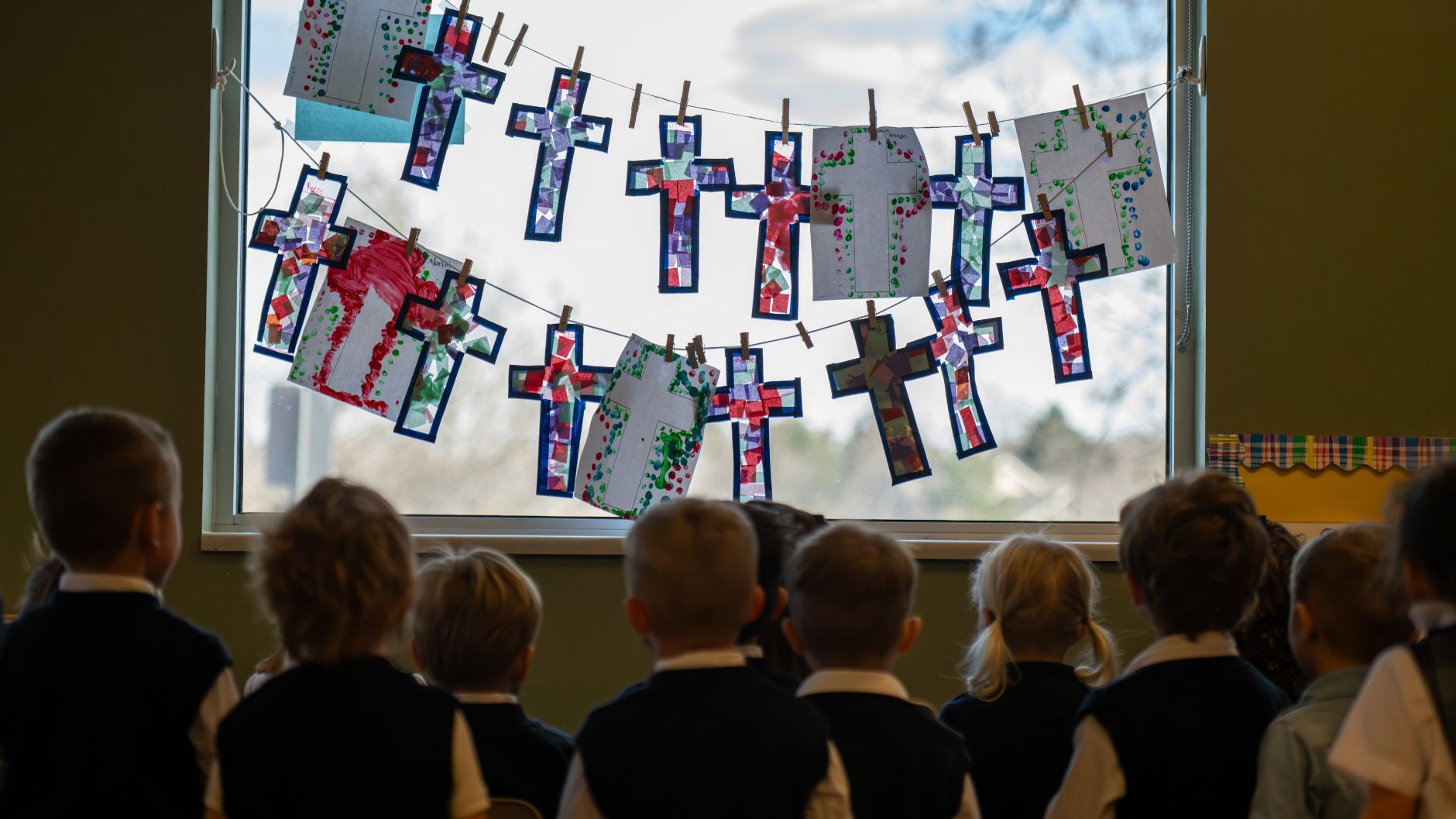
Colorado looked headed towards its fourth loss in row in Supreme Court matchups over LGBTQ rights and religious beliefs.WASHINGTON (CN) — The Supreme Court’s conservative supermajority seemed likely Tuesday to give anti-LGBTQ Catholic preschools a path around Colorado’s requirement that taxpayer dollars only go to schools that are open to all.During two hours of oral arguments, the Republican appointees dismissed Colorado’s need to condition funding for its universal preschool program on an equal opportunity mandate, and they elevated concerns that nondiscrimination laws could be used to indirectly discriminate against religious beliefs.“When a state imposes a condition that it knows certain religions cannot accept, the only question that is presented is whether that was done with the intent to discriminate against those religions,” Justice Samuel Alito, a George W. Bush appointee, said.St. Mary Catholic Parish says it was excluded from the Centennial State’s universal preschool program because it is only open to families that are supportive of the Catholic Church’s teaching on sex and marriage. The preschool filed a lawsuit in 2023 after being denied a religious exemption from Colorado’s equal opportunity mandate.Two lower courts dismissed the suit, finding Colorado’s program did not explicitly discriminate based on religion. But the high court appeared likely to reverse, viewing the case in line with the Roberts court’s recent First Amendment jurisprudence.In Trinity Lutheran v. Comer in 2017, the court held churches couldn’t be excluded from secular aid programs. Then, in 2020’s Espinoza v. Montana Department of Revenue, the justices ruled states couldn’t refuse government aid to schools controlled by churches.Those two rulings culminated in the Supreme Court’s landmark 2022 ruling in Carson v. Makin, holding state-funded school choice programs must include education at religious institutions.St. Mary Catholic Parish says it is being excluded from Colorado's universal preschool program because of its religious practices of ensuring all enrolling families are supportive of the Catholic Church’s teaching on sex and marriage. (Becket)Chief Justice John Roberts, another George W. Bush appointee, said the effect of the law in Carson was the same in St. Mary’s case, preventing schools from receiving funding based on their religious beliefs.Justice Amy Coney Barrett, a Donald Trump appointee, questioned why Colorado couldn’t have foreseen its mandate being a problem when the high court has repeatedly ruled against the state’s protections for LGBTQ rights in cases concerning cakemakers, website designers and conversion therapy.Justice Neil Gorsuch, also a Trump appointee, further suggested states have intentionally enacted similar laws to Colorado’s to circumvent the court’s protections of religious beliefs.The liberal wing had starkly different views on the case before the high court. All three Democratic appointees framed the matter as an attempt to greenlight discrimination against LGBTQ families.“What you’re basically saying is we can exclude people merely because of exposure to them,” Justice Sonia Sotomayor, a Barack Obama appointee, said. “We can exclude children of same-sex marriage. We can exclude children who might have transgender feelings or beliefs because exposing other children to them creates a problem.”Sotomayor and the other liberal justices said excluding LGBTQ families was no different than using religious beliefs as justification for discriminating based on race.“There’s no principled basis, I think, to distinguish between an entity that says my religious faith says my children can’t go to school with the children of gay people from a religious entity that says my religion says my children can’t go to school with the children of Black people,” Justice Ketanji Brown Jackson, a Joe Biden appointee, said.Instead of equal treatment, the liberal justices framed St. Mary’s case as a request for special treatment. As such, Justice Elena Kagan, another Obama appointee, said it was “far-fetched” to suggest that Colorado was surreptitiously targeting religious beliefs.St. Mary’s case asked the justices to apply strict scrutiny to public funding requirements that interfere with protected rights. But Kagan questioned why the high court would want to put itself in the middle of weighing the importance of religious beliefs versus nondiscrimination interests of the state in an endless number of cases.The conservative justices appeared undeterred by their colleagues’ concerns. Gorsuch remarked that he struggled to see how applying strict scrutiny would “be the end of the world,” and Justice Brett Kavanaugh, another Trump appointee, noted the court’s support for LGBTQ rights wasn’t in spite of other rights.“One of the things that Obergefell was very careful to say, though, was that in recognizing a constitutional right to same-sex marriage, that the court was also respecting the rights of people, particularly religious people, who had religious beliefs that were different, and that it was important going forward as a country to make sure both rights were respected,” Kavanaugh said.Subscribe to our free newslettersOur weekly newsletter Closing Arguments offers the latest about ongoing trials, major litigation and rulings in courthouses around the U.S. and the world, while the monthly Under the Lights dishes the legal dirt from Hollywood, sports, Big Tech and the arts.Additional Reads
Conservative justices likely to endorse Catholic preschool exclusion of LGBTQ families
Full Article
Original Source
Read the full article at Courthousenews →KhanList aggregates and links to publicly available news content. We do not host full articles from third-party sources. Always verify important information with original sources.