
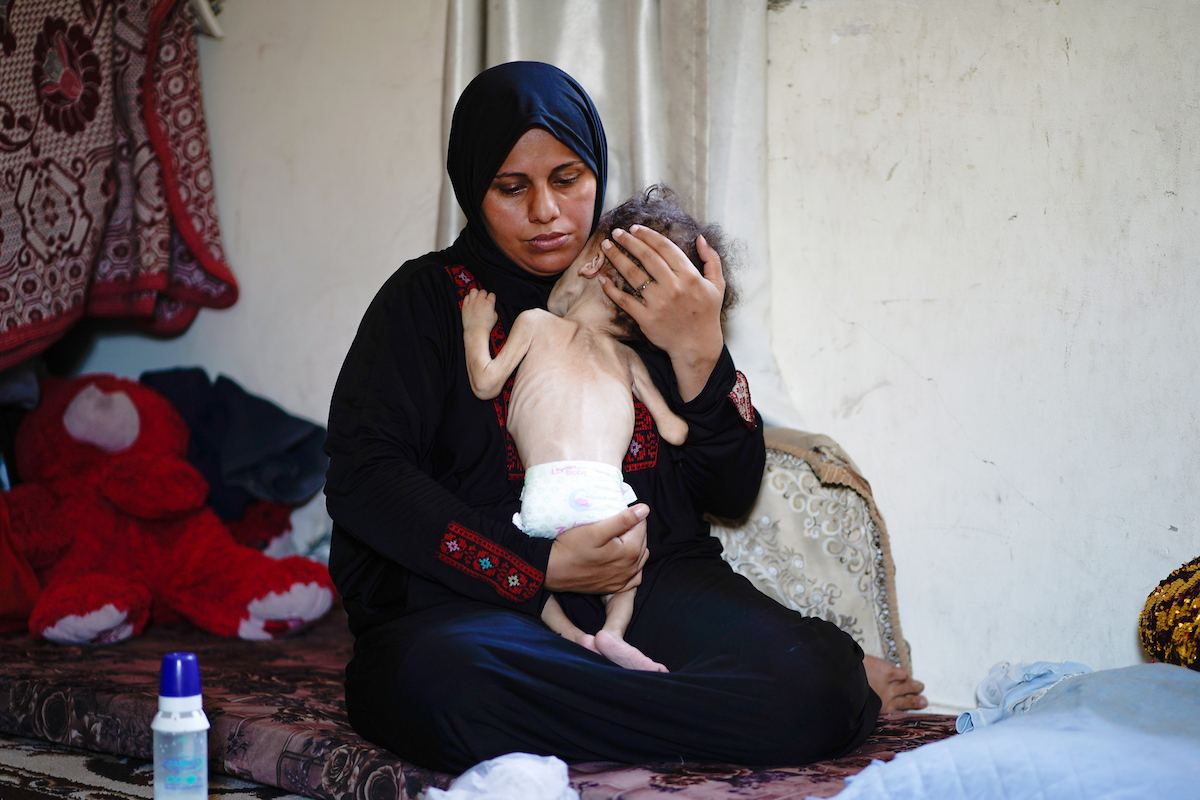
Faiqa al-Arini, 33, gave birth to her first child on October 19 at Al-Awda Maternity Hospital in central Gaza. She was forced to deliver early, at the beginning of her ninth month of pregnancy, after developing high blood pressure. Al-Arini gave birth to a baby girl through a cesarean section. They named her Nour. After the delivery, the new mother remained in the intensive care unit while the newborn was transferred to the neonatal ward. Al-Arini did not see her daughter at all that first day. Whenever she asked, “Where is my baby?” the nurses and her family members reassured her that the infant was in the neonatal ward. The following day, Al-Arini began to feel that something was wrong. She recalled not hearing her daughter cry when she was born. She started questioning her family and was determined to get up and look for the baby herself if the nurses did not bring her. Eventually, her husband, Muhammad Abdel Jawad, 37, confronted her with the news. “You know it is better to hear this from us than from someone else,” he told her. “Our baby has a congenital deformity. She was born without hands.” Abdel Jawad had seen his daughter immediately after her birth. When he had asked the doctors about the main factors that could cause such abnormalities in newborn babies, the doctors pointed to the dust from missiles, toxic chemicals, and the unhealthy environment where displaced people are forced to live across the Gaza Strip. According to Gaza’s Ministry of Health, the number of recorded congenital abnormalities among newborns has been increasing year after year. The ministry confirmed that 260 cases of congenital abnormalities had been recorded among newborns by the end of September 2026, compared with 184 cases in 2022. The number of recorded cases reached 322 in 2025, representing a 75% increase over a three year time period. However, the Ministry of Health says these figures alone do not establish the rate of congenital abnormalities among newborns or determine their causes. Ashraf Qeshta, an obstetrics and gynecology specialist at Nasser Medical Complex in Khan Younis, says that the number of cases of miscarriage and congenital abnormalities among pregnant women has exceeded normal levels. He attributes this to several factors produced by the genocide, most notably the inhalation of toxic gases, exposure to missile remnants, living in an unhealthy environment, malnutrition, and other hardships imposed by war. “We are seeing a significant number of congenital abnormalities. For example, babies are being born without skulls, others without limbs, and some with serious health problems, such as non-functioning or damaged kidneys, or heart defects,” Qeshta told Mondoweiss. Even in cases where doctors believe that the congenital abnormality is caused by exposure to bombs and toxic substances, proving this requires advanced medical testing, sophisticated equipment, and qualified specialists. According to Qeshta, these are precisely the resources the Ministry of Health lacks, making it difficult to investigate and establish the different causes with scientific certainty. Al-Arini said her pregnancy was extremely difficult. She was repeatedly displaced from one place to another and faced severe economic hardship, including famine, as her pregnancy began during the final months of the famine in 2025. “Like all women in the Gaza Strip, we live under the same conditions,” al-Arini said. “We are displaced, we go hungry, we live in fear, and we narrowly escape death almost every day. Bombs and missiles explode beside us, and shrapnel flies over us. This is the reality for all women in Gaza.” “But the effects of all these things are now beginning to show on us. I am happy that I gave birth to a girl, and I love her very much. I had indeed wished she would be born with limbs, but their absence does not make her any less my daughter, nor does it change anything about my feelings toward her. However, it makes me think deeply about the condition of our homeland, and about how even giving birth here has become fraught with danger. A baby can be born with congenital abnormalities because of the conditions we are living in,” she said. A report published by Human Rights Watch on January 28, 2025, documented the grave health and humanitarian risks that pregnant women in the Gaza Strip are facing as a result of the siege, destruction of healthcare facilities, shortages of food, water, and medicine, and Israel’s genocidal war. The report noted that pregnant women in Gaza face a severe shortage of medical care before, during, and after pregnancy, in addition to malnutrition, dehydration, and anemia. They also struggle to reach hospitals and obtain the medical examinations, vitamins, and supplements necessary for a healthy pregnancy. The report added that the deterioration of maternity and childbirth services had increased the risks of complications, including bleeding, preeclampsia, and infections, amid shortages of incubators and medical supplies. These conditions threaten the lives of mothers, fetuses, and newborn babies alike. In addition, a report issued by the United Nations Office for the Coordination of Humanitarian Affairs (OCHA) on August 7, 2026, presented the findings of a survey conducted between June 2 and June 16. The survey covered a sample of 1,335 children and found that 12.2% suffered from stunting relative to their age as a result of chronic malnutrition and inadequate access to sufficient food. Farah Abu Mustafa, 25, lives in the al-Mawasi area of Khan Younis with her nine-month-old daughter, Zainab. Abu Mustafa’s pregnancy was fraught with unexpected hardships, repeated displacement, daily bombardment, witnessing people die, and exposure to gases and missile remnants. Abu Mustafa says her daughter, Zainab, was born under difficult circumstances marked by deprivation of food and a lack of medical services during pregnancy. Since her birth, she has spent almost as much time in the hospital as she has in the tent of their displacement camp. Zainab is suffering from malnutrition, brain atrophy, delayed neurological and muscular development, and recurrent seizures. When she’s in the hospital, her weight and health improve because of the care she receives. But as soon as the family returns to the tent in al-Mawasi, Khan Younis, her condition deteriorates again. Abu Mustafa says her daughter requires specialized medical care and strict adherence to medications and treatment. But in the tents, she can barely provide her with something to sleep on, let alone a clean and suitable place to recover. “This is the life of displacement,” Abu Mustafa said. “Even the simplest things require a miracle for us to obtain them. Everything around us is crushing and grinding down displaced people.” Abu Mustafa also points out that even preventive treatments intended to reduce the risk of congenital abnormalities are not available in pharmacies or easily accessible. “Our Israeli occupier is waging war on the very air we breathe,” she said. “It is creating an environment conducive to diseases, congenital abnormalities, and miscarriages. Every woman I know has experienced a miscarriage, and I know many women who have given birth to babies with congenital abnormalities.” “The occupation wants to eliminate generations, not just leave them with deformities,” she said.
Congenital birth defects are on the rise in Gaza. Doctors say Israel’s genocide is to blame.
Full Article
Original Source
Read the full article at Mondoweiss →KhanList aggregates and links to publicly available news content. We do not host full articles from third-party sources. Always verify important information with original sources.