
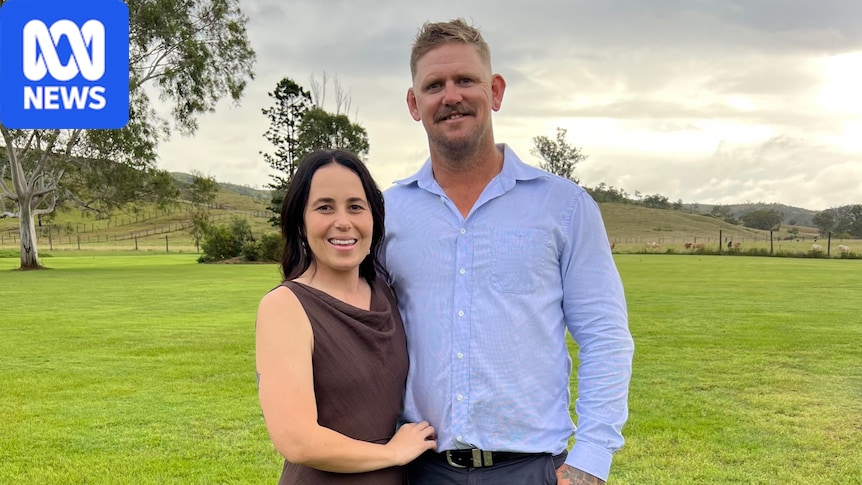
When Dru Arnold was struck suddenly by slurred speech and a migraine, his first instinct was to try to sleep it off.The 39-year-old concreter had no idea he was enduring a potentially deadly stroke.And in the 24 hours it would take him to get to hospital, he suffered two more in quick succession.After his wife called an ambulance, doctors found he had also been hit by a stroke two years earlier.Seven months on since his February scare, he has mostly recovered, but his speech is still affected."There's a lot of people that have got it worse off than me," Mr Arnold said.Dru Arnold says it has been an emotional journey for him and his wife Josie. (Supplied: Dru Arnold)The fit and healthy Sunshine Coast man said he was unaware of the basic stroke symptoms until after his emergency."People that are just living their normal lives don't know much about strokes and about the symptoms and signs," he said.One of his treating stroke nurses, Danika Lloyd, said Mr Arnold was "very lucky" considering how long it took him to seek medical attention."Being his age, most people probably don't think about that kind of stuff," she said.Danika Lloyd says Mr Arnold was extremely lucky. (Supplied: Danika Lloyd)Strokes do not discriminateQueensland Health ranks strokes as one of the leading causes of death in Australians.In 2024, strokes claimed 9,147 lives and, on average, affected someone every 11 minutes.Sunshine Coast University Hospital (SCUH) stroke clinical nurse consultant Bailey McNamara said time was the most critical factor when it came to surviving a stroke.The Sunshine Coast University Hospital stroke team, including Bailey McNamara, Jess Pyman and Robert Hopkinson, recently won an award. (Supplied: Queensland Health)"We notice that a lot of people just sit on their symptoms at home," she said."By the time they get to hospital, sadly, they're out of that timeframe for us to be able to provide that hyper-acute therapy such as the clot-busting medication."Mr Arnold was treated by the team at SCUH, which recently won an international award for how quickly it was able to treat the dangerous clots.Lifestyle choices play a partMs McNamara said 80 per cent of strokes could be prevented.She said it was important for people to eat well, exercise, monitor cholesterol and blood pressure, have regular GP check-ins and blood tests, and stay on top of any heart conditions or diabetes.Binge drinking, smoking, vaping, and taking illicit drugs were among the major risk factors.Stroke Foundation Australia's Kelvin Hill said strokes were increasing in people under 65.Kelvin Hill says time can save lives when it comes to treating strokes. (Supplied: Stroke Foundation)"Over the past 10 to 15 years, things like obesity and the rise in diabetes have also meant that for some people they're getting strokes earlier than what we've seen in the past," he said."We do need people to be more aware because every minute a stroke occurs, there are 1.9 million brain cells that die when they don't get the nutrients and oxygen in the blood supply."Awareness could save livesMr Hill said people needed to be aware of the symptoms and act quickly."One in four people in their lifetime will be impacted," he said.The symptoms of stroke include facial droop, arm weakness, slurred speech, headaches, and brain fog.The Sunshine Coast University Hospital recently won an award for its stroke treatment. (ABC News: Michael Lloyd)Mr Arnold said he wanted to help people understand what strokes looked like and how they should respond."It doesn't necessarily have to happen to you, but if you see the signs happening to someone else, you could save their life," Mr Arnold said."If we knew, I could have been better than I was, we could have got to the hospital a day earlier, and it might not have been so bad."
Concreter survives three deadly strokes, warns against ignoring symptoms
Full Article
Original Source
Read the full article at Abc →KhanList aggregates and links to publicly available news content. We do not host full articles from third-party sources. Always verify important information with original sources.