
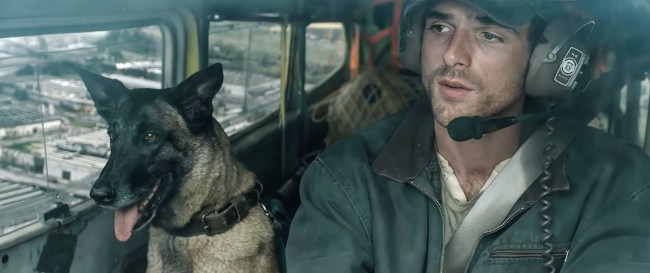
Composer Harry Gregson-Williams first worked with director Ridley Scott 21 years ago, on “Kingdom of Heaven,” and created a score as sweeping and complex as the epic it supported. “I absolutely adore that film, and I think it’s so beautifully shot,” Gregson-Williams told IndieWire. “I had absolutely no excuse for not maximizing that as a musical opportunity.” Scott liked what he heard — on a recent episode of IndieWire’s Filmmaker Toolkit podcast, he said he still thinks “Kingdom of Heaven” is Gregson-Williams’ best score — and since “Kingdom of Heaven,” the director and composer have collaborated on seven more films, including Scott’s latest, “The Dog Stars.” A dystopian fable that combines romance, horror, action, and sci-fi, the movie presented Gregson-Williams with one of his most challenging projects yet, given the disparate tones and styles his score needed to reconcile. “The movie is a combination of the intimate and the large scale,” Gregson-Williams said, noting that at its heart, “The Dog Stars” is a movie about individual people trying to make connections — something that required a slightly different approach from the one Gregson-Williams took on massive projects like “Prometheus” and “Gladiator 2.” “Quite often on Ridley’s movies, I leaned quite heavily on the orchestra as my foundation of musical expression. On this, that didn’t seem entirely right; these guys are living in the woods, and it’s pretty rough,” Gregson-Williams said. With that in mind, Gregson-Williams incorporated more instruments that he felt were “a little rough around the edges, a little bit unproduced,” a combination of banjos, guitars, and ukuleles, and incorporated some ethnic percussion instruments to emphasize the story’s tribal elements. He didn’t leave his penchant for sweeping orchestral sounds behind, however — in fact, some of the most beautiful pieces in the movie capitalize on Gregson-Williams’ talent for dynamic and melodic emotional themes. That’s certainly true of the music Gregson-Williams wrote for some of hero Hig’s (Jacob Elordi) early scenes, in which he’s flying alone with his beloved dog Jasper, looking for signs of life in a post-pandemic world. “There’s no dialogue there and very little sound aside from the buzzing of the plane in the background,” Gregson-Williams said. “But there are beautiful visuals, and that creates a marvelous opportunity to state a theme.” Gregson-Williams began by coming up with a musical language to express Hig’s state of mind, a typical practice when working with Scott. “Ridley loves thematic material to be pegged to a particular character or a geographic location,” Gregson-Williams said. “That first flight gives us an idea of what remote, beautiful surroundings Hig seems to live in. But as the flight goes on, we see the destruction of Denver and the cue turns dark.” For Gregson-Williams, collaborating with Scott on scenes like Hig’s flight is a matter of finding aural corollaries for directions that come more from Scott’s background as a visual artist. “Ridley is a painter, and it’s no coincidence that when he talks to me about music he talks in terms of texture, tone, color, light, and darkness,” Gregson-Williams said. “I’ll translate those terms into music, or often he’ll give me a reference. On ‘Prometheus,’ for example, he sent me this colossal piece of music by Richard Wagner, which intimidated me. Maybe that was his tactic; I don’t know. But he said, ‘Listen to the layers. Listen to the terror behind the beauty.’ It’s wonderful working for him because he doesn’t give me exact directives, but he suggests paths that I might go down.” Scott gave Gregson-Williams a particularly specific reference when it came to a scene in which Josh Brolin’s character has his last stand against the “roaches,” survivors who have turned violent and feral after the pandemic. “Ridley usually starts with a ‘what if’ question,” Gregson-Williams said. “He said, ‘What if [German composer Carl Orff’s cantata] ‘Carmina Burana’ got completely messed up?’ and left me with that thought.” Having worked with Scott for decades now, Gregson-Williams was able to interpret the question and determine its meaning. “At its heart, the comment meant, ‘I like the thought of voices,'” Gregson-Williams said. “In fact, we distilled it into a kind of chanting, in a very distorted and rather scary way. That’s an example of how Ridley’s comments are always productive and constructive.” The composer noted that while Scott gives him a great deal of latitude in composing his scores, he also loves to engage with the music at every stage — something he has in common with his late brother Tony, with whom Gregson-Williams also worked multiple times. “Ridley’s very keen to hear every draft I do; he won’t just wait until the final scoring session at Abbey Road or wherever,” Gregson-Williams said. “He likes to hear my demos early on. His brother Tony was even more extreme in that regard — he would spend many hours in my studio. He would just show up — ‘I’m color correcting down the road, thought I’d just drop in.’ I’d say, ‘Oh, I’m not ready for you,’ and he’d say, ‘That’s fine, just pretend I’m not here,’ and sit on the couch.” As Gregson-Williams and Scott collaborate on more and more films, the interactions become more efficient and more productive — and begin earlier in the process. “The longer we work together, the more he includes me early on,” Gregson-Williams said. “It stands to reason, the more time I get, the better I can serve the film. I remember back in the late ’90s when I first came to Hollywood and was working with Hans Zimmer, we were on a film that was seeming to go on forever. I remember asking Hans, ‘When do we finish?’ and he said, ‘When it’s the best it can be. Shut up and go back to your room.’ And that work ethos has served me pretty well since then.”
Composer Harry Gregson-Williams on His Eighth — and Possibly Best — Collaboration with Director Ridley Scott
Full Article
Original Source
Read the full article at Indiewire →KhanList aggregates and links to publicly available news content. We do not host full articles from third-party sources. Always verify important information with original sources.