
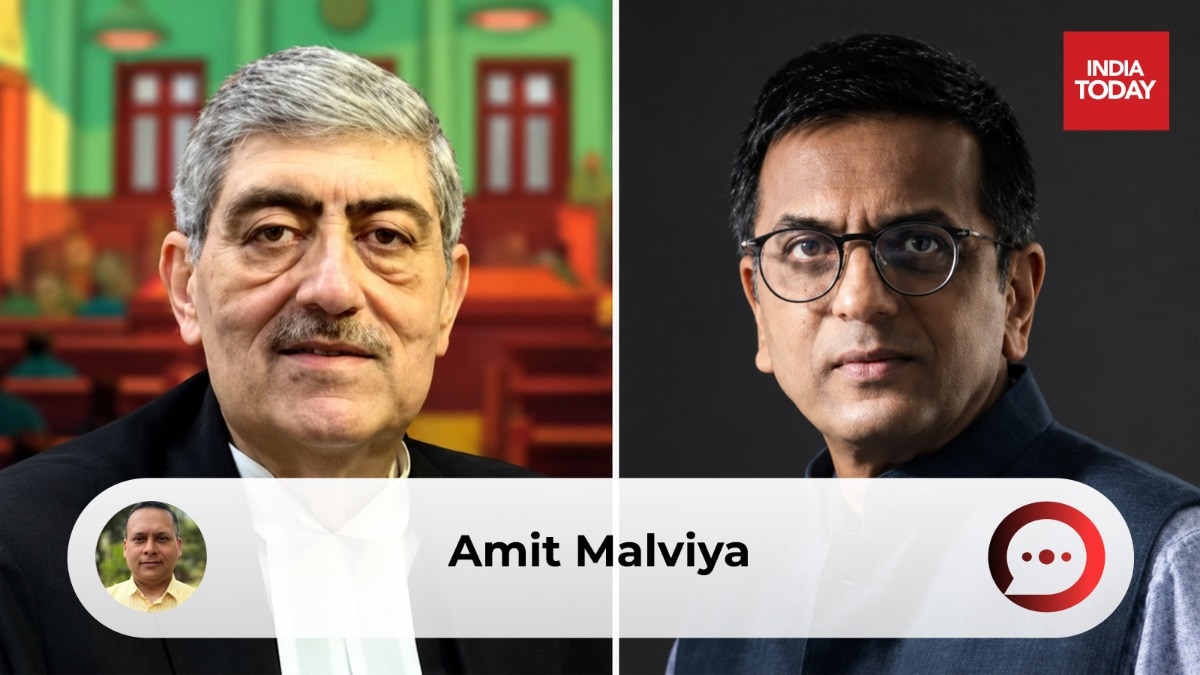
Justice SK Kaul’s recent observations on former Chief Justice of India DY Chandrachud have reopened an important debate about judicial independence and the relationship between the judiciary and the executive. Speaking about the administrative side of the Chief Justice’s role, Justice Kaul said, “There is a judicial side and there is an administrative side to a Chief Justice. I would not be concerned with the judicial side. I believe he had the intellectual heft, capacity and the hard work to do so. But in consultation with the Government, I felt he was too deferential [to the government] than necessary.”Justice Kaul also acknowledged that discussions between the judiciary and the government over appointments were not unique to Chandrachud’s tenure. “This has unfortunately become a practice of names being discussed, and some kind of previous discussion with government. That used to happen. It has been happening, I think, before CJI Chandrachud and after. That is why it troubles me.”These observations merit scrutiny, but they must also be read in their proper context. A concern about administrative consultations is not, by itself, proof that the executive dictated judicial decisions. Any serious assessment of judicial independence must distinguish between institutional interactions, however troubling they may appear, and demonstrable interference in the adjudicatory process.That distinction is particularly important when the Congress and its leaders speak of the judiciary’s independence. The historical record of the Congress, especially during Indira Gandhi’s tenure, offers a sobering reminder of what happens when the government begins to view the judiciary through the prism of political compatibility. On April 25, 1973, days after the Supreme Court delivered its landmark judgment in Kesavananda Bharati, establishing the basic structure doctrine, Indira Gandhi’s government appointed Justice AN Ray as Chief Justice of India, superseding three senior judges: Justices JM Shelat, KS Hegde and AN Grover. All three resigned from the court. Justice Ray had been among the judges who dissented from the majority’s reasoning in the case, making the decision to elevate him over his seniors particularly consequential.The appointment was not merely a departure from established seniority. It was accompanied by an explicit political argument about the kind of judge who should lead the Supreme Court. On May 12, 1973, Union Minister Mohan Kumaramangalam defended the government’s position in Parliament, stating, “Certainly, we as a government have a duty to take the philosophy and the outlook of the judge in coming to the conclusion about whether he should or should not lead the Supreme Court at this time.” The significance of that statement is difficult to miss. It placed a judge’s philosophy and outlook, as assessed by the government, at the centre of the decision about who should lead the highest court in the country. This was the political and institutional context in which the idea of a “committed judiciary” gained prominence: a judiciary whose approach was expected to align with the government’s understanding of its political and social objectives.The dangers of this approach became even more evident during the Emergency. On June 12, 1975, the Allahabad High Court set aside Indira Gandhi’s election on grounds of electoral malpractice. The Emergency was proclaimed on June 25. Civil liberties were curtailed, political opponents were detained, and the independence of constitutional institutions came under extraordinary pressure.The Shah Commission, constituted after the Emergency to investigate excesses committed during that period, became a particular target of Indira Gandhi’s criticism. In a letter to the Commission dated November 21, 1977, she described its terms of reference as “one-sided and politically motivated”. She also argued that “some excesses in their implementation cannot always be avoided nor do they always come to notice at that time”, while insisting that the inquiry should also examine the circumstances that led to the Emergency.Indira Gandhi's opposition to the Commission continued in Parliament. In August 1978, she called it “a standing monument for political vindictiveness” and alleged that it represented the misuse of legal process for political annihilation. She dismissed its report in emphatic terms, saying, “The Shah Commission report deserves a place. That place is in the waste paper basket. To that it will be thrown.”These were her political assertions; they do not, by themselves, settle the merits of the Commission’s findings. But they do illustrate the hostility with which the former Prime Minister confronted an inquiry into the conduct of her government during one of the darkest periods in independent India’s constitutional history.The judiciary’s own record during the Emergency remains an equally powerful reminder of the consequences of executive pressure and institutional timidity. In ADM Jabalpur v. Shivkant Shukla in 1976, the Supreme Court’s majority held that, during the Emergency and the suspension of the relevant remedies, detainees could not seek judicial relief to challenge their detention on the grounds at issue. Chief Justice AN Ray and Justices MH Beg, YV Chandrachud and PN Bhagwati formed the majority. Justice HR Khanna dissented, arguing that the rule of law and the protection of life and liberty could not be reduced to the government’s will.Justice Khanna’s dissent would later be recognised as a defining moment in the defence of constitutional liberty. He understood the personal consequences of his position. He reportedly told his sister after preparing his judgment, “I have prepared my judgment, which is going to cost me the Chief Justice-ship of India.”At his farewell, Justice Khanna warned against the dangers of institutional submission. “There can be no greater indication of the decay in the rule of law than a docile Bar, a subservient judiciary and a society with a choked or coarsened conscience.” He also declared, “Fearlessness is the tradition of the Bar since the days of the struggle for independence Where fear is, justice cannot be.”Events soon reinforced the force of his warning. On January 28, 1977, Justice Khanna was superseded for the office of Chief Justice of India by Justice MH Beg, who was junior to him. Justice Khanna resigned. The supersession, following his dissent in ADM Jabalpur, became one of the most enduring examples of the price a judge could pay for refusing to align his judicial position with the government’s expectations.Justice MH Beg’s subsequent public career also became part of the broader historical record surrounding judicial appointments and public office. After serving as Chief Justice of India, he went on to chair the Minorities Commission and was awarded the Padma Vibhushan in 1988 in the field of Law and Jurisprudence, as recorded in the official Gazette of India. These are matters of public record. Their significance should be considered in the context of the wider history of the period.Justice Baharul Islam’s career presents another episode in the intersection of judicial and political life. He had been elected to the Rajya Sabha in 1962 and again in 1968, resigned from Parliament in 1972, and was appointed a judge of the Gauhati High Court that year. He retired from that court in 1980 and was appointed to the Supreme Court in December of the same year.He resigned from the Supreme Court in January 1983 and subsequently contested the Lok Sabha election from Barpeta as a Congress candidate. The sequence of these public appointments and political engagements is part of the historical record and has long drawn attention to the relationship between judicial office and partisan politics.None of this means that every criticism of a contemporary Chief Justice is invalid, or that the conduct of a past government settles questions about the present. Justice Kaul’s observations deserve to be examined on their own merits. The point is that political parties cannot invoke judicial independence selectively, treating it as sacrosanct when they are in opposition while disregarding its institutional foundations when in power.The Congress’s record under Indira Gandhi is especially relevant because the concern then was not merely about the optics of administrative consultations. It involved the supersession of senior judges, the explicit argument that a judge’s philosophy should influence the choice of Chief Justice, and the wider climate of the Emergency, during which constitutional freedoms were curtailed, and the Supreme Court delivered a deeply troubling judgment on personal liberty.A judiciary committed to the Constitution is indispensable to democracy. A judiciary expected to be committed to the government of the day is something altogether different. The former protects citizens and restrains power; the latter risks legitimising power at the expense of liberty. That is the distinction India’s constitutional history makes clear, and it is one that political parties would do well to remember whenever they claim to speak in the name of judicial independence.Amit Malviya is the Sah Prabhari of BJP Maharashtra and a member of the National Executive.- Ends(Views expressed in this opinion piece are those of the author)
'Committed judiciary' to the Emergency: Congress's troubled judicial legacy
Full Article
Original Source
Read the full article at Indiatoday →KhanList aggregates and links to publicly available news content. We do not host full articles from third-party sources. Always verify important information with original sources.