
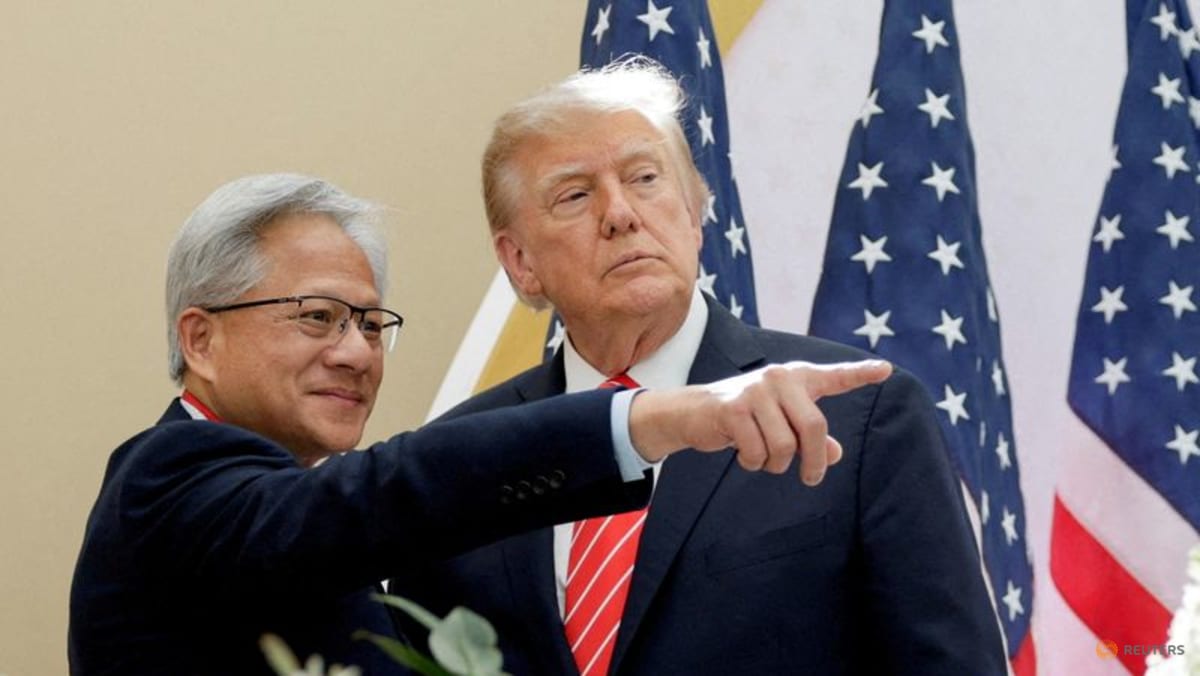
Commentary Whether Alice Huang was a spy, whether the Nvidia CEO was compromised or whether US national security was jeopardised remains to be confirmed. The political damage may already have been done, says Enodo Economics’ Diana Choyleva. FILE PHOTO: US President Donald Trump stands with NVIDIA CEO Jensen Huang, after presenting him with the National Medal of Science during the "A New Golden Age" summit at the US Institute of Peace, renamed The Donald J. Trump Institute of Peace by the Trump administration, in Washington, DC, US, October 8, 2026. REUTERS/Evan Vucci//File Photo New: You can now listen to articles. This audio is generated by an AI tool. LONDON: The scandal engulfing Nvidia's Jensen Huang, who resigned as CEO on Thursday (Nov 12) after 33 years at the company he co-founded, could have consequences far beyond the fate of one of the world's most influential technology executives.With the woman linked to him suspected to be a Chinese spy, his extramarital affair has taken on geopolitical proportions, given Nvidia is at the centre of the US-China AI rivalry.Alice Huang is a former executive at Singapore-based cloud computing provider Megaspeed, a major Nvidia customer that has come under US scrutiny over concerns about the possible diversion of advanced AI chips to China. When the scandal broke, US intelligence officials reportedly believed that she was working for China's Ministry of State Security.No evidence supporting that allegation has been made public. On Thursday, US Attorney General Todd Blanche said in a press conference that the Justice Department is investigating and there was not yet any conclusion about whether she was a Chinese spy. Whether she was a spy, whether Jensen Huang was compromised, or whether US national security was jeopardised remains to be established. Yet the political damage may already have been done. WHAT CHANGES FOR WASHINGTON?The scandal has weakened Washington's strongest voices for relaxing semiconductor export controls just as Congress is moving to tighten them. Huang has consistently argued against restricting China's access to American chips. His reasoning is that keeping China dependent on US technology is preferable to accelerating Beijing's drive for technological self-sufficiency.With Nvidia's advanced semiconductors a critical resource in the global contest for AI leadership, Huang had acquired extraordinary influence over Washington's approach to deciding how much of that technology China should be allowed to buy. One former US official reportedly described him as President Donald Trump's "China desk officer".The contrast between how the White House and Congress have reacted to Huang’s scandal is striking. Trump has continued to speak warmly of Huang, despite reports that he was warned about the national security implications before his May visit to China. Trump denies having received such a warning.Congress has been considerably less forgiving. The Republican chairs of three House committees have requested that Huang appear for a closed-door interview on Dec 1, warning that they could issue a subpoena if he refuses. He has also been asked to testify before the Senate Banking Committee on Dec 3, while Commerce Secretary Howard Lutnick faces separate questioning over the administration's handling of chip export controls.Meanwhile, bipartisan efforts to tighten semiconductor controls are advancing. Three proposed measures would restrict China's access to advanced chips, strengthen controls on chip manufacturing equipment and make it harder to divert restricted technology through third countries.Control provisions are already included in the Senate's draft version of the annual defence authorisation legislation, including the Chip Security Act, AI Overwatch Act and the Match Act. Last year, lobbying by Nvidia and the White House helped remove the GAIN AI Act from the defence bill. The measure would have required chipmakers to give American customers priority access to advanced AI chips before exporting them to China and other countries of concern. Nvidia is now in a much weaker position to mount that campaign.And with Democrats taking control of Congress in January 2027, pressure for tougher restrictions is unlikely to subside. FILE - China's President Xi Jinping, right, and U.S. President Donald Trump visit the Temple of Heaven in Beijing, May 14, 2026. (Brendan Smialowski/Pool Photo via AP, File) WHAT CHANGES FOR BEIJING?As for China, it is accustomed to American accusations of espionage and technological theft. This scandal will not fundamentally transform a rivalry already driven by competing national security and economic ambitions.But it could accelerate the deterioration in trust. China’s Foreign Ministry has already accused Washington of fabricating spy narratives as a pretext for imposing a technological “blockade”.For Beijing, tighter chip restrictions would reinforce a longstanding conviction that Washington is determined to contain China's technological rise, regardless of the commercial interests of American companies. That would leave Beijing feeling vindicated in its pursuit of technological self-reliance.Yet complete technological separation remains extraordinarily difficult. The US and Chinese technology ecosystems are deeply intertwined, and companies such as Nvidia have powerful incentives to preserve those connections.When the Biden administration imposed successive restrictions on advanced chip exports, the company developed alternative products designed to comply with the rules while remaining competitive in China. Even though Nvidia can sell virtually all the advanced chips TSMC can make for it outside China, abandoning the Chinese market would mean surrendering influence over one of the world's largest AI ecosystems and potentially helping Chinese competitors establish alternative technological standards.Beijing also retains leverage. Its controls over rare earth exports give it a powerful means of retaliation should Washington escalate semiconductor restrictions.WHAT AMERICA STANDS TO LOSEChina always regarded the US-China truce as temporary. It now has another reason to doubt its durability.But the US has also lost one of the most influential advocates for continued technological engagement with China. Whether Huang was right that keeping China dependent on American chips serves US national security better than restricting access remains an open question. What is clear is that his downfall has weakened that argument in Washington. The scandal also illustrates the inexorable forces driving what Enodo Economics forecast in 2018 as the Great Decoupling. The tension between US national security interests, China's determination to achieve technological self-reliance and the commercial interests of globally integrated companies was always going to be difficult to reconcile.Even if Huang is fully exonerated, those forces will remain. Indeed, his downfall risks accelerating them, strengthening the hand of those in Washington seeking tighter controls while reinforcing Beijing's conviction that it must reduce its dependence on American technology.The political damage may already have been done. Greater distrust, tighter technology restrictions and further erosion of the fragile US-China truce now look increasingly likely.Diana Choyleva is founder and chief economist of Enodo Economics and a keynote speaker on global macroeconomics, China, and US-China strategic competition. She is also a senior fellow at the Asia Society Policy Institute’s Center for China Analysis.
Commentary: Jensen Huang’s downfall will accelerate US-China ‘great decoupling’
Full Article
Original Source
Read the full article at Channelnewsasia →KhanList aggregates and links to publicly available news content. We do not host full articles from third-party sources. Always verify important information with original sources.