
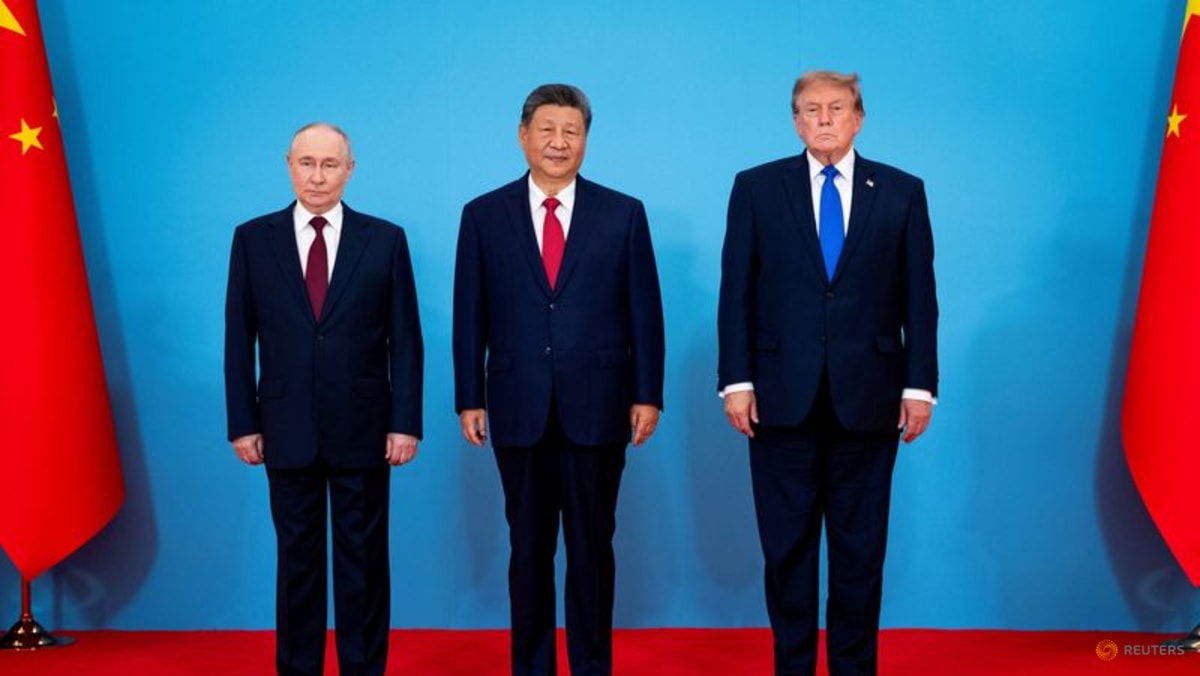
Commentary The three leaders gathered in the name of peace but showed little willingness to tackle the conflicts threatening global stability, says Patricia M Kim from the Brookings Institution. US President Donald Trump poses with President of China Xi Jinping, and Russian President Vladimir Putin as they participate in a trilateral meeting, at the Kylin Villa in Shenzhen, China, Thursday, Nov. 19, 2026. Doug Mills/Pool via REUTERS New: You can now listen to articles. This audio is generated by an AI tool. WASHINGTON DC: The three-way summit by United States President Donald Trump, Chinese President Xi Jinping and Russian President Vladmir Putin in Shenzhen on Thursday (Nov 19) was indeed historic, even if it yielded little beyond the symbolism of bringing the three leaders together.To the relief of those who feared that the gathering might herald the rise of a "G3" or result in a Yalta 2.0 that carved up the world up into spheres of influence, no grand bargain over the international order emerged.But perhaps just as unsettling was what the summit revealed about the limits of great power diplomacy.Mr Trump, Mr Xi and Mr Putin did not use their meeting to dictate the terms for ending the ongoing wars in Ukraine or the Middle East, let alone set the rules for the global order. This outcome was hardly surprising, given the lack of working-level preparation and agreement among the three parties of what this unprecedented trilateral was meant to accomplish. Instead the three leaders appeared more interested in the spectacle of their “unprecedented” gathering than in grappling with the major conflicts driving global instability. AVOIDING THE HARD QUESTIONSThe joint "declaration toward peace" that resulted from the trilateral was striking for its narrow scope and vague commitments.It made no mention of the wars in Ukraine or the Middle East despite the leaders' professed commitment to advancing peace. It called for reform of the United Nations without specifying what that should entail.It advocated expanding production of refined petroleum products and criticised the International Criminal Court (ICC) – both provisions favourable to Mr Putin, who faces an ICC arrest warrant over alleged war crimes in Ukraine and whose country's oil exports have been subject to sanctions and price caps since Russia's invasion.The leaders avoided the difficult issues on which meaningful cooperation was most needed. Their declaration that "a nuclear war cannot be won and must never be fought" was welcome but hardly reassuring. Moscow endorsed the same statement in January 2022, alongside the other four permanent members of the UN Security Council, just weeks before invading Ukraine. The commitment has done little to curb its nuclear sabre-rattling in the years since.Nor has Washington and Beijing's endorsement of the statement given either country much pause in pursuing their respective nuclear modernisation programmes, and, in China's case, the rapid expansion of its nuclear arsenal. THE LIMITS OF GREAT POWERSIn terms of optics, Beijing was undoubtedly the summit's biggest winner. The trilateral helped burnish China's image as a great power peacemaker while reinforcing Mr Xi's stature as a global statesman.Yet it also demonstrated the limits of Beijing's willingness to assume the responsibilities that come with such a role. Despite its numerous diplomatic initiatives and efforts to cast itself as a force for peace and stability, China has shown little inclination to use its influence to advance meaningful conflict resolution. Doing so would require pressing Russia over its war in Ukraine or exerting greater pressure on partners such as Iran and North Korea – steps Beijing has been reluctant to take, seeing little reason to expend political capital on crises it regards as posing little direct threat to its own interests, especially at the expense of its key strategic relationships.The other two leaders hardly offered a more encouraging picture. The American president has long been more interested in the spectacle of diplomacy than in the painstaking, sustained negotiations required to produce substantive agreements.Mr Putin, meanwhile, remains undeterred in pursuing Russia's expansionist ambitions, with little regard for international norms and apparently little concern that his fellow summit participants will seriously challenge him. US President Donald Trump, China's President Xi Jinping and Russia's President Vladimir Putin participate in a trilateral meeting during the Asia-Pacific Economic Cooperation (APEC) Economic Leaders' Meeting in Shenzhen, China, November 19, 2026. REUTERS/Carlos Barria INFLUENCE WITHOUT RESPONSIBILITY?The one potentially meaningful outcome of the trilateral was the stated intention to initiate a dialogue on nuclear risks and nonproliferation.Given intensifying nuclear competition and growing proliferation risks, such a dialogue would be both welcome and necessary. There is no shortage of issues a trilateral dialogue could usefully address, from crisis communications to nuclear command-and-control safeguards amid the growing military use of artificial intelligence, and potentially even reciprocal restraints. Yet with limited political appetite in any of the three capitals for an ambitious trilateral agenda, and little incentive for any of them to make meaningful concessions, it is difficult to see what would drive sustained progress.Beijing, for one, has long resisted arms control negotiations, insisting that the United States and Russia must first make substantial reductions to their nuclear arsenals before China can be expected to accept comparable constraints. Meanwhile, more immediate concerns from Russia's ongoing war in Ukraine to US-China trade tensions, are likely to command greater political attention, leaving little room for sustained engagement on nuclear risk reduction. One can only hope that this skepticism proves misplaced.All of this points to a troubling trend in the international system: Great powers seek the status and influence that come with their position but show little willingness to shoulder the responsibilities of sustaining a stable and functioning international order.The danger revealed by the Shenzhen summit was thus not simply that Beijing, Moscow and Washington might formally divide the world into spheres of influence, but that they might be content to convene in the name of peace while doing little to address the conflicts threatening international stability.Patricia M Kim is a Senior Fellow with a joint appointment to the John L Thornton China Center and the Center for Asia Policy Studies at the Brookings Institution.
Commentary: Historic Xi-Trump-Putin summit reveals an unsettling truth about great power diplomacy
Full Article
Original Source
Read the full article at Channelnewsasia →KhanList aggregates and links to publicly available news content. We do not host full articles from third-party sources. Always verify important information with original sources.