
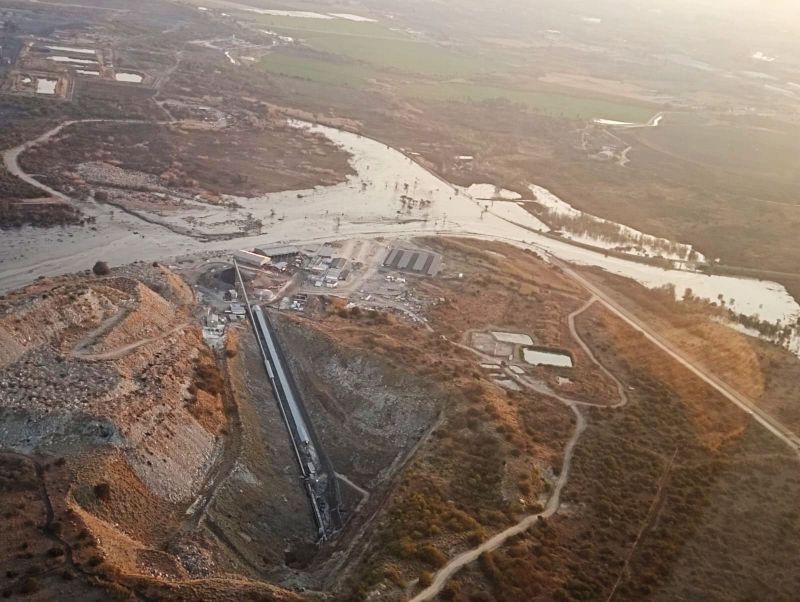
On 13 August, at precisely 5.39pm, the Inyoni tailings storage facility, part of the Dikwena Chrome plant complex at Samancor’s WCM Mine, east of Brits, burst its seams, unleashing a toxic slurry of sludge across the landscape.There were thankfully no fatalities and only one reported injury. The debris briefly forced Northam Platinum’s neighbouring Eland Mine to close an access road.It seems the lay of the land, marked by railway lines and small embankments, prevented the disaster from being more widespread – water is the main force at work here and it can only travel downhill.In a Notice of Orders issued by the Department of Mineral and Petroleum Resources in the wake of its on-site investigation, of which Daily Maverick has seen a copy, a few things stand out.One is that “it appears that the slimes dam has been showing persistent seepages” and this alarming state of affairs was “reasonably foreseeable as per the evidence adduced from the reports and documents at the operation”. The second was that “it appeared to have not been registered with the Department of Water and Sanitation”.This finding dovetails with the findings of the Civil Society Tailings Working Group, an activist group monitoring mine waste, which says that the July 2025 dams register does not include this facility.In short, it was an illegal facility operating in plain sight that was showing clear signs of an impending disaster.“It’s mind-boggling. It’s a big facility. How could the authorities not know about it?” Alastair Bovim, CEO of environmental consultancy Insight Terra and a tailings monitoring expert, told Daily Maverick.The minerals department’s Notice of Orders is explicitly directed at Samancor Chrome, an unlisted company. Desmond McManus, its CEO, was quoted by the SABC as saying it was assuming all responsibility for the clean-up and rehabilitation.The company did not respond to Daily Maverick’s requests for comment.An aerial view of the spill after the dam wall at the Samancor Dikwena tailings storage facility near Brits in the North West collapsed on Thursday, 13 August 2026. (Photo: Iaan Myburgh) The Inyoni tailings storage facility was operated by a company called One Chrome, which does not appear to have a website – an astonishing lack of transparency for a potentially hazardous operation in an environmentally sensitive and important agricultural region.It’s also revealing to note that Samancor is no longer a member of the Minerals Council, South Africa’s main mining industry group. Such membership is not a guarantee of good corporate behaviour. But its membership compact includes things such as facilitating “responsible product design, use, reuse, recycling and disposal of their products”.That would preclude the operation – even by a third party – of a tailings storage facility on a member’s property that was clearly not up to standard.Failures on many frontsThis raises concerning questions against the backdrop of a surge in illegal chrome mines and washing plants in the area.One is the issue of regulatory oversight on such an important front. Both the minerals and water departments clearly failed to take notice of a sizeable tailings storage facility that was operating without a water-use licence. How many such operations are not in the database and what communities, landscapes and other industrial operations are potentially at risk?Another related question, alluded to the above, is that of transparency. Even unlisted companies should surely be required to provide public disclosures about the management of such operations, given the significant risks posed.And given how “grey” aspects of the chrome industry have become, it poses a question about the source of the tailings material for the facility in an area that is rife with illegal and unregulated operations.“I think what happened there was they were depositing too much and there was too much water… It is clear from the satellite imagery there is a lot of water. It was bad management, poor oversight and no control,” Bovim told Daily Maverick.Source: MDPI Metals, 2022; Earthworks, April 2025; ScienceDirect/WISE-Uranium, 2024 This view was echoed by other experts and mining executives Daily Maverick consulted. “Tailings dams are really complex systems and you start treating one badly, it’s going to fail on you. It’s like the human body. You keep feeding it bad stuff and it’s going to get diabetes,” Bovim said.Tailings storage facilities are used to store the discarded byproducts of mining operations in a dam-like setting. They have been in the global spotlight in the wake of the collapse in 2019 of the Brumadinho dam in Brazil, operated by Vale, which killed 270 people.The latest South African incident recalls the Jagersfontein tailings dam burst in the Free State, which killed one person and displaced scores of others, and the parallels are striking: shoddy management by an unlisted company that has no affiliation with the likes of the Minerals Council and the standards it sets for its members.Houses surrounded by mud when the tailings dam at the nearby mine in Jagersfontein in the Free State burst on 12 September 2022. (File photo: Felix Dlangamandla) South Africa’s tailings standards date to 1998 and they are being revised. One senior mining executive told Daily Maverick they were not aware of any operation that followed those standards having a catastrophic incident.Still, this latest tailings storage facility failure will add to calls to tighten or improve existing standards. Tightening oversight and having an accurate and up-to-date database of such operations would surely be a good start.How many other ticking time bombs are out there amid the accumulating slurry, and when things go pear-shaped, which communities will be affected? DMThis story first appeared in our weekly DM168 newspaper, available countrywide for R35.
COLOSSAL FAILURE: Slimes dam collapse raises safety and transparency issues anew
Full Article
Original Source
Read the full article at Dailymaverick →KhanList aggregates and links to publicly available news content. We do not host full articles from third-party sources. Always verify important information with original sources.