
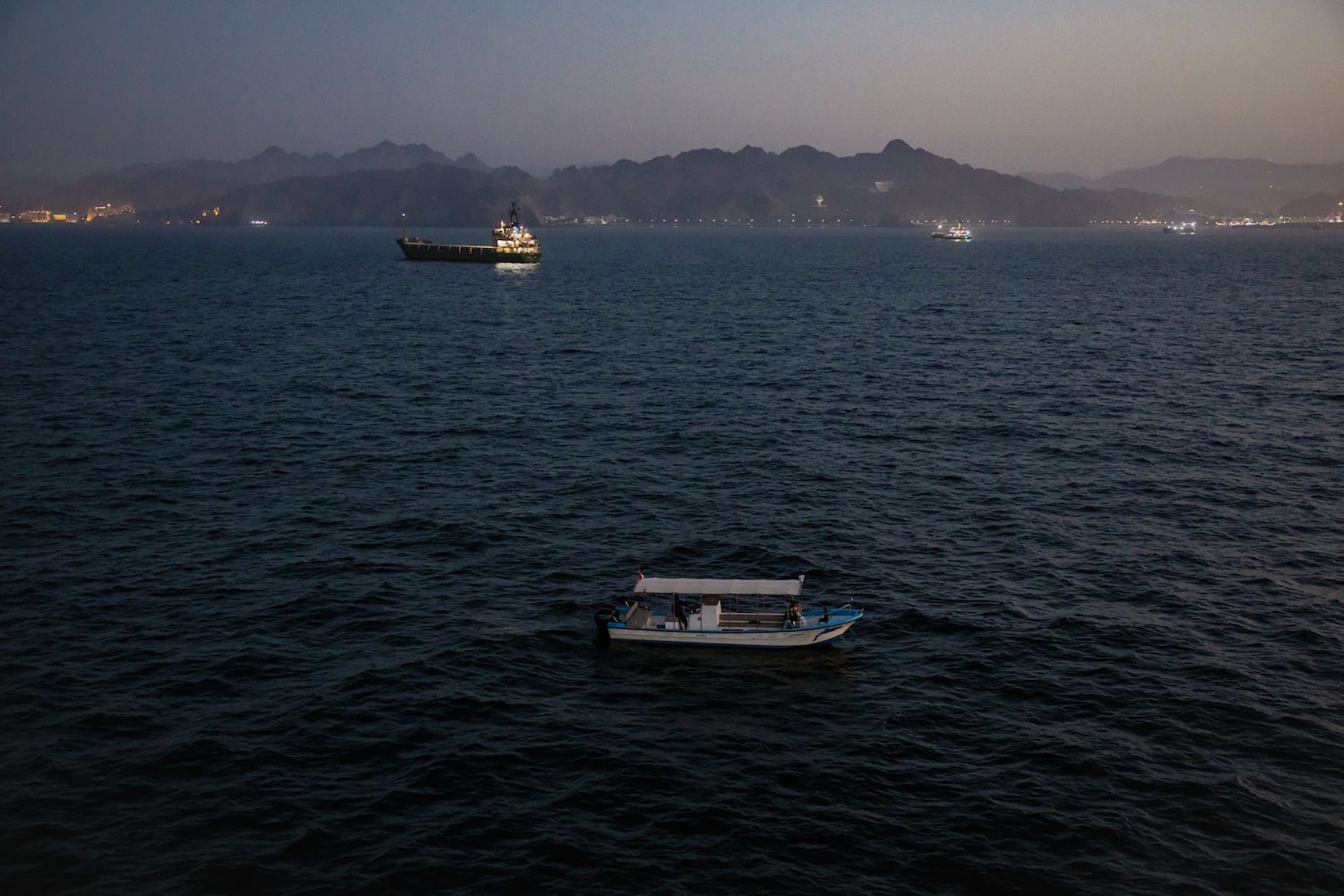
Ships can’t navigate a reality that exists only in Trump’s head. By Elisabeth Braw, a columnist at Foreign Policy and a senior fellow at the Atlantic Council. Oil tankers and cargo vessels are anchored off the coast of Oman after being stranded for days as congestion at Port Sultan Qaboos has prevented them from docking in Muscat, Oman on June 23. Oil tankers and cargo vessels are anchored off the coast of Oman after being stranded for days as congestion at Port Sultan Qaboos has prevented them from docking in Muscat, Oman on June 23. Elke Scholiers/Getty Images September 1, 2026, 11:56 AM “I have just been informed by the United States Navy that all mines have been removed and/or detonated from within the International Waters of the Strait of Hormuz,” U.S. President Donald Trump posted on Truth Social on Aug. 25. At the beginning of the war, Iran had mined the Strait of Hormuz’s Traffic Separation Scheme (TSS), the official shipping lane that runs through the middle of the strait. Mines, of course, make it extremely risky for ships to sail through. And now, Trump has said that the mines are gone. It is fantastic news because removing mines is painstaking and dangerous work, particularly during an ongoing conflict. “Now that the mines have been cleared, ships will be able to move simultaneously in both directions through the strait with protection from the U.S. Air Force, allowing the export of more oil to global energy markets,” Axios reported. “I have just been informed by the United States Navy that all mines have been removed and/or detonated from within the International Waters of the Strait of Hormuz,” U.S. President Donald Trump posted on Truth Social on Aug. 25. At the beginning of the war, Iran had mined the Strait of Hormuz’s Traffic Separation Scheme (TSS), the official shipping lane that runs through the middle of the strait. Mines, of course, make it extremely risky for ships to sail through. And now, Trump has said that the mines are gone. It is fantastic news because removing mines is painstaking and dangerous work, particularly during an ongoing conflict. “Now that the mines have been cleared, ships will be able to move simultaneously in both directions through the strait with protection from the U.S. Air Force, allowing the export of more oil to global energy markets,” Axios reported. The shipping community, alas, didn’t believe the announcement. Despite the news from Washington, ship traffic remained steady at around 30 transits each day, compared to a daily average of 129 before the war—and most of them opted for the routes along the Iranian and Omani coasts, respectively, not the supposedly safe TSS. Indeed, cognitive dissonance now dominates the Strait of Hormuz: there’sThere’s what Trump the President of the United States ssays, and there’s what shipowners see on the ground (or rather, on the water). Indeed, cognitive dissonance now seems to dominate Trump’s relations with the world. “That sucker is open,” Trump insisted on Aug. 27, two days after his first announcement. The following day, U.S. Central Command leader Brad Cooper delivered a similar message on social media. “We have successfully cleared sea mines in the strait’s international shipping lanes,” he said, adding that “internationally recognized transit routes are free of Iranian sea mines thanks to the incredible work of the U.S. military.” Bravo Zulu to the U.S. Navy divers and SEALs who, with great skill and bravery, managed to clear the mines. Unlike Trump, however, Cooper didn’t say that all the mines had been cleared, because it’s impossible to know how many mines have been laid and where they are. Trump’s messages, and even that of Cooper, appeared to have been intended to mollify global oil markets. But traffic in the strait still did not increase; the shipping community had deduced that not all mines had been cleared. What’s more, mines are not the only peril facing ships in the strait these days. On Aug. 30, the United States fired missiles and rockets at Iran once again, after Centcom discovered that Iran was planning to lay more mines in the Strait of Hormuz. The following day, Trump posted an artificial intelligence video of Iran’s Kharg Island “being blown to smithereens.” Oil prices promptly rose. The cognitive dissonance in the White House extends far beyond a narrow maritime passage in the Middle East. In January of this year, when Trump was entertaining taking Greenland from Denmark, he let it be known that the Greenlanders “want to be with us.” But in an opinion last year, 85 percent of Greenlanders said that they didn’t want the island to be annexed by the United States, and the island’s leaders have repeatedly told the world as much. A few weeks after weighing in on the wishes of Greenlanders, Trump attacked Iran. In his speech to the nation, he also turned to the people of Iran, promising that “the hour of your freedom is at hand. Stay sheltered. Don’t leave your home. It’svery dangerous outside. Bombs will be dropping everywhere. When we are finished, take over your government. It will be yours to take.” U.S. intelligence agencies, though, had no information indicating that the Iranian regime would collapse or fold in case of a U.S. attack. Once again, cognitive dissonance had led Trump astray. For a certain amount of time, cognitive dissonance works—if one is a powerful country ruled by a person with autocratic tendencies. Trump imagining that North Korean leader Kim Jong Un was his friend did seem to result in Kim becoming friendly, if only to humor his American counterpart or because he knew that North Korea stood to benefit enormously from the charade. But at a certain point, reality proves stubborn. Declaring that Hormuz is fully demined or that it’s “fully open and operating” (as he’s also said) will inevitably be disproven by a glance at a maritime-traffic site. Assertions that Greenlanders want to join the United States will melt when faced with opinion polls. And predictions that Iran’s regime will collapse won’t survive the clash with said regime. Whatever marginal gains that Trump may achieve by presenting a distorted view of the world, the losses are much higher. The United States’ credibility has been dealt an enormous blow. These days, people looking for facts on any matter involving the United States often consult sources other than the U.S. government. Even Iranian and Russian government reports seem to hew closer to the facts than Trump’s posts do. More alarmingly, the cognitive dissonance has led the United States into adventures from which it will struggle to extricate itself. Trump doesn’t know much about other countries, and acquisition of knowledge is not his thing. Fair enough. But where are the White House staffers who are willing to present their boss with the phenomenal wealth of knowledge that resides within the U.S. government before he leads the country into more international misfortune? By presenting Trump with the truth, they could do a good deed for him, for the country, and for the world. It is, in fact, their duty. Iran Elisabeth Braw Elisabeth Braw is a columnist at Foreign Policy, a senior fellow at the Atlantic Council, and the author of Goodbye Globalization. Bluesky: @elisabethbraw.bsky.social Read More White House Press Secretary Karoline Leavitt shows an artist's rendering of US President Donald Trump's planned Triumphal Arch during a press briefing in the Brady Briefing Room at the White House in Washington, DC, on April 15. Trump Tests the Limits of Farcepolitik Will America join the long line of countries confronting defeat with self-delusion? Trump and Vance are seen seated side-by-side, Trump seen in profile with his mouth open as he speaks, Vance leaning in slightly to listen. Both men wear dark business suits and ties. Vance Pitches a New Objective for the Iran War Simply lowering energy prices for U.S. consumers is “goal No. 1” OTHER SUBSCRIPTION OPTIONS Stories Readers Liked Go to slide 1 Go to slide 2 Go to slide 3 Go to slide 4 Go to slide 5 Go to slide 6 Go to slide 7 Go to slide 8 Go to slide 9 Go to slide 10 A woman crosses a road in front of a mural depicting Russian President Vladimir Putin in Kashira, Russia, southeast of Moscow, on Oct. 16, 2017. The Western Myth of Russian Greatness By Christian Caryl A battle scene from the film ‘The Odyssey’ by director Christopher Nolan. An illustration depicting a man submerged up to his nose in water. The wavy water is divided horizontally into three color bands that mimic a flag: white foam at the very top peaks, a deep blue middle section filled with bubbles, and a red lower section covering his neck and suit jacket. His blue eyes look upward with a wide, strained expression. As the Tide Turns Against Putin, Beware the Drowning Man By Peter Frankopan Negotiators from the United States, Canada, and five European countries converse after finishing the draft of the North Atlantic Treaty in Washington on March 18, 1949. Trans-Atlanticism Isn’t Dead—It’s Being Renegotiated By Alexandra de Hoop Scheffer An illustration of a vintage-style map featuring North America and parts of Europe and Africa. Overlaid on the map are 3D red brick walls shaped exactly like the borders of the contiguous United States and Alaska, casting long shadows to the right. America, the Once Global Nation By Odd Arne Westad A creative illustration against a pale yellow background showing a garden planter containing a dense green hedge. Five human arms emerge from the hedge, with four of the hands holding small flags of China, Russia, the United States, and the European Union, while the fifth hand holds the flag of India. An illustration showing a pair of hands tightly wringing out an American flag. Water droplets shaped like missiles squeeze out of the twisted fabric and fall toward a puddle shaped like the map of Iran on a red background. Central Military Commission Vice Chairman Zhang Shengmin raises his right hand in a salute to Chinese President Xi Jinping, who is walking a level lower in a red-carpeted auditorium. Republican presidential nominee, former President Donald Trump pumps his fist as he walks off stage at the end of a campaign rally at the Santander Arena on November 04, 2024 in Reading, Pennsylvania. An aerial photo shows Doha in the booming petrostate of Qatar. Back to School An illustration shows the back of a person wearing a graduation cap with a globe motif on it. A hand reaches in to move a locator pin on the top of the cap/map. So You Want to Work in International Affairs A veteran practitioner’s 12 tips to land that first job. An illustration of hands tossing graduation caps into the air against a blue sky and lines of a chart for a ranking of international relations schools. A teacher interacts with students at a UNRWA school. Students graduate during a ceremony at Tsinghua University in Beijing on July 18, 2007.
Cognitive Dissonance Dominates Hormuz
Full Article
Original Source
Read the full article at Foreignpolicy →KhanList aggregates and links to publicly available news content. We do not host full articles from third-party sources. Always verify important information with original sources.