
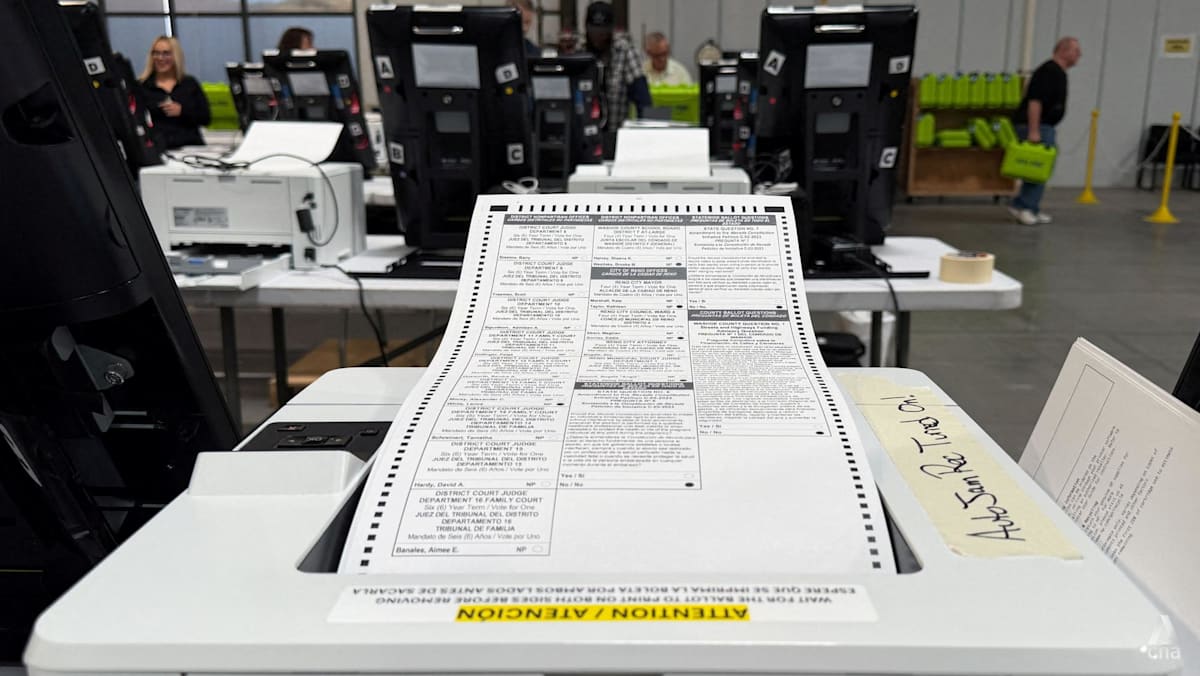
World Plenty is at stake in this midterm election as the Democrats try to win back control in the US Congress. Election workers print sample ballots during mandatory testing of voting machines ahead of the 2026 midterm elections in Reno, Nevada, US, on Oct 7, 2026. (Photo: Reuters/Elizabeth Mendez) New: You can now listen to articles. This audio is generated by an AI tool. The US midterm elections will be held on Nov 3, with millions of Americans already having cast their ballots for seats in the House of Representatives and Senate, as well as governorships across the country.As the name suggests, midterms are held two years into each US presidential term. All 435 seats in the House of Representatives and about a third of the Senate (35 seats) are up for the ballot.Plenty is at stake in this midterm election.Currently, the Republicans hold a 218-214 majority in the House, and the Democrats must win a net gain of four seats to gain control. The Democrats are also fighting to win the Senate, where Republicans hold a 53-47 majority, and they must win a net of four additional seats to get control.As of Thursday (Oct 29), nearly 40 million mail-in and early in-person votes have been cast, NBC News reported.Reuters estimates that over 100 million ballots will be cast in this year’s elections, if the turnout is anything like the previous midterms in 2022 - 112 million ballots were counted then, according to the US Election Assistance Commission. Experts CNA spoke to said that inflation, the cost of living, Trump’s immigration policies and the Iran War are among the key issues for voters headed to the polls.For US President Donald Trump and the Republican party, losing control of one or both chambers would "adversely affect" his ability to implement his policy agenda, says Kevin Chen from Nanyang Technological University’s S Rajaratnam School of International Studies (RSIS).Why do the midterm elections matter?The midterm elections could make the latter half of Trump's presidency look very different from the first.The US Government is made up of three branches - the legislative, executive, and judicial branches. Congress makes up the legislative branch and provides a check and balance on the Executive Branch, led by the President and the Vice President.This separation of powers means that Congress has some power to restrain the executive branch, or the administration, said Associate Professor Chong Ja Ian of the National University of Singapore (NUS) political science department."The clearest is the power over the budget. It also has the ability to subpoena administration officials to testify under oath."The US Senate, the upper house representing state interests, also has the power to approve or reject key appointments."Should Democrats gain control of the House of Representatives, they have some ability to restrain the administration," said Assoc Prof Chong, adding that this capacity increases if the Democrats also control the Senate.However, the President has significant powers over foreign policy, the use of force and tariffs. Trump could also use executive orders to push through policy, but Congress could potentially withhold or limit funding. US President Donald Trump walks on stage during a campaign event ahead of the midterms in San Antonio, Texas, US on Oct 7, 2026. (Photo: Reuters/Callaghan O'Hare) What is at stake for the parties?The outcome of the midterm elections will determine which party plays a key role in making laws, controlling the budget and keeping the President’s power in check.The Democrats currently do not have a majority in either body of the US Congress, and another two years without control will surely hurt their agenda."For the Republicans, it’s the ability to govern for Trump’s final two years. For the Democrats, it’s the ability to check him," said Elvin Lim, professor of Political Science and Dean of the College of Integrative Studies at the Singapore Management University.The House of Representatives is particularly consequential for three reasons, explained Prof Lim. It has the power of the purse, with all spending Bills required to originate there. It also has subpoena and investigative powers, as well as the authority to impeach the President.Control of the House may also allow the Democrats to hinder Trump’s policy agenda, but it depends on how far both sides are willing to go to pursue their political interests, said Mr Chen. Why do the midterms matter for Trump?The outcome of the midterms will have a bearing on the US government’s policy agenda, Mr Chen said. The party in control of the House can oversee key spending Bills and convene hearings to scrutinise Trump’s foreign policy.If the Democrats win control of the Senate, they would also be able to block votes on Trump’s national security nominees, said Mr Chen, who is also an Associate Research Fellow from the US Programme at RSIS.However, while Congress has these abilities on paper, Mr Chen said that Trump has a "much more influential platform" to express his opinions and promote his agenda.For example, he has been known to bypass Congress entirely on issues, such as his recent purchase of Russian gas, which has sparked criticism from both sides of the aisle.In a bipartisan letter, Democratic and Republican lawmakers said the agreement would provide Russian President Vladimir Putin’s government with more fuel to finance its war, and will not benefit Americans.The midterms are also often taken as a barometer of Presidential performance regardless of who is in the White House, said Assoc Prof Chong.The Iran War is a deeply unpopular conflict among Americans, and a Democrat-controlled House or Senate could try to use defence spending to pressure Trump to end the conflict, said Mr Chen from RSIS."A Democrat-controlled House may also push back more forcefully against Trump’s tariff plans, though their procedural nature gives these tariffs more legal backing."What are some key issues driving US voters?Polls have shown that economic anxiety is the top issue for voters, who have expressed concerns about fuel prices and overall affordability, said Mr Chen."While other concerns include data centres and immigration, this economic lens has made foreign policy issues such as the Iran War and Trump’s tariffs relevant to the pocketbooks of voters," he said.While the midterms usually favour the opposition, this year, "inflation and the cost of living weigh heavily despite the fact that the top numbers for the US economy look fine", said NUS' Assoc Prof Chong.The effect of the Iran War on the cost of living, particularly on fuel, has also amplified sentiments that the administration is not handling the US economy well, he said.Trump’s excessive efforts to deport immigrants have also caused unhappiness - an issue that "used to drive support for Trump and the MAGA wing of the GOP is proving divisive for some communities while depriving others of needed labour", he added.Earlier this month, the home of Democratic Representative Ilhan Omar of Minnesota was raided by Immigration and Customs Enforcement agents. She is an outspoken critic of Trump and has been the target of his political insults. Why should Singapore and Asia care about the US midterms?As foreign policy is largely a presidential domain, the midterms would change the constraints on Washington more than its direction, said Prof Lim.Earlier this year, the US Supreme Court ruled that Trump had exceeded his powers under the International Emergency Economic Powers Act - which grants sweeping powers to the President to control economic transactions - when he tried to enact sweeping global tariffs for the rest of the world.Trump has since pivoted to using forced labour probes as a means of imposing rates on other countries. Singapore currently faces a 12.5 per cent tariff on a range of exports."A Democrat Congress would scrutinise and contest those tariffs more aggressively. It cannot easily overturn them, though, because a presidential veto needs a two-thirds majority to override," said Prof Lim.For a trade-dependent economy like Singapore, the likely outcome is not necessarily lower tariffs but more legal and political uncertainty.Assoc Prof Chong also agreed, explaining that a Democrat-controlled Congress could "reduce but not remove" some of the volatility over the use of force, US foreign policy and tariffs."That could dampen but not eliminate some of the volatility relating to things like energy prices that affect Asia and Singapore."On issues involving China, Prof Lim said there is broad bipartisan hawkishness, and predicted that a Democrat-controlled Congress would probably push harder - and not softer.Congress has also already pushed back on issues involving the Middle East, he noted. In June, both chambers voted for a war powers resolution directing Trump to halt military action against Iran, the first time that has happened since the War Powers Act was passed in 1973."That resolution was symbolic. A Democratic House would have more concrete leverage through war funding to limit presidential war powers. This could mean more predictability for markets and supply chains." What would either party do with their mandate?Control of the entire US Congress will give the Democrats more leverage over the administration to force it to negotiate with them, although the Democrats are far more likely to flip the House than the Senate."Republicans hold a 53-47 majority, so Democrats need a net gain of four seats. But the momentum is with them," said Prof Lim.According to American analyst and statistician Nate Silver, the Democrats have a 92.9 per cent chance of winning the House and a 73.9 per cent chance of winning the Senate.In 2012, Silver correctly forecast Barack Obama’s historic presidential victory.If the Democrats win the House, the Republicans would lose control of the legislative agenda, budget and oversight, said Prof Lim."Expect subpoenas, investigations into the administration, and hard bargaining over every spending bill, with government shutdowns a real possibility."Impeachment would become possible again, though removal requires two-thirds of the Senate, which is very unlikely," he added.If the Democrats also win the Senate, the Republicans would lose control of confirmations, which include judges, secretaries and other officials."Trump would also lose the option of passing major legislation with a simple majority through budget reconciliation," said Prof Lim.Either way the Senate goes, cooperation will still be required to get things done, as 60 out of 100 votes are needed to stop filibusters on most legislation and general matters.Meanwhile, a Republican victory would be seen as a vindication of the work that has been done so far, and the current policies would likely be continued.Trump would have the chance to seal conservative control of the institution by appointing more judges, potentially including Supreme Court appointees, said Mr Chen."Expect more of the same, with fewer brakes," said Prof Lim, though he offered two caveats; the majorities will likely still be narrow, and a handful of defectors could block legislation, like on issues relating to Iran."As a term-limited president, Trump’s leverage over his own party will fade as Republicans start positioning for 2028," he added.
CNA Explains: Why do the US midterm elections matter?
Full Article
Original Source
Read the full article at Channelnewsasia →KhanList aggregates and links to publicly available news content. We do not host full articles from third-party sources. Always verify important information with original sources.