
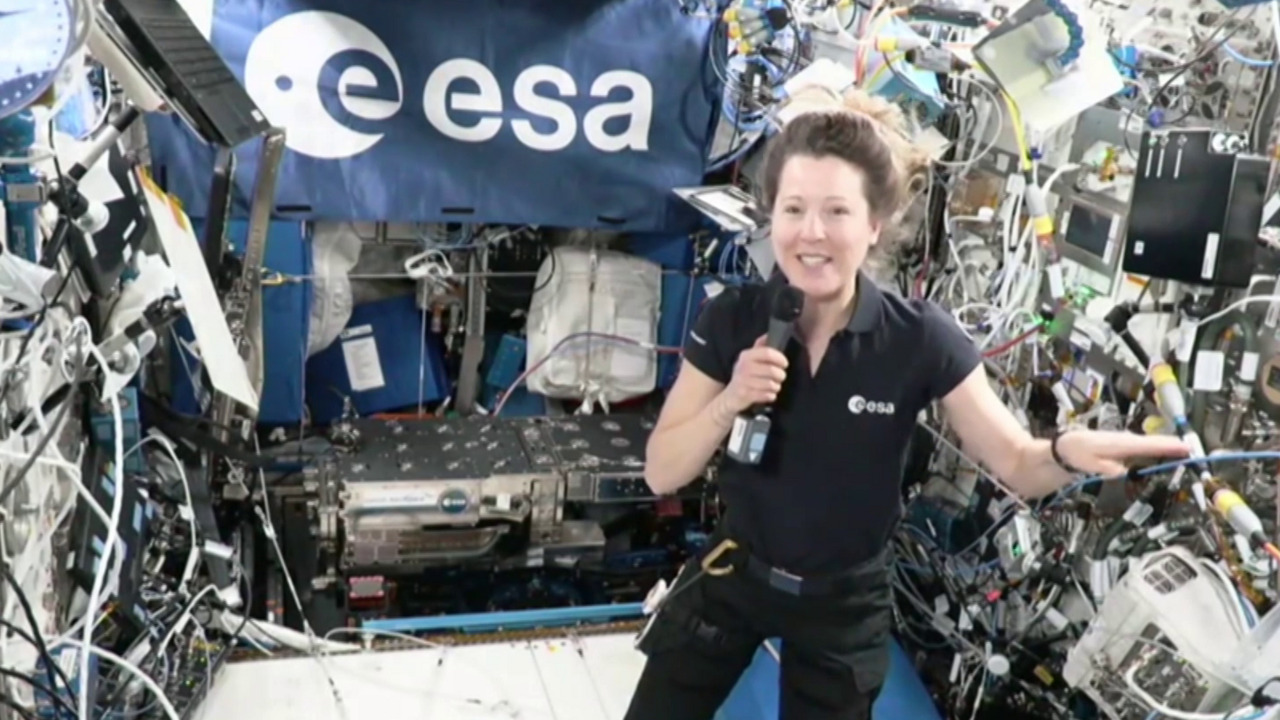
In an exclusive interview with RFI and sister TV channel France 24 from the International Space Station, French astronaut Sophie Adenot described the signs of climate change she can see from orbit and how she overcame major technical problems during her second spacewalk earlier this week. For her second spacewalk, Adenot and her American crew mate Anil Menon installed the new Space to Ground Antenna (SGANT) on Tuesday, in an operation lasting six and a half hours. This antenna allows the International Space Station (ISS) to communicate with mission control in Houston, Texas. Nasa has announced a third spacewalk before 1 September, this time involving Adenot and her Swedish-American crew mate Jessica Meir. Adenot spoke to France 24's Sylvain Rousseau and RFI's Baptiste Coulon, from 400 kilometres above the Earth. Sylvain Rousseau: You carried out two spacewalks in the past week for maintenance operations. We know that this is very physically demanding. How are you feeling? Sophie Adenot: Psychologically and mentally, I feel great. It’s mission accomplished. We managed to repair that antenna despite all the issues we ran into with the electrical connectors, the screws, and so on. Honestly, we faced it all – every mechanical glitch imaginable, we had them. And yet, we succeeded in completing the mission. The new antenna is installed. The teams have already begun the initial tests; we are awaiting the final results soon and hope the testing proves fruitful. But for now, everything seems to be going well. So, psychologically and mentally, it is a major victory. It wasn't easy, but we succeeded as a team – working with the Houston teams guiding us, the internal Station teams here, and Jack and Jessica, who operated the robotic arm and helped us get ready in the morning and out of our gear in the evening. And, of course, there was the partnership with Anil; we were truly in sync and managed to work in a highly coordinated way to accomplish what we needed to do. Physically, I’m a bit sore right now – but then again, I think that’s normal the day after a spacewalk. The spacesuit is a beast to tame – it’s huge and heavy, really heavy. Every movement is exhausting, every movement of the arm or hand. Just holding an object takes an incredible amount of energy. So yes, to be honest, I am a little sore, but it’s no big deal, it’ll pass. French astronaut Sophie Adenot has been using her Instagram account to share her experiences on the ISS. © Instagram / Sophie Adenot / Screen grab by Nina Carel / RFI French astronaut Adenot takes giant leap with historic spacewalk Baptiste Coulon: Tell us about the moment the door opened and you took your first steps into space. What does it feel like? Was this consistent with what you had anticipated? SA: Yes and no. Because, in fact, everyone experiences it in their own way. I had prepared myself precisely by gathering accounts from various people to get a sense of what their experiences were like. As for what happened between the first and second spacewalks – I experienced them a bit differently. The first extravehicular activity was a moment of intense joy – a real "wow" feeling: "This is it, the airlock is opening, here I am." But at the same time, there was a bit of apprehension because, inevitably, it’s a giant leap into the unknown, so to speak. So it was a mix of joy and a touch of apprehension. As for the second spacewalk – since it was a continuation of the first, and we’d run into so many technical issues during that initial outing – there was a certain amount of pressure. We really wanted to succeed in installing that new antenna. Sometimes the mechanical aspects play tricks on you, which creates a certain amount of pressure. To deal with that, I relied on advice from Claudie [Haigneré, France's first female astronaut to go into space]. She sent me an email the day before telling me: "Sophie, have faith – trust the teams, trust everything you’ve learned, trust the procedures, trust the tethers connecting you to the station, and trust the tethers connecting your tools to your suit." So, I really held on to that advice and I sincerely thank her for it. Sylvain Rousseau: Did you feel any sense of frustration as an astronaut about having finished this mission in two spacewalks instead of just one as was originally planned? SA: No frustration at all because really, given all the technical glitches we ran into, it’s a miracle we managed to get through it in just two outings. We had every problem imaginable – electrical connectors, bolts, you name it. The teams were prepared; we had about 30 pages listing every possible non-conformance scenario, and we encountered almost all of them. So, ultimately, I think it was a pretty good achievement to pull this off in two outings and end up with equipment that actually works. So, I’m going to stay positive. Who is Sophie Adenot, the French engineer destined for space? Baptiste Coulon: We are wrapping up a summer marked by extreme heat and massive wildfires. To what extent can you see the consequences of climate change from where you are? SA: You can certainly see this climate change, or at least the hot, dry summers – it’s glaringly obvious. What struck me most was the difference in colours. We had left in February, when France was green – or generally green, anyway. But since the summer, everything has been grey and yellow, like a field of harvested wheat. The difference in the colour of France as a whole was really striking. That’s the first thing. The second thing is that you can see the fires, but what really stands out is the smoke – specifically, the clouds of smoke rising from them. When there’s wind, you can see the long trail of smoke being carried away, that’s quite striking. Regarding climate change, you can also see lakes drying up – the most glaring example being the Aral Sea, which is visibly shrinking very rapidly. Furthermore, in the areas where the water has receded, you can see the land transforming into forest. That is really interesting to observe. I also saw something that really struck me the first time I saw it, I hadn't expected to see that from up there: submerged islands where you could see just a thin layer of water covering the atoll. I realised that right underneath there had been an island, probably just a few years ago. So yes, the consequences of climate change are very visible from space. French astronaut Thomas Pesquet describes devastating climate change from space station Sylvain Rousseau: Has spending time at this vantage point changed your perspective? Do you feel a greater sense of purpose? SA: Absolutely. It really is a transformative experience, and I hope many people get the chance to live something like it. The way you see Earth changes. I haven't actually returned to Earth yet, so I’ll see when I get back – but it’s clear that the experience has been truly transformational. I’d really like to share the perspective of what you see from up here and engage with people. And if this can spark dialogue, ideas, or encourage progress in certain areas regarding caring for the Earth, then I consider that to be part of my mission when I return. Baptiste Coulon: You are expected back on Earth in about a month's time. What conclusions can you draw from your first foray into space? SA: I think things have gone very well so far. We’ve managed to carry out almost all the scientific experiments we planned. We’ve succeeded in ticking every box regarding the mission objectives. There are still a few left to complete before the return to Earth, plus the spacewalks. [Plus there's] the fact that we’ve managed to share the experience with France and other countries who were interested in listening, but the French people in particular. My experience could potentially inspire others to pursue this path.
Climate change is ‘very visible from space’, France's Sophie Adenot tells RFI
Full Article
Original Source
Read the full article at Rfi →KhanList aggregates and links to publicly available news content. We do not host full articles from third-party sources. Always verify important information with original sources.