
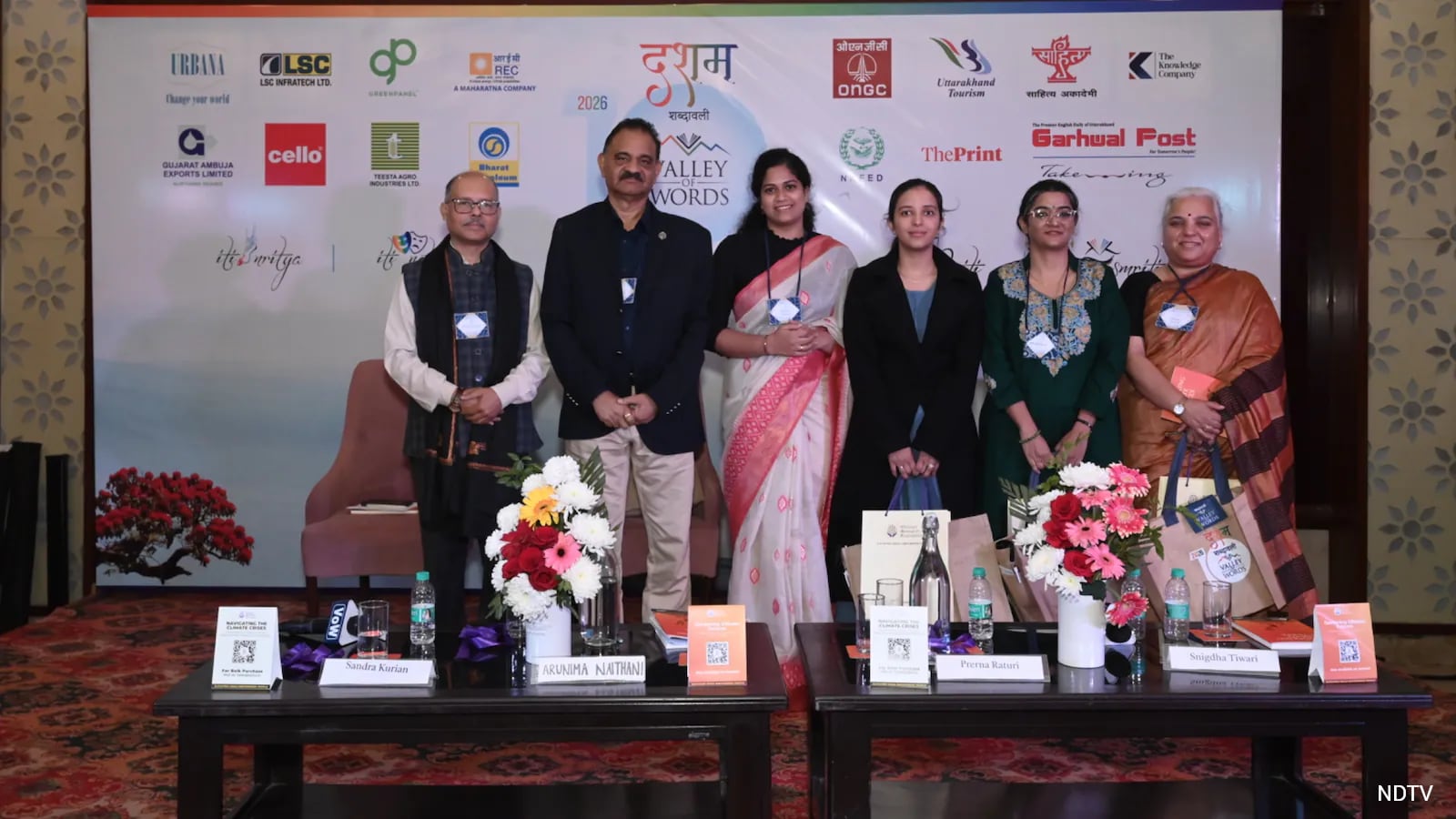
Dehradun: "Climate action is not just about protecting the environment; it is about empowering communities, ensuring inclusive participation and shaping a sustainable future for generations to come." This overarching message resonated across three climate-focused sessions organised by Chintan Research Foundation (CRF) at the 10th edition of the Valley of Words (VoW) Literature and Arts Festival in Dehradun. Bringing together researchers, academics, writers, policymakers and young professionals, the discussions explored the interconnected challenges of climate change, gender justice, energy transition and the vulnerabilities of mountain ecosystems.The three sessions sought to move beyond conventional climate conversations and examine how global commitments and policy frameworks translate into everyday realities. With a particular focus on the Global South and the Himalayan region, the discussions highlighted the importance of community participation, scientific research, institutional accountability and context-specific approaches to climate action.The first session, "Climate Change & Gen Z," featured a screening of the film El Flamingo's Crying Glacier, followed by a panel discussion with Smriti Singh, PhD Scholar at Wadia Institute of Himalayan Geology, Omkar Dhanke, Research Analyst, CRF and Dr Rajendra Dobhal, Director General, Uttarakhand Science and Technology (UCost) and chaired by Prof. B.R. Arora, former Director of the Wadia Institute of Himalayan Geology. The discussion examined the changing dynamics of Himalayan glaciers and the implications of climate change for mountain ecosystems and communities. A key concern was the differing rates of glacial retreat across the Karakoram and Garhwal ranges, with the latter witnessing comparatively faster melting. The panellists emphasised the need to strengthen glaciological research, expand specialised academic programmes in universities and establish dedicated institutional capacities for glacier monitoring. Drawing attention to the importance of perennial and seasonal river systems, Dr Dobhal highlighted the significance of the Ganga basin, which supports the livelihoods of nearly 400 million people, and called for greater investment in scientific monitoring and research infrastructure. The discussion also underscored the need to engage young scientists in continuous glacier monitoring, drawing lessons from international practices. Bringing a generational perspective to the conversation, Omkar Dhanke highlighted how changing climate is impacting the younger generation and the need to increase their adaptive capacity and resilience to reduce vulnerabilities. The panellists emphasised preparing younger generations through greater awareness, responsible production and consumption, and stronger adaptive resilience capacities built by institutions.The second session, "Living with Change: Gender, Livelihood, Climate," examined the intersection of gender, climate change and livelihood security. The session also witnessed the relaunch of CRF's edited volume, Gendering Climate Futures: Power, Finance, and Justice in a Warming World, edited by Kalyani Shukla, Research Consultant and Sandra Kurian, Program & Research Associate at CRF. Moderated by Sandra Kurian, the panel featured Snigdha Tiwari, a lawyer in the High Court of Uttarakhand; Dr Arunima Naithani, an independent researcher; and Prerna Raturi, a writer and researcher. The panel highlighted the disproportionate burden women face, the relationship between gender inequalities and environmental challenges, and also explored the idea of ecofeminism. Particular attention was given to the representation of women in international climate negotiations, including the Conference of the Parties (COP), and to women's contributions to climate movements and grassroots initiatives. The panel stressed that climate policies reinforce existing vulnerabilities and hence require intersectional framing rather than treating women as a monolith. The panel urged Free, Prior, and Informed Consent, genuine intersectionality, and the "5 Fs" (fast, fair, funded, feminist, and finance) to place women at the heart of climate solutions. It also brought attention to the importance of recognising women's leadership and agency in building climate resilience at the community level. The conversation concluded that women's participation must extend beyond representation to meaningful influence over policies, resources and institutions shaping climate responses.Bringing the focus to the region, the third session, "Beyond COP 2026: Towards Climate Action and Mountain Realities," explored the challenges of translating international climate commitments into practical interventions in ecologically fragile mountain regions. CRF's edited volume, Navigating the Climate Crisis: Perspectives and Actions from the Global South for Adaptation and Mitigation, edited by Dr Debajit Palit, Dr Akanksha Jain, and Mr Omkar Dhanke, was relaunched during the session. Moderated by Dr Debajit Palit, Centre Head, Centre for Climate Change and Energy Transition, CRF, the panel featured Jatinder (Jay) Cheema, Designated Senior Counsel and Senior Advocate at the Supreme Court of India, Dr B.S. Negi, Former Adviser and Scientist-G at India's Ministry of New and Renewable Energy (MNRE) and Prof. Dr Tripta Thakur, Vice Chancellor of Veer Madho Singh Bhandari Uttarakhand Technical University (VMSBUTU / UTU) in Dehradun. The discussion examined the limitations of multilateral climate governance, particularly in the context of the recently concluded COP31 in Antalya, and highlighted the challenges of translating international commitments into meaningful action. The panellists also discussed the role of fossil fuels amid rising energy demand, the need to scale up alternative renewable energy options like green hydrogen and the importance of assessing the entire energy value chain when evaluating the sustainability of emerging technologies.The conversation further explored sustainable energy transition pathways for mountain regions, emphasising the potential of decentralised renewable energy, microgrids, battery storage and indigenous manufacturing capabilities. The panellists highlighted the importance of region-specific risk assessments, sustainable construction practices, stronger industry-academia collaboration and increased climate finance, supported by innovative financing instruments. Tripta Thakur emphasised the need to explore alternative sustainability pathways suited to India's development context, alongside everyday behavioural changes and more resource-efficient practices. The discussion reinforced that mountain development must balance energy security and economic aspirations with ecological protection and local livelihoods.Across the three sessions, a common thread was the need to make climate action more inclusive, locally relevant and grounded in scientific evidence. Whether through strengthening glacier research, advancing women's agency in climate governance, or developing sustainable energy pathways for mountain communities, the discussions highlighted that effective climate responses require coordinated action across individuals, communities, institutions and governments.Through its engagement at Valley of Words 2026, Chintan Research Foundation brought research, policy and public discourse closer together, creating a platform for diverse perspectives on the climate crisis. The relaunch of the two edited volumes further reinforced CRF's commitment to bringing perspectives from the Global South into wider conversations on climate adaptation, mitigation, justice and sustainable development.
Climate Action, Gender Justice and Mountain Realities Take Centre Stage At Valley Of Words 2026
Full Article
Original Source
Read the full article at Ndtv →KhanList aggregates and links to publicly available news content. We do not host full articles from third-party sources. Always verify important information with original sources.