
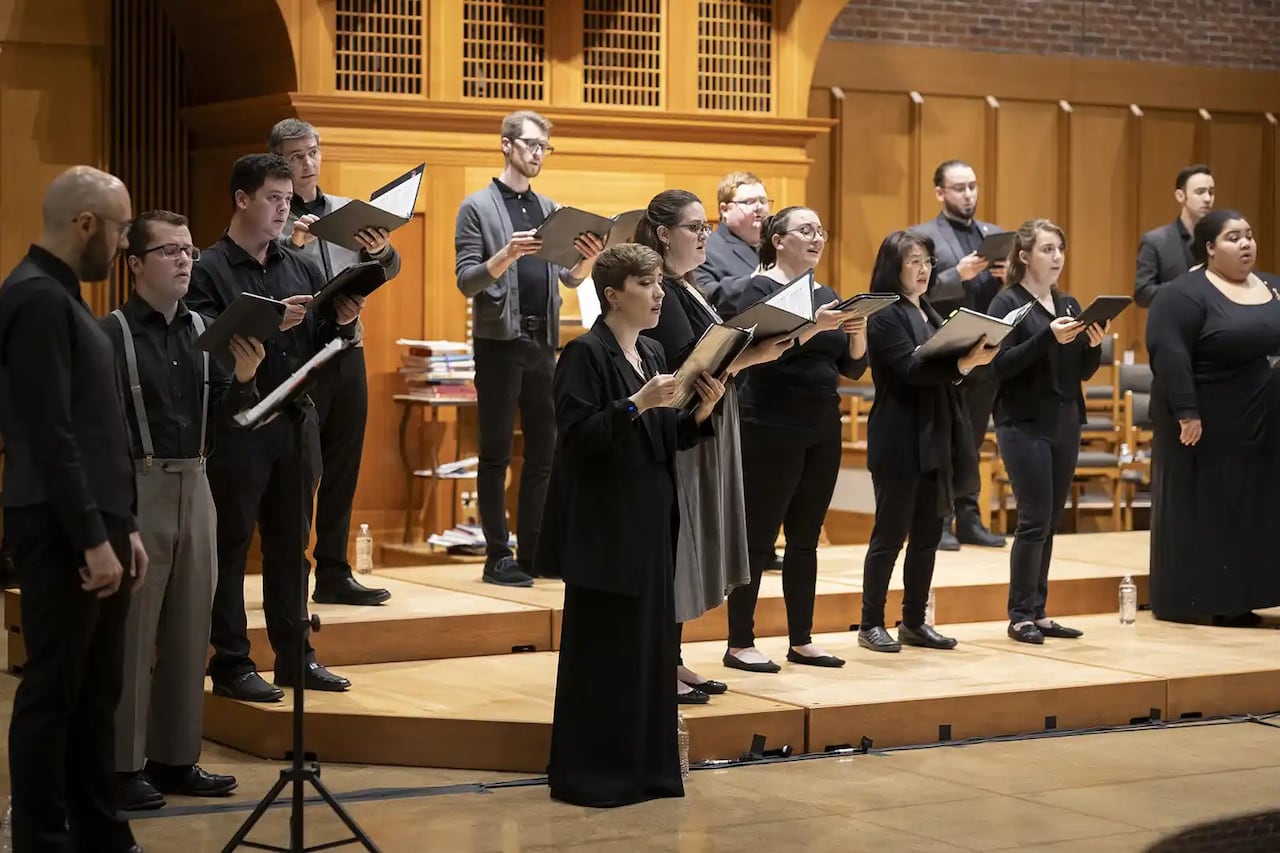
CLEVELAND, Ohio – Never mind that nearly 400 years lie between them. In performance, the two works on the next Cleveland Chamber Choir program may come across as musical soulmates. What they have in common is spirit. Stylistically, Tomás Luis de Victoria’s “Officium Defunctorum” and Eleanor Daley’s “Requiem” are radically different. Both, however, are deeply personal tributes to the dead, crafted with both incredible skill and remarkable artistic freedom.Artistic director Gregory Ristow is “always considering all the angles,” said Charles McGuire, the group’s program annotator and a professor at Oberlin Conservatory. “Lux Aeterna,” he said, is another marvelous example of Ristow “continually forcing me to learn new things... He’s taken things that seem diametrically opposite [and shown that] you’ve got these really interesting expressions of public grief.”“Officium Defunctorum” (“Office of the Dead”) came first, both chronologically and conceptually. Not only was the work, an early example of a musical Requiem, penned in 1605; Ristow has long sought a reason to perform it in full, to do more than represent it with an excerpt or two. He got one this fall, when his choir’s calendar lined up near All Saint’s Day. At last, Ristow had good cause to take up a mass for the dead, a chance to highlight a brilliant work that manages to straddle the Renaissance and Baroque eras. “Digging in, I started falling in love, and that grew until I wanted to do the whole piece at some point,” Ristow said, noting that in the Spanish composer’s magnum opus, “You get all the exquisite polyphony” of the older age as well as “all the outwardly expressive beauty” of later music. Daley’s “Requiem” came later, in both respects. It hails from 1993, and entered the program as what Ristow called the “perfect companion” to the Victoria. Just how perfect become clearer over time. As Ristow and the 16 singers slated to perform on “Lux Aeterna” looked more deeply into the music, they found points of resonance they hadn’t anticipated. One of those is a fundamental link to the sound and style of Medieval chant. In both works, “There’s this natural following of speech-like text,” Ristow explained. “When I hear [them], I feel like I’m right there with someone, hearing them say the words in a natural expression of the text.” That’s not all, though. The long chronological gap between them notwithstanding, the two works approach their subjects, at least in part, from the perspective of the mourners, and share a certain creative independence. Victoria, for instance, departs from the Catholic Requiem liturgy with verses from the Biblical Book of Job. These transform the work from a merely functional “office” in honor of his patron, the Empress Maria of Spain, into something more emotive, a genuine expression of grief.“The more I dive into it, the more personal it feels,” Ristow said. “I can’t help but hear it as a composer speaking those words, as a personal gesture to someone close to him.”Daley does something similar within the Protestant tradition. Fulfilling a commission for one who’d cared for a terminally ill friend, she fills out portions of the Anglican Requiem with poetry by Caroline Smart. This, too, shifts the focus, ensuring the piece serves less as an intercession on behalf of the dead than as a balm to the living. “When we talk about a deeply personal setting, this is very much that,” Ristow said. “This is in so many ways a piece about comfort for those of us who have lost.”Victoria and Daley even have a little something in common musically, at least in this case: a sense of sonic luxury. Daley, employing a rich palette of sixth, seventh, and ninth chords, compiled sound that’s “like being wrapped in comforting warmth,” Ristow said. In the same way, centuries earlier, Victoria used the occasion of the Empress’s death as a reason to create what McGuire called “something beautiful and elaborate,” and then went to the trouble of seeing it published. “He was obviously very proud of it,” McGuire said. “I’m sure he [Victoria] took a great deal of pride in the workmanship.”The same might also be said of the Cleveland Chamber Choir itself, as it takes up two different and differently complex pieces on the same evening. In the Victoria, the group must call on a host of specialized skills to fully understand and accurately interpret a work nearly 400 years old. Between unusual stress patterns in the text, the original’s lack of bar lines, and Renaissance conceptions of pitch, the piece “sort of bends my mind a bit,” Ristow said. The Daley, meanwhile, is fairly straightforward in terms of notes and technique, Ristow said. However, it’s also exceptionally direct, and therefore challenging in terms of expression.Then again, the best thing one can say about either work may be what McGuire said of the Daley Requiem. All its fascinating elements aside, ultimately, “It’s very touching and beautiful,” he said. “It’s just a beautiful piece.”PREVIEWCleveland Chamber ChoirWhat: “Lux Aeterna: Victoria’s Requiem”When: 7:30 p.m. Friday, Nov. 6 and 7 p.m. Saturday, Nov. 7.Where: Trinity Cathedral, Cleveland (Friday) and Christ Episcopal Church, Oberlin (Saturday).Tickets: Pay-what-you-wish, $20 recommended. Visit clevelandchamberchoir.org.
Cleveland Chamber Choir explores grief through music
Full Article
Original Source
Read the full article at Cleveland →KhanList aggregates and links to publicly available news content. We do not host full articles from third-party sources. Always verify important information with original sources.