
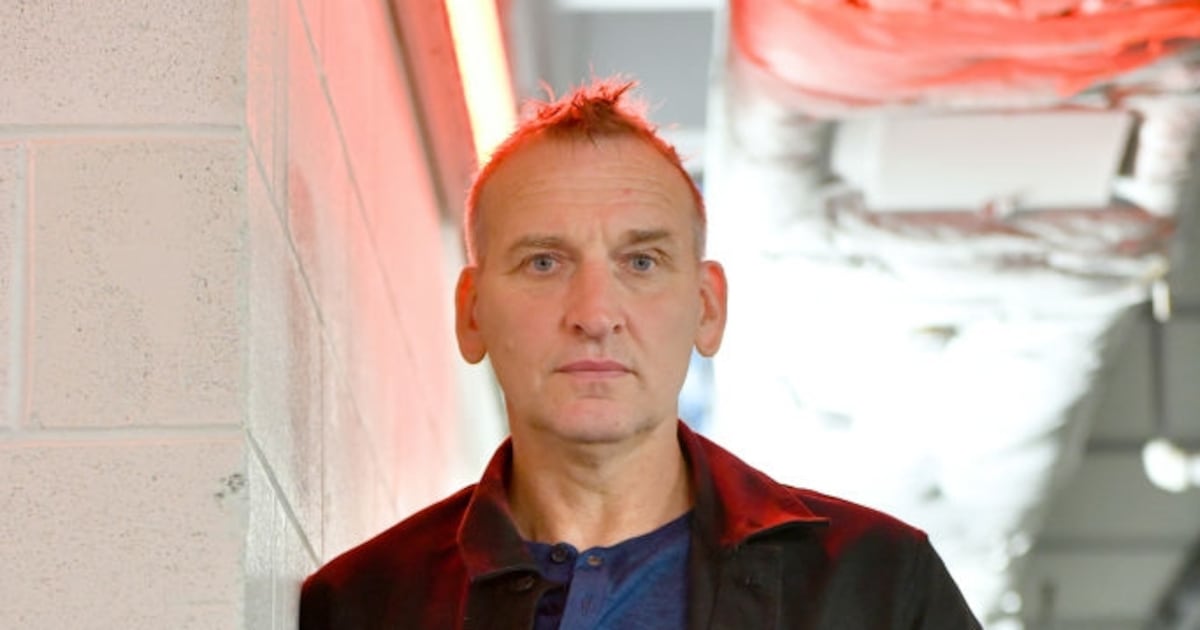
We have something to clear up first. Taking the cheap and easy route, I begin by jokily venturing that, as a son of Manchester, Christopher Eccleston must have a bit of Irish in him. “I have to stop you there,” he says with a dry smile.I immediately twig where he’s coming from.“Salford! I mean Salford!”READ MOREThe good burghers of that city, inspiration for the fictional Coronation Street, are proud of their distinctive identity within Greater Manchester.“There is a worrrrrld of difference,” Eccleston says, cackling. “This is our centenary. It’s 100 years a city. So yeah. We know little about my mum’s side. But my paternal great-grandmother was Katy Connor from Dublin. That much we do know. My mum’s side are a bit more mysterious. We think Mum’s side were canal people.”At any rate, Eccleston has done both Lancashire and the Irish diaspora proud over the past three or four decades. Breaking through with fine early TV work on Jimmy McGovern’s Cracker and the campaigning movie Let Him Have It, he went on to become a defining actor of Britain’s millennial years: part of a stellar rising cast in Our Friends in the North; reviving an icon in Russell T Davies’s disinterment of Dr Who. He admits to slowing down a little in recent years, but gaps in the CV are rare.We meet as he takes on the role of a harried Northern Irish police officer in Stephen Burke’s diverting Irish comedy Chasing Millions. Positioned as a mismatched-buddy flick – Madeleine Madden plays a younger, visiting Australian officer – the film is about the aftermath of the Northern Bank robbery of 2004. More than £26 million was stolen in the largest such heist in British or Irish history. It is surprising the extraordinary story is not better known. “So much more was going on in terms of the peace process, which of course we know it impacted on massively,” Eccleston says. “I was aware of the broad headlines at the time and then forgot about it. It was only when they came to me with the script that I listened to a brilliant podcast on BBC Sounds, which was forensic in its detail for background.”Chasing Millions, written by Burke and Katherine Thomson, finds the humour in some grim circumstances.“That was the tone we tried to go for,” Eccleston says. “I think it’s fair to say it’s true of Salford and Manchester – and it’s true of Belfast – that when these things happen that humour is there. Think of the joy that Manchester United supporters are getting from Manchester City. Humour always foregrounds in those great working-class cities,” he says with a laugh.We speak just hours after Manchester City were found guilty of more than 100 charges related to breaches of the Premier League’s financial regulations. As a lifelong United supporter, Eccleston would not be human if he didn’t take some relish in the decision.He is proud of his working-class roots. Dad was a fork-lift driver. Mum worked as a cleaner at a launderette. I had read that the acting bug didn’t set in until he was at sixth-form college.“I failed all my GCSEs and my O-levels, so I went to a sixth-form college,” he says. “It was a very middle-class environment, and I was the lunatic. A drama teacher spotted me f**king around in the communal area and said: ‘Well, if you’re going to do that, you might as well do this play.’ “I did this play, and they allowed me to put mascara on, which I left on when I went to the pub. We were around postpunk. So that whole thing was happening.”Chasing Millions: Christopher Eccleston and Madeleine Madden in Stephen Burke's film about the Northern Bank heist of 2004 His initial motivations were uncomplicated.“There was a very beautiful woman playing opposite me. I was 17. I fell in love with her. Yeah, wine, women and song. I’m afraid that there was no depth to my ambitions. Avoid the factory. Avoid the nine to five. Of course, when you get old you realise you really wanted a creative life. But then I just wanted to get out of a very specific environment and lifestyle.”Eccleston has spoken of how, 40 years ago, financial assistance was still available for working-class folk seeking a career in the theatre. It is much tougher now for people from his background.“I had no academic qualifications – which, fortunately for me, were not needed at the Central School of Speech and Drama, which was grant-assisted,” he says. “Also, I was given a discretionary grant by Salford council. “Again, I had no academic qualifications, but because I’d got myself a place in one of these drama schools, Salford gave me a discretionary grant. I am the luckiest man on the planet compared to the equivalent of me nowadays. Somebody like me is not getting there.”[ Film Four new films to see this week: Sense and Sensibility, The Lost Children of Tuam, Her Private Hell, Stupid AugustOpens in new window ]This is a peculiar story. In the 1950s and 1960s, British theatre, hitherto the preserve of the middle classes, woke up to working-class and northern voices. The Royal Court Theatre in London staged plays such as John Osborne’s Look Back in Anger and Edward Bond’s Saved. Actors such as Tom Courtenay and Salford’s own Albert Finney became stars. It feels as if the business is heading back to the days before that social revolution.“It’s not shifting back. It’s there,” Eccleston says. “They’ve just done a play at the Royal Court in London, and they had a f**king red carpet outside. A red carpet outside the Royal Court Theatre? What the f**king hell’s that about?”This appears to be a reference to the opening of Manfred Karge’s Man to Man at the famously radical theatre on Sloane Square last month. “Unusually, there was a first night red carpet outside the Royal Court,” Mark Lawson wrote in The Guardian, “leading a writer long associated with the venue to express ‘shock’ to ushers at such Hollywood vulgarity.”[ Daisy Edgar-Jones: ‘It was great practice for Sense and Sensibility, all that time in Fermanagh fields with cows’Opens in new window ]Speaking of red carpets, that is not where Eccleston ever expected to find himself. He remembers the Irish actor John Lynch, who was at Central with him, heading off to make Pat O’Connor’s Cal before graduation.“One Sunday morning we were playing football – Central versus Rada. We all turned up, getting changed by the goalpost, and out of the mist, he came. Here’s Johnny Lynch with his boots. He was back, and he’d made a feature film. It was mind-blowing.”Who knew the Royal Academy of Dramatic Art had a soccer team?“At drama school from 1983 to 1986, you never saw a camera,” he says. “Everything we did was theatre based. I can’t believe how naive I was, because it never occurred to me that I might be on television. I had no ambition to be on screen. The great passion was to be on stage – to play the lead, big classical roles and the contemporary roles.”Let Him Have It: Christopher Eccleston as Derek Bentley. Photograph: Richard Blanshard/Getty Eccleston sees himself as a theatre actor who became a screen actor by accident. After drama school he didn’t work for three years. He moved back to Salford. He eventually wangled an Equity card and landed the role of Derek Bentley, a young man controversially hanged for murder in 1953, in Peter Medak’s acclaimed Let Him Have It.“So I went from being the least successful in my year to the most successful,” Eccleston says. “Complete lottery. Sir Alex Ferguson said it about himself. He said: ‘Apart from everything else, I’ve always been lucky.’”Talent and charisma also mattered. Eccleston was suddenly everywhere. He appeared in Danny Boyle’s debut feature, Shallow Grave, in 1994. He was DCI David Bilborough in the first two series of Cracker. And then there was Our Friends in the North. Screened on the BBC in 1996 in nine feature-length episodes, Peter Flannery’s series followed four Geordies from the early 1960s to what was then the present day: from Harold Wilson’s first general election victory to the birth of New Labour.The casting could hardly have been cannier: Eccleston, Daniel Craig, Mark Strong and Gina McKee. A James Bond. A Doctor Who. And two more of the most versatile actors of their generation.“I remember feeling in awe of all three of them in terms of their ability,” he says. “Daniel, as well as being a brilliant actor, had a kind of sexual, physical, leading-man rock-star charisma. Whenever he was on set, you thought, wow, that’s charisma. “Mark’s a brilliant actor. And Gina, of course, was the best of the bunch in terms of the performance. Very good. Talk about performance on television for camera.”Christopher Eccleston as Doctor Who. Photograph: BBC A degree of controversy still surrounds Eccleston’s time as Doctor Who. The 2005 rejuvenation – the first formal series since 1989 – was a critical and ratings success. Eccleston’s hard-edged northern Doctor went down well. Billy Piper excelled as a smart assistant. But the lead left after just one season.“My relationship with my three immediate superiors – the showrunner, the producer and co-producer – broke down irreparably during the first block of filming and it never recovered,” he told Radio Times in 2018. “They lost trust in me, and I lost faith and trust and belief in them.”Is there anything he wants to say about it now?“No. Just that I’m very proud of the 13 episodes that I was part of, because they were made, from a professional point of view, under the most difficult circumstances,” he says, politely. “The establishing of a series like that – the first series – when you’re shooting it, that’s a tough one to do. I’m very proud of what I did. And I adored the character.”Christopher Eccleston in True Detective: Night Country. Photograph: HBO Eccleston survived. He had good roles in the US series Heroes, True Detective and the cult favourite The Leftovers, among others. He brushed against the MCU in Thor: The Dark World. He was an acclaimed Scrooge on stage at the Old Vic in London. Yet I have read him saying that, if he had another go round, he might not become an actor again. He would prefer to get his hands on the levers of power.“You’re not going to level up the playing field as an actor,” he says. “If I’d have gone to try and run the National Theatre then I might have levelled the playing field. Then I can effect change. Then I can affect taste. But all those jobs, we know, go to the Oxbridge, public-school lot. They’re only going to lean towards the culture they know. They’re going to lean to the people they know. It’s just got more and more unfair.”Eccleston admits he is not as busy as he once was. Time to stretch out.“It’s been quiet for me for a good few years,” he says. “Changes in the industry. Changes in my age. It’s been a tough time, but the biggest part of being an actor is being unemployed. I’m very good at being unemployed.”He laughs a fatalistic laugh.“I need a little bit of luck to get going again.”Chasing Millions is in cinemas from Friday, October 9th
Christopher Eccleston on Chasing Millions: A tale from Ireland’s biggest bank heist
Full Article
Original Source
Read the full article at Irishtimes →KhanList aggregates and links to publicly available news content. We do not host full articles from third-party sources. Always verify important information with original sources.