
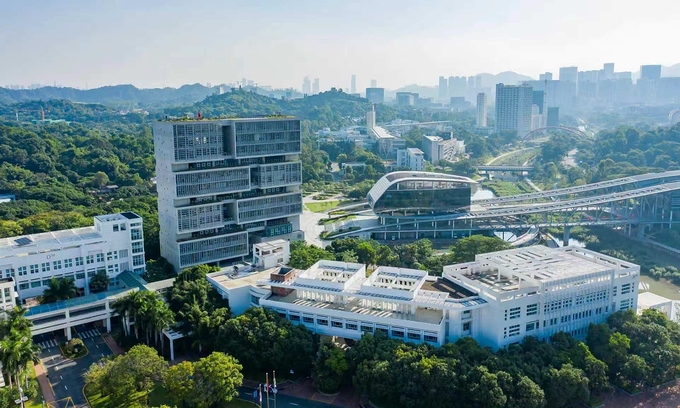
Chinese universities claimed six of the world's top 10 positions in chemistry, with Tsinghua University taking the No. 1 spot in the 2026 ShanghaiRanking Global Ranking of Academic Subjects. Tsinghua topped the list with a score of 384.9 points. Stanford University followed in second place with 370.2 points, and the University of California, Berkeley, placed third with 353.6 points.The Massachusetts Institute of Technology ranked fourth, while China's University of Science and Technology of China secured fifth. Zhejiang University placed sixth, followed by the California Institute of Technology in seventh. An aerial view of Tsinghua University campus in Beijing, China, Oct. 26, 2026. Photo from the university's Facebook page China's Nankai University and Peking University tied for eighth place, and Shanghai Jiao Tong University rounded out the top 10.Other Chinese institutions featured prominently within the top 20. Jilin University ranked 13th, followed by Nanjing University (15th), Tianjin University (16th), Xiamen University (17th), Sichuan University (18th), and Fudan University (20th).In the broader Asian region, the National University of Singapore emerged as the highest-ranked institution in Southeast Asia at 14th. Japan's University of Tokyo placed 23rd, followed by Kyoto University in 26th.The ShanghaiRanking evaluates universities across 57 disciplines spanning natural sciences, engineering, life sciences, medical sciences, and social sciences. For the chemistry subject ranking, 500 universities worldwide were evaluated.The methodology relies on nine academic indicators grouped into five categories: world-class faculty, world-class research output, high-quality research, research impact, and international collaboration.These metrics specifically assess internationally recognized academic awards, highly cited researchers, publications in leading journals, citation impact, and cross-border research partnerships.Top 20 best universities for chemistry in 2026: World rank Institution Country Total score World-class faculty World-class output High- quality research 3 Research impact International collaboration 1 Tsinghua University China 384.9 142.9 89.1 95.6 47.9 9.4 2 Stanford University United States 370.2 122.5 141.0 46.8 44.4 15.4 3 University of California, Berkeley United States 353.6 105.6 147.6 43.2 42.9 14.2 4 Massachusetts Institute of Technology United States 339.8 90.2 141.2 49.1 44.7 14.6 5 University of Science and Technology of China China 337.8 82.6 100.0 100.0 46.4 8.8 6 Zhejiang University China 323.9 93.8 78.7 98.8 43.2 9.4 7 California Institute of Technology United States 310.5 81.5 142.5 29.0 44.0 13.5 8 Nankai University China 310.1 74.9 93.1 87.9 46.0 8.4 8 Peking University China 310.1 96.2 81.1 79.0 44.3 9.6 10 Shanghai Jiao Tong University China 304.6 75.2 83.2 92.9 43.6 9.6 11 Harvard University United States 284.7 74.7 106.9 45.5 41.6 16.0 12 Northwestern University United States 281.8 64.3 115.0 44.7 43.5 14.2 13 Jilin University China 277.0 78.8 66.0 82.5 41.9 7.8 14 National University of Singapore Singapore 273.5 74.7 65.9 67.0 47.8 18.2 15 Nanjing University China 268.3 58.4 78.8 79.1 44.0 8.1 16 Tianjin University China 266.8 60.0 70.9 83.2 43.5 9.2 17 Xiamen University China 264.8 69.7 70.4 70.3 44.6 9.8 18 Sichuan University China 263.1 60.6 62.6 89.1 42.9 8.0 19 Princeton University United States 261.0 99.6 76.6 28.3 43.8 12.8 20 Fudan University China 259.6 51.1 75.2 80.3 44.2 8.8 To qualify for the 2026 chemistry ranking, an institution must have published at least 300 research papers in the field between 2021 and 2025. Bibliometric and publication data is sourced directly from Web of Science and InCites.The subject rankings are designed exclusively to measure research performance in individual disciplines, rather than assessing a university's overall institutional standing or the quality of its undergraduate teaching.
Chinese universities sweep top 10 in global chemistry rankings
Full Article
Original Source
Read the full article at E →KhanList aggregates and links to publicly available news content. We do not host full articles from third-party sources. Always verify important information with original sources.