
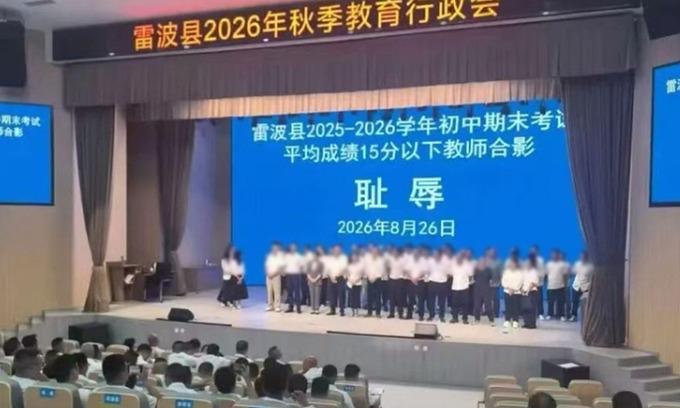
More than 20 teachers in one of China's poorest counties were made to pose on stage beneath a screen reading "Shame," prompting an apology from the local government. Photographs from Leibo County's 2026 autumn education administration meeting on Aug. 26, verified by the Shanghai outlet The Paper with the education and sports bureau of Liangshan Yi Autonomous Prefecture, show roughly 20 teachers in white shirts and black trousers standing on a stage before a full hall.The screen behind them read "Group photo of Leibo County teachers with junior secondary final exam averages below 15 for the 2025-2026 school year," with the characters 耻辱, meaning shame or disgrace, enlarged at the center. A second image carried the primary school version of the caption, set at 30.The prefecture bureau told The Paper it had not determined whether the figures referred to the teachers' own appraisal scores or to their students' results, and that the county Party committee and government were investigating.A bureau official told Xiaoxiang Morning Herald that the prefecture had never used disciplinary measures of this kind and does not allow them.The Leibo County People's Government published an apology on its official website on the evening of Aug. 28, saying the meeting had involved wrongful conduct that disrespected teachers, caused serious psychological harm to those present and produced a damaging public effect.It said a special working group had been formed to investigate and that it would act on the findings. A joint investigation team organized by the prefecture government arrived in the county that afternoon, the county propaganda department told The Paper. No conclusions have been released. Junior secondary school teachers in Leibo, Sichuan, were called on stage for a photograph under a "Shame" sign. Photo courtesy of Weibo The photographs drew more than 100 million views on a single social media platform, according to the South China Morning Post, which cited Zhengzai News in reporting that they were taken during an awards-and-punishment segment of the meeting.Commenters questioned whether the education bureau had any respect for teachers, and some called for the officials responsible to step down.Huashang Bao's Dafeng News found the reaction split, with many arguing students' results cannot be attributed to teachers alone and others saying averages that far below a passing mark indicated teachers were not doing enough.Five months before the meeting, China's Ministry of Education issued a basic education directive published by Xinhua, which prohibits ranking schools by promotion rates or exam scores and bars ranking, rewarding or punishing teachers on the same basis.The CPC Central Committee and State Council had set that direction on Oct. 13, 2020, in the Overall Plan for Deepening Educational Evaluation Reform in the New Era, which sought to reverse the treatment of grades and entrance exams as the sole criterion for evaluating students, teachers and schools.Leibo sits on Sichuan's southwestern edge in mountainous terrain, is designated a national key county for rural revitalization assistance and has a population of about 300,000.Official figures show 79 schools excluding kindergartens as of 2024, serving 54,651 students and staffed by 3,217 full-time teachers.The Yi are the largest ethnic group in the surrounding prefecture, and many of Leibo's students are left-behind children whose parents work in larger cities, the South China Morning Post reported, quoting an anonymous junior secondary school teacher in Shanghai who said high scores are difficult to reach in a district that disadvantaged.Sichuan's provincial government approved Leibo's exit from the list of poverty-stricken counties only in February 2020, and Liangshan was among the largest contiguous areas of extreme poverty in China, Guancha noted in an Aug. 28 commentary.
Chinese teachers made to pose under 'Shame' sign over low exam scores
Full Article
Original Source
Read the full article at E →KhanList aggregates and links to publicly available news content. We do not host full articles from third-party sources. Always verify important information with original sources.