
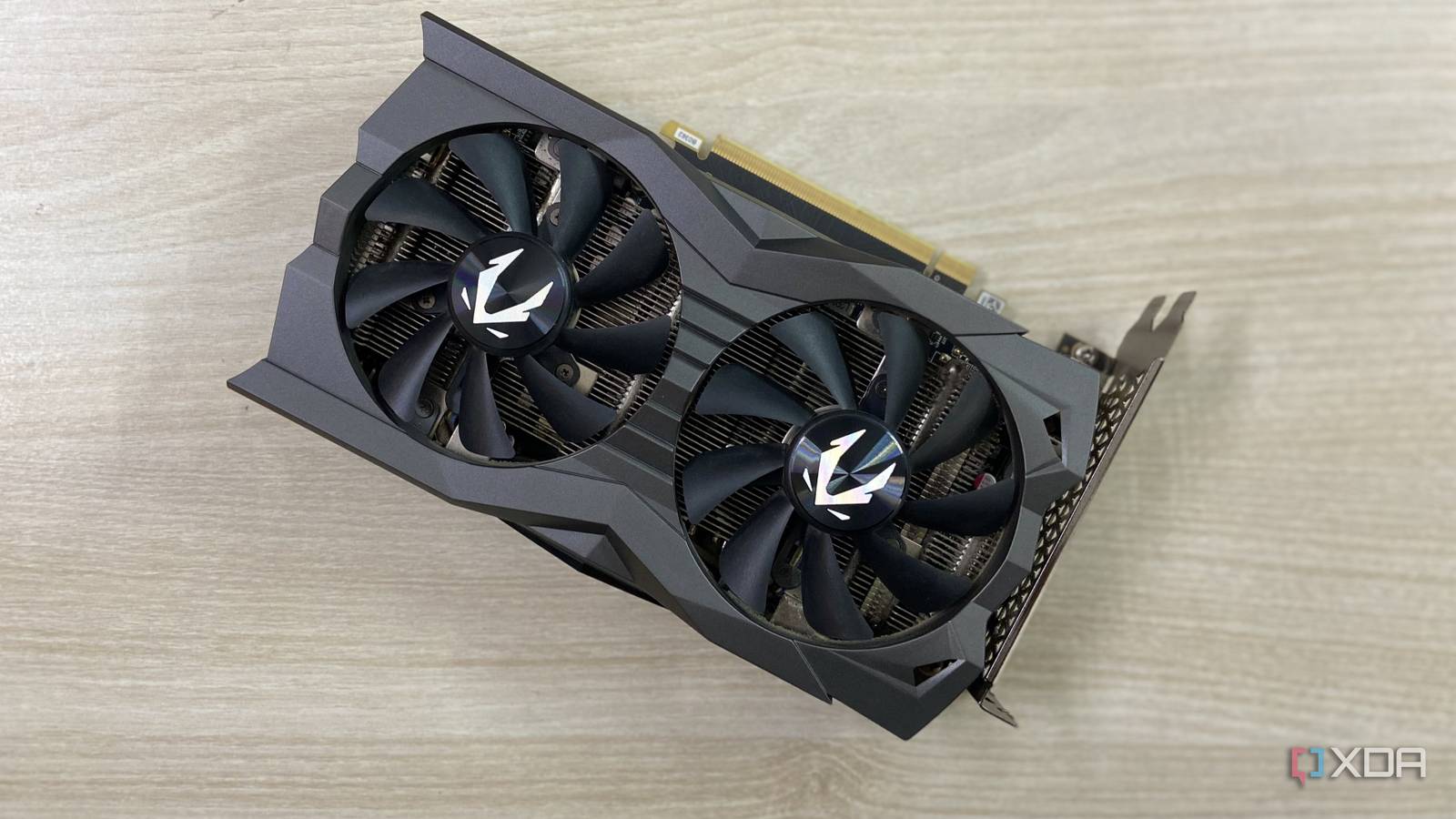
Published Oct 16, 2026, 7:01 AM EDT Abhinav pivoted from a career in banking to pursue his first love in writing. Even while working full-time, he continued contributing as an editor-at-large, a role he has held for more than 7 years. A lifelong tech enthusiast who has built three gaming and productivity powerhouse PCs since 2018, his passion for technology keeps him closely following the semiconductor industry, from NVIDIA and AMD to ARM. His MSc dissertation explored how artificial intelligence will reshape the future of work, reflecting his curiosity about the wider social impact of emerging technologies. If you've been watching the PC hardware market, you'll know that GPU prices are skyrocketing again. As such, a cheap listing for a big-name Nvidia or AMD card itself is enough to warrant a second look when you're a potential buyer. According to the latest reports from Tom's Hardware, the only card that's even selling close to its MSRP is AMD's RX 9070 GRE, which should tell you enough about how desperate the marketplaces have become. When the market is in desperate times, desperate measures are soon to follow. And sure enough, an unlikely workaround which has been running on Chinese marketplaces for years seems to have resurfaced. Laptop GPUs can be seen soldered on desktop boards, being sold as a cut-price alternative to the real desktop card. These cards exist, function, run games, and you should always avoid them no matter how great the price looks like. Nvidia never made a desktop card with a laptop chip So the workshops in China did, and now they're selling at unreal prices Credit: AliExpress If you've looked into the supply chain of GPUs, you'll likely already know that Nvidia sells its laptop GPUs as bare chips to OEMs, and it has never built a desktop card around one. However, small Chinese workshops have taken it upon themselves to take care of the problem, and they've been doing so for years. According to a Chinese creator named Jie Mou who tested an RTX 4080 in July 2026, the chips powering these cards are salvaged laptop silicon soldered onto a custom PCB with a desktop cooler and display outputs and shipped with a modified driver installer, because Nvidia's standard driver cannot be installed on them. This practice predates the current GPU crunch by years. This act of salvaging has been standard practice across numerous Chinese marketplaces for years. In 2024, Tom's Hardware reported that vendors tend to purchase defective laptop motherboards through various internet auctions, along with boards carrying qualification samples. The same report found cracked GPU dies on cards being sold as finished products. If the price is right, is there a reason not to buy? The million-dollar question, especially given the market conditions In the matter of silicon, often when a deal appears too good to be true, it almost always isn't. Such "Frankensteined" GPUs have made their way across many online marketplaces such as AliExpress, eBay, and Temu, to name a few. If you frequent any of these marketplaces often and are in the market for graphics, chances are, you've probably encountered a few of these GPUs already. It's not lost on me that GPU prices have gone through the roof thanks to the global memory crisis, and as such, many buyers would be looking to find a reasonable deal. The point is that these GPUs aren't a reasonable purchase, and there are a couple of reasons as to why they aren't. First and possibly foremost, is that they are underpowered by design, but if you know how to differentiate between a mobile GPU versus its desktop equivalent, you probably already know that. A laptop GPU is engineered for a laptop's power and thermal budget. The 4080M tested by Mou topped at 100W, which was well under the mobile chip's own 175W TGP ceiling. The reviewer noted that the desktop RX 9070 GRE also outperformed the 4080M at higher resolutions in 7 out of 8 AAA titles tested. Since Nvidia and AMD don't sell these cards, neither of them will service one. Your only cover is whatever online shop you purchased these from, and that shop is almost always a small operation on a Chinese marketplace. If the card arrives dead, you'll be stuck in a dispute process with little hope of seeing a replacement or your money back. Perhaps equally important is the state of the drivers. Nvidia and AMD's standard software stack will likely be unsupported on these cards, and as a buyer, you will be stuck with the seller's own driver package or community projects. There would be no Nvidia app for a GeForce RTX card, and no AMD Adrenalin for Radeon graphics. Avoid them if possible, but if you must buy... Shop like you're buying a used car in a bad neighborhood The best advice is to always walk away from a product like this, but if you absolutely must, and the price is enough to be worth the risk, there are a couple of things you should always keep in mind, and details that you should verify before pulling out your credit card. First thing to do, as always, would be to go through the specs behind the name. A card that's labeled RTX 4080 and features only 12GB of GDDR6X should alarm you, because Nvidia has never released a 4080 with those specifications. It's always worth the extra fifteen minutes to compare against SKUs released by official board partners. Some sellers are more transparent and append an "M" at the end of the SKU, but when you see a deal that's too good, it's worth verifying. It's also worth checking the connectors, because if a card is branded 4080 or 4090 and uses an 8-pin power connector, it isn't drawing the power that the desktop card needs. It's also a good idea to ask for a GPU-Z screenshot from the seller before you buy, although these have become increasingly less reliable as they can be spoofed. After the purchase, always run your own benchmarks before the return window closes. Some of the benchmarks I prefer are 3DMark Time Spy, or if you prefer a free utility, you can't go wrong with FurMark. You can run either to compare against public results to find any anomalous results that warrant your attention. The savings aren't worth the headache There's a lot of things that could work against you if you were to commit to purchasing an unsupported GPU on online marketplaces. The chip on the PCB may be real, but nonetheless, it is on the wrong board, possibly drawing the wrong power, with the wrong drivers, and nobody behind it when something inevitably breaks. Perhaps that's the reason why it's always going to be a gamble purchasing a card like that, because there's no reliable way to estimate how long it's going to serve your workflow. As such, it's always a better idea to have a look at secondary marketplaces for a good deal.
Chinese sellers are putting laptop GPUs on desktop cards, and you absolutely shouldn't buy one
Full Article
Original Source
Read the full article at Xda-developers →KhanList aggregates and links to publicly available news content. We do not host full articles from third-party sources. Always verify important information with original sources.