
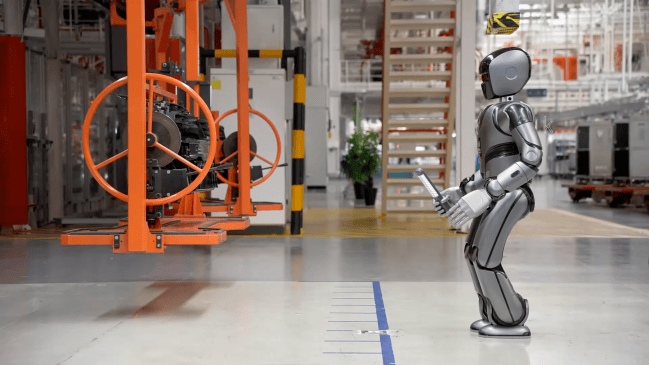
Chinese robotics firm UBTECH and FAW-Volkswagen have agreed to develop and test humanoid robots for logistics applications at vehicle manufacturing facilities. The partnership will focus on developing demonstration scenarios and testing robotic solutions for factory logistics and smart manufacturing. UBTECH has previously worked with FAW-Volkswagen on vehicle quality-inspection trials using its Walker S Lite humanoid robot at the automaker’s Qingdao factory.The companies said the expanded cooperation aims to support more flexible manufacturing as automakers respond to growing demand for personalized vehicles. Targets factory logistics UBTECH and FAW-Volkswagen have expanded their collaboration on humanoid robots, moving from vehicle inspection trials toward logistics and broader smart-manufacturing applications. Under a strategic cooperation agreement announced October 8, the companies will jointly develop and test embodied AI robot applications for factory logistics and build demonstration sites to evaluate their use in real production environments. The partnership builds on FAW-Volkswagen’s earlier deployment of UBTECH’s Walker S Lite humanoid robot at its Qingdao factory. The robot has been used for vehicle quality-inspection training and connected to the plant’s automation control system. The latest agreement extends the collaboration beyond inspection, making logistics a formal area of development. The two companies began working together in July 2024, when FAW-Volkswagen opened production-line scenarios at its Qingdao facility for UBTECH’s industrial Walker S humanoid. The robot was tested on tasks including bolt tightening, component installation, and parts handling. The companies also identified industrial logistics and supply-chain applications as potential areas for future cooperation. The new logistics focus targets one of the more repetitive parts of vehicle manufacturing: moving components and materials around production facilities. Unlike fixed industrial automation systems designed for specific operations, humanoid robots can potentially perform multiple tasks using the same physical platform. This could make them useful in factories where production configurations need to change more frequently to accommodate increasingly personalized vehicles. Scales robot deployment UBTECH is building its industrial humanoid technology around four main systems: an embodied brain, a humanoid cerebellum for motion control, high-performance robotic hardware, and swarm intelligence for coordinating multiple robots. The company says its embodied-intelligence system uses a self-developed stack that combines a foundation model, a world model, and an action model. The architecture is designed to let robots interpret their surroundings, predict how environments may change, and choose appropriate actions. Combined with humanoid hardware, the approach is designed to give robots greater flexibility than conventional automation equipment that typically performs predefined movements. UBTECH is also expanding its manufacturing infrastructure. Its industrial humanoid super smart factory in Liuzhou, Guangxi, began operating on September 12. The 14,000-square-meter facility produces the company’s Walker S and Cruzr series and is designed to manufacture robots using robotic systems. According to the Guangxi regional government, the factory can produce one robot every 10 minutes. For FAW-Volkswagen, the expanded partnership provides a real automotive manufacturing environment in which to test those capabilities. The automaker operates production facilities in Changchun, Chengdu, Foshan, Qingdao, and Tianjin, producing vehicles under the Volkswagen, Audi, and Jetta brands. However, the agreement does not yet specify the humanoid model that will be used for the new logistics applications, the exact logistics tasks to be tested, the number of robots involved, or a timetable for routine deployment. The immediate focus is on joint development, testing, and demonstration. If the trials succeed, the partnership could provide a pathway for humanoid robots to move from isolated inspection tasks into broader factory operations, where they could handle materials, components, and other logistics work alongside existing automated production systems.Get the latest in engineering, tech, space & science - delivered daily to your inbox.Jijo is an automotive and business journalist based in India. Armed with a BA in History (Honors) from St. Stephen's College, Delhi University, and a PG diploma in Journalism from the Indian Institute of Mass Communication, Delhi, he has worked for news agencies, national newspapers, and automotive magazines. In his spare time, he likes to go off-roading, engage in political discourse, travel, and teach languages.
Chinese humanoid robots set to take on logistics jobs at Volkswagen factories
Full Article
Original Source
Read the full article at Interestingengineering →KhanList aggregates and links to publicly available news content. We do not host full articles from third-party sources. Always verify important information with original sources.