
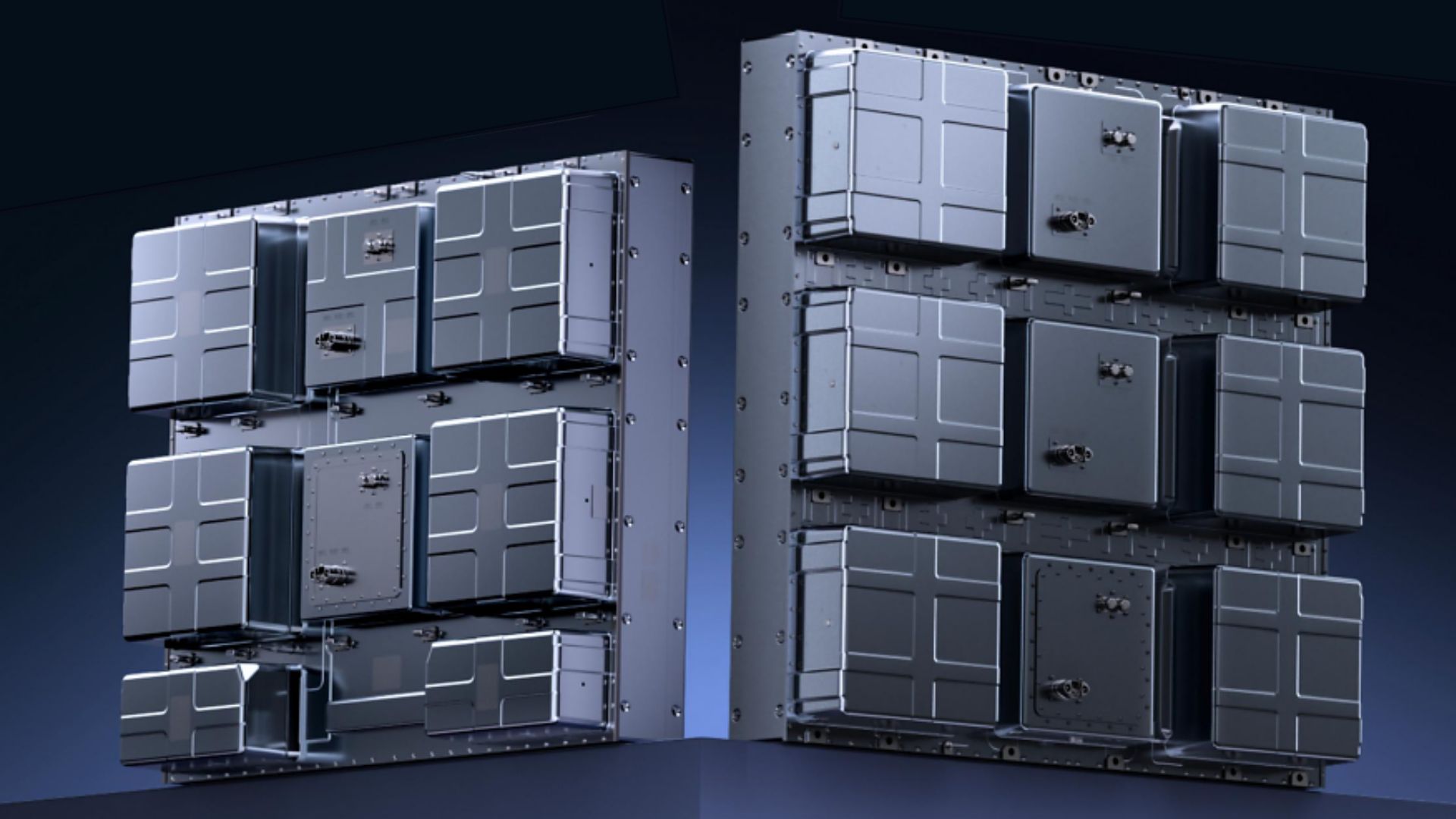
The world’s largest battery maker, CATL, has combined swappable battery packs with an onboard range-extender system to solve range anxiety in heavy-duty electric trucks. Drivers on long-haul routes often pull into stations while their packs still hold substantial power. The new dual-battery design runs two independent energy systems inside a single vehicle. This allows haulers to use virtually all stored power without the risk of stopping short of a charger. “The combination of the dual-electric range extension battery and QIJI battery swapping offers the best solution for electrifying heavy-duty trucks,” said Jesse Yang, CEO of QIJI Energy. The core technology uses a setup called a “1+X” architecture. Instead of relying on a conventional fuel-burning combustion generator for range extension, the powertrain splits work between two entirely electric battery packs. The main battery rests in the truck chassis and is built to be swapped out quickly at robotic stations. Behind the driver cabin sits a secondary 77 kWh battery capable of 3C fast-charging, which acts as a permanent onboard reserve. Steady flow of torque Having two separate power systems fundamentally changes how the vehicle manages electricity. In conventional operations, drivers rarely use the bottom 30 percent of their battery capacity. With a secondary pack always on board to act as an energy cushion, the main battery can safely be drained much deeper. Drivers can run the primary chassis pack down until less than 5 percent of its charge remains. This lifts the total depth of discharge from roughly 70 percent to more than 95 percent, squeezing far more work out of every charge cycle. When the main chassis battery finally runs dry, onboard switching electronics reroute power to the cabin-mounted backup within milliseconds. Because this transfer occurs almost instantly, the electric drive motors maintain a steady flow of torque without any drop in vehicle momentum. Engineers can also modify each battery system independently because the two circuits operate separately. The swappable chassis unit stays standard to match charging docks, but the backup pack can be tailored to specific driving conditions. To handle diverse logistics duties For instance, operators working in sub-zero regions can install cells with cold-resistant chemistry. Other trucks can carry alternative backup variants focused on ultra-high energy density or extra power delivery for difficult routes. Physical swapping equipment has also been expanded to handle diverse logistics duties. Alongside the existing 75# unit, the system introduces two higher-capacity standardized blocks: a 432 kWh pack known as the 260# and a 513 kWh pack known as the 300#. Automated bays complete the physical swapping process in five minutes, maintaining a mechanical success rate of 99.99 percent on the first attempt. The dual-pack setup extends into asset accounting as well. The backup unit remains with the truck as a permanent vehicle asset. “Aside from the dual-electric solution, CATL also introduced a new lineup of heavy-duty truck batteries tailored to different vehicle configurations and operating requirements at the event,” concluded the Chinese giant in a press release. “The lineup includes rear-mounted ultra-light and ultra-thin batteries for weight- and space-sensitive applications, as well as chassis-mounted solutions for short-haul and long-haul operations.”Get the latest in engineering, tech, space & science - delivered daily to your inbox.An active and versatile journalist and news editor. He has covered regular and breaking news for several leading publications and news media, including The Hindu, Economic Times, Tomorrow Makers, and many more. Aman holds expertise in politics, travel, and tech news, especially in AI, advanced algorithms, and blockchain, with a strong curiosity about all things that fall under science and tech.
Chinese giant unlocks 95% EV battery utilization with swappable heavy-duty truck setup
Full Article
Original Source
Read the full article at Interestingengineering →KhanList aggregates and links to publicly available news content. We do not host full articles from third-party sources. Always verify important information with original sources.