
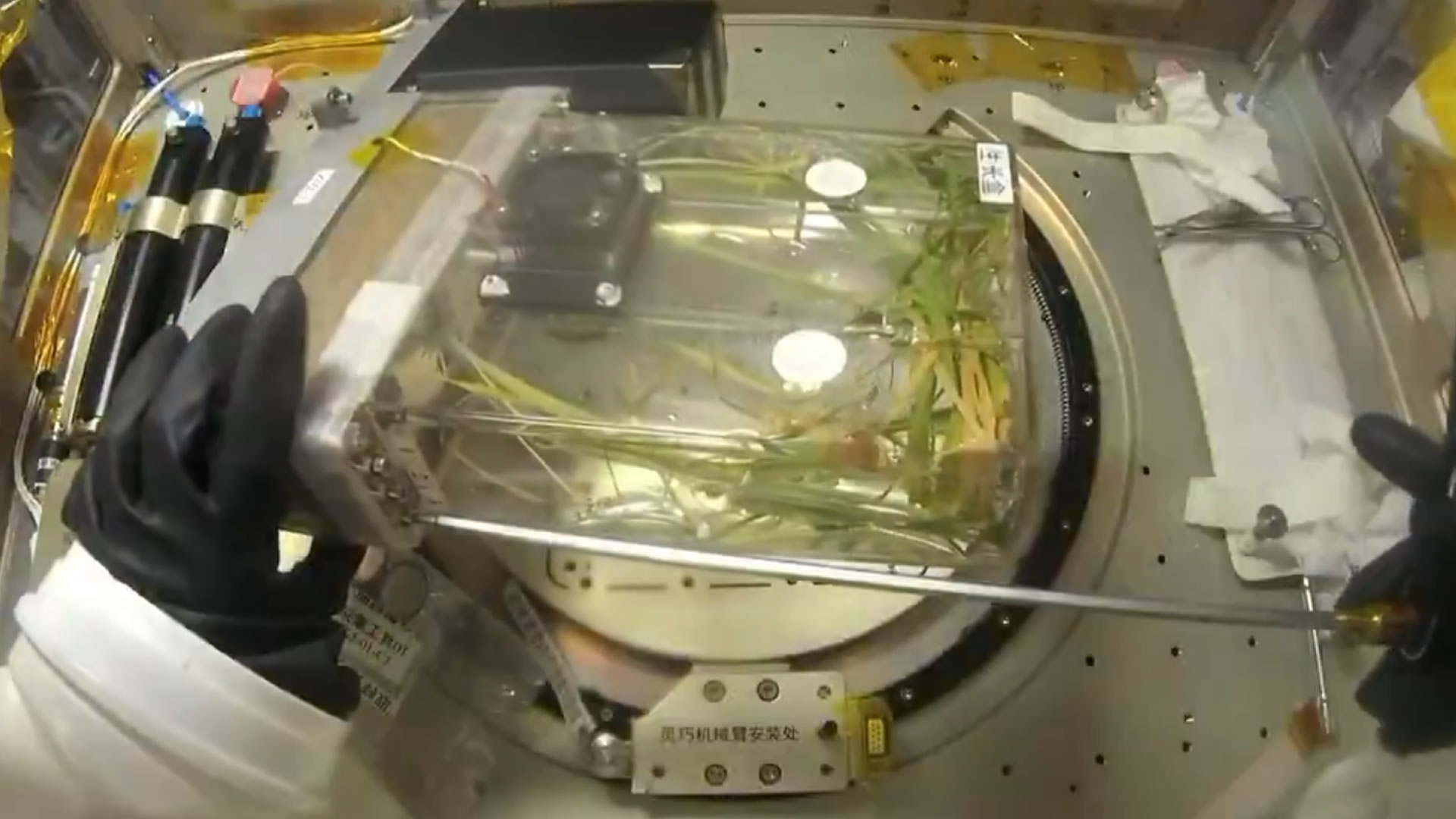
Chinese astronauts aboard the Tiangong space station have completed what they called the “Autumn harvest” of their in-space rice cultivation experiment. According to reports, the astronauts successfully collected, sowed, and stored a new batch of rice on the space station. Reported on October 18, this marks a major milestone in the project’s hopes to reproduce rice over successive generations entirely in space. The first generation of rice involved the use of seeds brought from Earth and sown in orbit. These have been allowed to germinate, mature, flower, and seed in microgravity. Seeds harvested from these plants are then being used to grow a second generation entirely in orbit. This is crucial, as the new plants will develop from seeds produced in microgravity rather than on Earth Rice in space According to the Chinese Academy of Sciences, this experiment began earlier in 2026 and is intended to complete two seed-to-seed cycles. This is not the first time rice has been grown on the space station (in fact, this was achieved back in 2022). The seeds produced by those plants were returned to Earth, where researchers successfully grew another three generations. But what is interesting here is that the astronauts are investigating the genetic stability of rice plants in microgravity. Living organisms on Earth have evolved under Earth’s gravity, so removing that might, in theory, influence how the plants develop and reproduce, grow, and mature. They are particularly interested in not only genetic changes, but also things like epigenetics (or how genes express themselves). They also want to see how rice adapts over successive generations in space. Ultimately, they want to see if foodstuffs like rice will develop over successive generations of growing in space. Interestingly, researchers are also comparing ordinary Earth-grown seeds with descendants of rice previously grown in space in 2022. This should help them determine whether previous exposure to microgravity leaves any lasting effects that influence how subsequent generations develop. Additionally, the team is also investigating two methods of crop growth in space to see which, if any, is more valuable under microgravity conditions. The first is sexual reproduction, as we’ve already mentioned above. Part of the puzzle, not a solution The second is something called asexual regrowth (called ratooning). This method involves harvesting the rice while maintaining the parent plant’s root systems. This will allow the plant to grow new shoots and ultimately produce more rice. This method could be more valuable as it bypasses the need to replant crops. If the same plants can produce multiple harvests of rice, rather than just one, that would be far more efficient in the long run. Whichever method (or a combination of both) is best is yet to be seen, but the ultimate ambition is to find a way to produce food in space to reduce the need for resupply from Earth. Critically, this kind of experiment doesn’t necessarily mean we can then transfer the technology to places like Mars or the Moon. There is a huge difference between the conditions on a space station and the conditions on another celestial body. It is an important part of such a puzzle, but will likely not yield the solution. Get the latest in engineering, tech, space & science - delivered daily to your inbox.Christopher graduated from Cardiff University in 2004 with a Masters Degree in Geology. Since then, he has worked exclusively within the Built Environment, Occupational Health and Safety and Environmental Consultancy industries. He is a qualified and accredited Energy Consultant, Green Deal Assessor and Practitioner member of IEMA. Chris’s main interests range from Science and Engineering, Military and Ancient History to Politics and Philosophy.
China’s space rice experiment could help astronauts grow their own food
Full Article
Original Source
Read the full article at Interestingengineering →KhanList aggregates and links to publicly available news content. We do not host full articles from third-party sources. Always verify important information with original sources.