
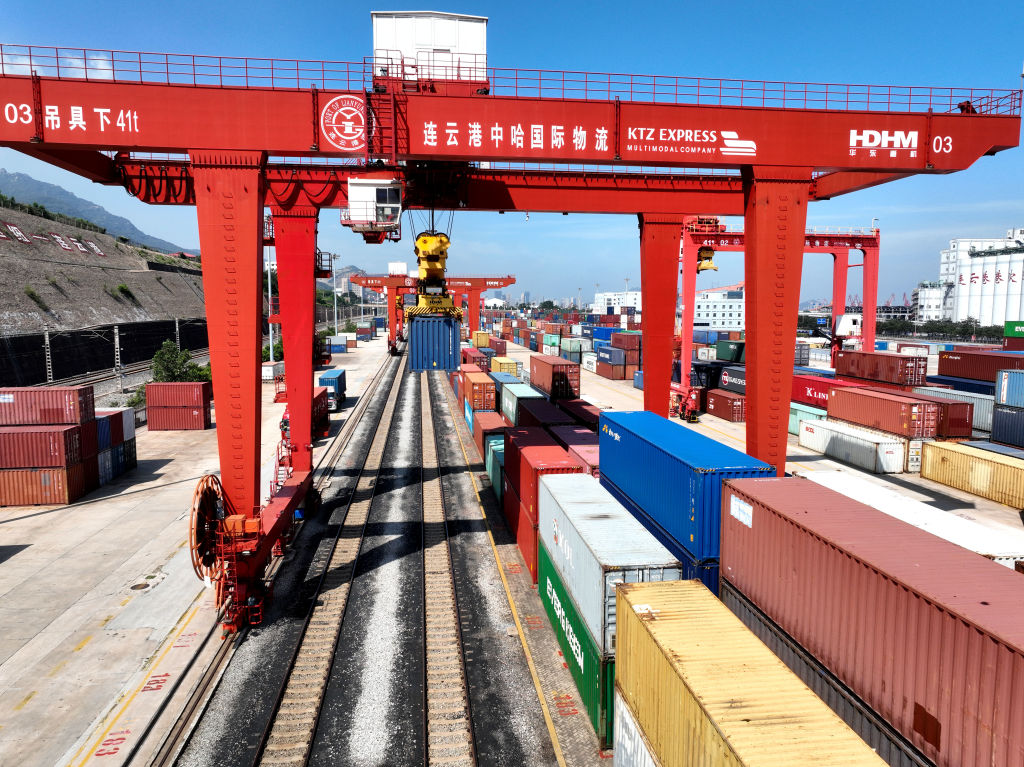
A new front in the U.S.-China competition is taking shape along the Middle Corridor, the critical trade route linking China and Europe while bypassing Russia and Iran. This corridor, also known as the Trans-Caspian International Transport Route, provides the most viable method for east-west trade bypassing Russia and Iran. At a September 1 summit, the Shanghai Cooperation Organization (SCO), a bloc comprised of China and nine Eurasian states, pushed for deeper coordination over the transport, customs, and digital systems that underpin Eurasian trade. This supports Beijing’s efforts to deepen its influence over the Middle Corridor through China’s Belt and Road Initiative (BRI). Although the corridor is intended partly to carry Chinese goods to Europe, Washington has an interest in preventing Beijing from dominating the infrastructure and logistics systems through which Central Asia accesses Western markets. Such dependence could undermine U.S. efforts to diversify critical-mineral supply chains away from China. The SCO Pushes Greater Eurasian Transport Integration The SCO summit issued a declaration calling for deeper cooperation on road and rail routes, multimodal corridors, logistics centers, and digital technologies. Eight SCO members, including all four Central Asian members, reaffirmed support for China’s BRI. SCO members are simultaneously developing a 2026-2030 action plan for ports and logistics centers. These technical mechanisms can determine the key platforms, standards, and procedures for moving goods across Eurasia. The summit connected this emerging framework directly to the Middle Corridor. Kazakhstan proposed an SCO transport strategy through 2035 linking the BRI, the Middle Corridor, and other transport routes. Uzbekistan proposed an SCO council to integrate member railway networks. Together, these initiatives could shift more of the coordination over how the Middle Corridor operates into an SCO-centered framework dominated by China. Beijing Extends Its Central Asian Advantage Into the Middle Corridor China’s role in the Middle Corridor builds on its growing economic position in Central Asia. China has become the region’s largest foreign investor, with nearly $36 billion in direct investment by mid-2025. That presence is increasingly visible along the Middle Corridor. Last year, Kazakhstan opened a new container hub at Aktau developed with China’s Lianyungang Port. Kazakhstan and China are also developing a logistics network stretching from the Caspian Sea to the China’s Pacific coast. Kazakh officials describe the next phase as an “intelligent transport corridor” integrating artificial intelligence, big data, digital twins, and freight-management systems. The share of Chinese trade using the Middle Corridor is also growing. Washington and Brussels are looking to the Middle Corridor to expand commercial access to Central Asia and strengthen supply-chain resilience. A top priority is boosting exports of Central Asian critical minerals to reduce dependence on China. Diversifying extraction and processing away from China will also require reliable westward transport to Western markets, making the Middle Corridor one part of that broader strategy. But Beijing’s growing role in the corridor’s ports, logistics networks, and digital systems could give China outsized influence over that trade. Washington Should Anchor the Middle Corridor to the West Western countries must use their own diplomatic frameworks, financing tools, and infrastructure projects to offer alternatives before China can consolidate its hold over the Middle Corridor. Last year, Washington and Central Asian governments committed to develop the corridor’s Trans-Caspian route, which they intend to connect to Europe through a proposed infrastructure network between Armenia and Azerbaijan while harmonizing customs regimes and promoting trusted digital infrastructure. In addition, the U.S. International Development Finance Corporation (DFC) and U.S. Export-Import Bank (EXIM) launched an investment platform with Uzbekistan earlier this year covering transportation, logistics, critical minerals, infrastructure, and information technology. The DFC is also expanding strategic investment in Kazakhstan. Washington should build on this progress by encouraging DFC, EXIM, and allied financing institutions to expand participation in Caspian ports, logistics hubs, cargo-tracking systems, and customs infrastructure, while increasing oversight to guard against inadvertent exposure to Russia, Iran, or China. The United States should also link its existing critical-mineral investments in the region to non-Chinese processing capacity, westbound transportation, and offtake agreements, helping strategic commodities reach Western markets without dependence on Chinese processing or logistics. Keti Korkiya is a research analyst with the Russia Program at the Foundation for Defense of Democracies (FDD). Angela Howard is a research analyst at FDD’s Center on Economic and Financial Power. For more analysis from the authors and FDD, please subscribe HERE. Follow FDD on X @FDD. Follow Angela on X @angela__howard. FDD is a Washington, DC-based, nonpartisan research institute focused on national security and foreign policy.
China’s Push for Transport Integration Could Expand Beijing’s Control of Central Asian Trade Routes
Full Article
Original Source
Read the full article at Fdd →KhanList aggregates and links to publicly available news content. We do not host full articles from third-party sources. Always verify important information with original sources.