
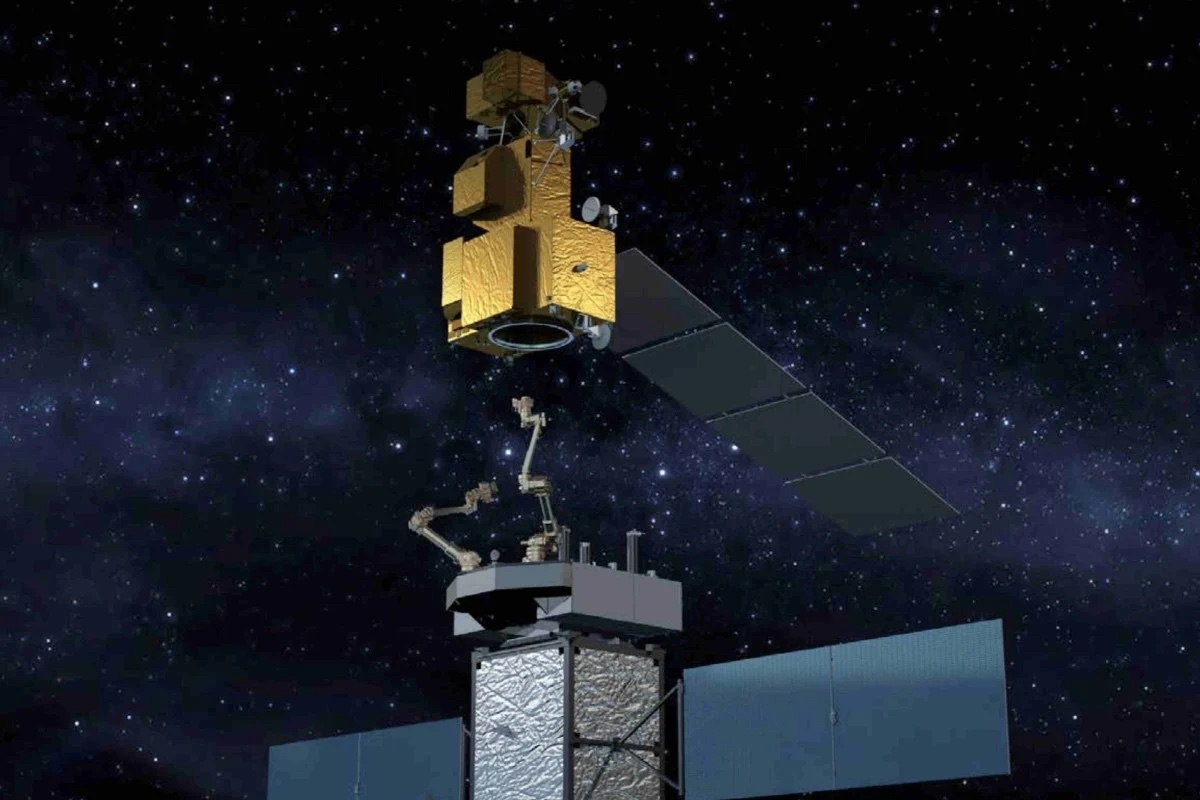
Recent disclosures about China’s purported in-orbit servicing operations have intensified a quiet revolution in space, where the mechanics of satellite sustainment are swiftly becoming the frontline of great-power counterspace rivalry. This month, the South China Morning Post (SCMP) reported that Chinese researchers claim the country carried out a pioneering in-orbit refueling operation on a high-altitude navigation satellite, though orbital tracking data raise doubts about whether the mission occurred, according to recent scientific papers and satellite specialists. Studies by the state-backed Deep Space Exploration Laboratory and the Chinese Academy of Sciences assert that the servicing spacecraft Shijian-25 transferred 142 kilograms of propellant to the BeiDou-2 G7 satellite in February 2025, extending the navigation orbiter’s operational life by eight years. While orbital refueling could significantly cut replacement costs and bolster constellation resilience for civilian and military guidance, the technology has stoked alarms in the US, where US Space Command officials warn that space-based replenishment could provide an adversary a tactical maneuvering edge during orbital conflict. However, Western orbital tracking records compiled by the US Space Force contradict the claimed rendezvous. Independent astrophysicist Jonathan McDowell noted that BeiDou-2 G7 and Shijian-25 remained separated by roughly ten longitudinal degrees in geostationary orbit during early 2025, concluding that the drift rates make an undetected docking physically implausible unless tracking networks misidentified the target objects. Emerging in-orbit refueling and autonomous proximity operations are fundamentally transforming orbital warfare from a doctrine of static endurance into an active, maneuvering gray zone contest between the US and China. Although it is unclear whether China accomplished in-orbit refueling, the feat – if achieved – carries profound tactical implications. As Paul Szymanski and Calogero Bonasia mention in a July 2026 Proceedings article, a satellite with a 15-year operational lifespan carries only enough onboard propellant for routine station-keeping and end-of-life deorbit maneuvers, leaving large evasive burns to drain this fixed reserve rapidly. Because evasive burns shorten operational lifespans, an aggressor need only feign an interception to force defensive displacement, Szymanski and Bonasia explain. Even if the defender avoids physical impact, the aggressor permanently degrades its operational reserve. Szymanski and Bonasia add that by simulating an imminent strike and peeling away at the final moment, a hostile platform can evaluate defensive response timelines and maneuvering tactics without ever crossing the threshold into overt conflict. Propellant replenishment eliminates these operational constraints. In a January 2026 white paper, Novaspace notes that in-orbit refueling unlocks continuous tactical mobility, allowing defense assets to execute frequent, unpredictable orbital adjustments. Such agility enables military spacecraft to slip adversary tracking networks, reposition against co-orbital threats, and conduct close-range inspections on demand. The Novaspace white paper states that assured orbital propellant replenishment also ensures persistent coverage during high-tempo engagements, allowing space-based interceptors and surveillance constellations to reset stations, absorb combat tasking, and sustain sensor-to-shooter links. Novaspace adds that refuelable military spacecraft introduce operational ambiguity for adversaries while enabling rapid capability gap bridging and extended operational readiness across contested orbital domains. At the operational level, Norbert Pouzin and Pierre Sauveton note in a May 2025 Aldoria case study that China uses maneuvering satellites to execute an operational doctrine of gradual interdiction and space control without resorting to debris-generating kinetic strikes. Pouzin and Sauveton note that by deploying platforms capable of complex rendezvous and proximity operations (RPO), China conducts close-up inspections, electromagnetic jamming, and physical towing. China’s dual-use Shijian program provides the hardware backbone for these missions, as Arran Hope details in a December 2025 Jamestown Foundation article, noting the satellites’ advanced servicing capabilities and marked counterspace potential. Hope highlights Shijian-21, officially designated for scientific testing and debris mitigation, which demonstrated robotic grappling by docking with and towing an inactive BeiDou navigation satellite 3,000 kilometers out to a graveyard orbit. Hope points out that the newer Shijian-25, outfitted with an AI-assisted robotic arm, functions as an orbital tanker capable of transferring propellant to lengthen operational lifespans. Beyond proximity operations and refueling transfers, Hope emphasizes that the Shijian family regularly releases secondary sub-satellites and carries dual-use payloads engineered by defense-affiliated research institutions. For Pouzin and Sauveton, these high-orbit platforms and synchronized low-orbit maneuvers — described by US defense officials as simulated space dogfighting — convert China’s strategic intent into subtle coercive tactics designed to track, disorient, or neutralize adversary space assets during a crisis. These capabilities reinforce the reality that orbit is an expanding gray-zone battleground. As Alan Dugger explains in an April 2025 Modern War Institute (MWI) article, space is uniquely susceptible to this dynamic because competition is waged through non-declaratory maneuvers calibrated below the threshold of open warfare. Dugger notes that hostile maneuvers in space remain shrouded in strategic ambiguity as nations blur the line between civilian systems and military assets, making intent and attribution nearly impossible to discern. Because competing major powers like the US and China fear catastrophic debris cascades from kinetic strikes, Dugger points out that they prioritize silent positional plays, electronic jamming, and cyber disruptions. Dugger notes that by preemptively maneuvering dual-use spacecraft to shadow or threaten critical orbital slots, adversaries can engineer a decisive fait accompli before rival powers even recognize an engagement has begun. Not to be left behind, the US is accelerating orbital warfare preparations to counter Chinese counterspace threats and defend critical space architectures. To safeguard satellite networks that support long-range targeting, the US military is deploying ground-based electromagnetic weapons and developing secretive unmanned spaceplanes that can launch secondary payloads. These spaceplanes are designed to operate alongside maneuverable hunter satellites for close-proximity operations, target grappling, and in-orbit refueling. In September 2025, US and British forces jointly maneuvered in orbit near China’s Shiyan-12-01 satellite to demonstrate allied deterrence. Additionally, the US’s planned Golden Dome missile defense system might be adapted into offensive orbital weapons to interfere with enemy battle networks. As the boundary between routine orbital maintenance and counterspace posturing continues to dissolve, the nation that first masters sustained, refuelable maneuvering will effectively set the terms of engagement and dictate deterrence across contested orbits before terrestrial hostilities even begin.
China’s disputed satellite refueling heralds new space war era
Full Article
Original Source
Read the full article at Asiatimes →KhanList aggregates and links to publicly available news content. We do not host full articles from third-party sources. Always verify important information with original sources.