
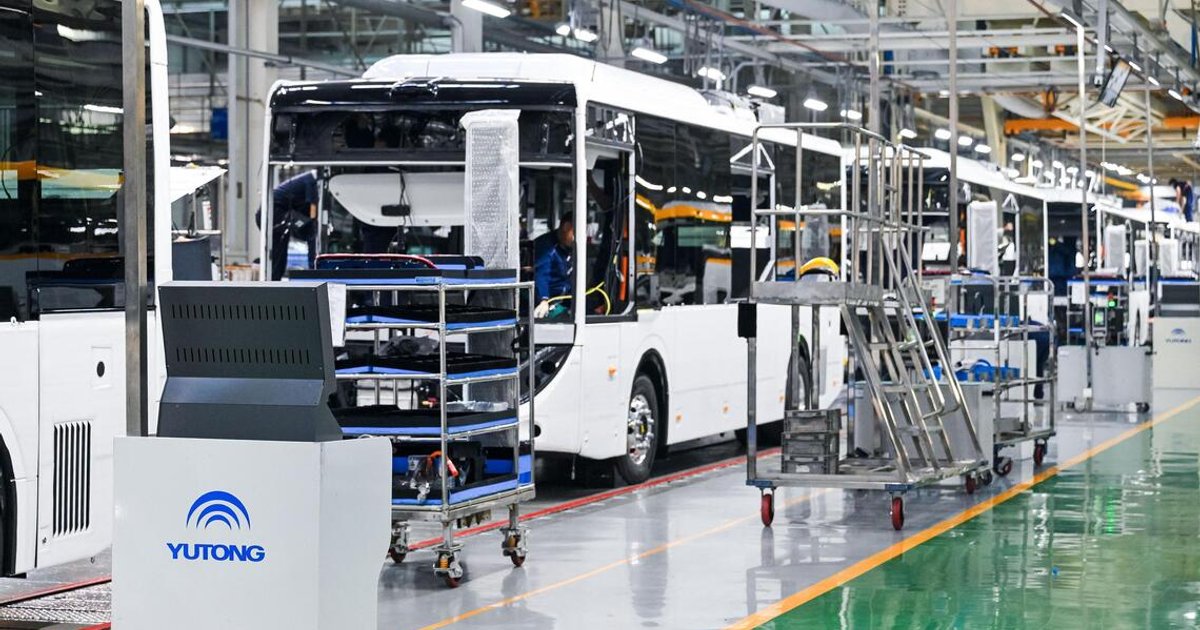
ZHENGZHOU – Inside a manufacturing complex the size of 200 football fields in the capital of China’s central Henan province, buses wrapped in a kaleidoscope of international liveries roll off assembly lines every few minutes.These “new energy” vehicles are among the tens of thousands produced annually by Chinese commercial vehicle giant Yutong and shipped to all corners of the globe, including Europe, Latin America, the Middle East and South-east Asia.In Singapore, 100 of the company’s single-deck electric buses are slated to join the public bus fleet progressively from the end of 2026. They will add to the 20 Yutong electric public buses already in service and the more than 700 privately registered Yutong coaches and tour buses operating across the island.Such is Yutong’s reach, especially in the fast-growing electric bus market, with the publicly listed company operating buses in more than 100 countries.It said it holds more than 10% of the global market, putting it ahead of domestic rivals such as BYD and King Long, as well as European incumbents including Volvo and Daimler Buses.In 2025, Yutong’s overseas revenue surpassed domestic sales for the first time in the company’s now 63-year history, with orders growing rapidly in countries such as Saudi Arabia, Mexico and Uzbekistan.Yet, ask company executives and they say the road to becoming an enduring global powerhouse has just begun.“Our manufacturing and industrial capability – our ‘hard power’ – is good. But our ‘soft power’ is relatively lacking,” Yutong Bus global brand director Jason Huang told The Straits Times at the company’s Zhengzhou headquarters in late October.Huang noted that automotive stalwarts Toyota and Volkswagen took decades to move beyond their domestic bases and establish long-term sustainable growth abroad.“We believe customer satisfaction across our products, sales and services is the true foundation of our brand,” he said, adding that Yutong hopes to strengthen its brand reputation and pragmatically deepen its international footprint.But against a backdrop of rising trade protectionism and heightened national security sensitivities, this expansion has set off alarm bells.As Yutong works to win over more customers, some buyers are increasingly weighing the commercial benefits against the risk of relying on a foreign supplier for critical infrastructure.Security issuesIn October 2025, Yutong made headlines when Norwegian public transport operator Ruter conducted tests which suggested the manufacturer’s electric city buses could, in theory, be shut down remotely.Yutong rejected the claim, saying such an intervention is technically impossible. Ruter, which runs about 300 Yutong buses, also stressed that its findings applied to connected vehicles in general, rather than any single manufacturer or country of origin.In Singapore, the Land Transport Authority clarified in late 2025 that its existing Yutong fleet does not support over-the-air software updates and cannot be remotely controlled.Still, anxieties over espionage and data security risks persist.Asked about this, Yutong cited a September 2026 audit commissioned by Danish transit agency Movia, in which the Chinese manufacturer scored top marks across several benchmarks, including for compliance with United Nations cybersecurity standards and software update management.The third-party audit by EY assessed electric bus models from seven Chinese and European suppliers, as well as electric passenger cars from Tesla and BYD.Yutong executives also stressed that telematics data from Yutong vehicles in Europe, which is stored at a data centre in Germany, cannot be viewed or accessed without the customer’s explicit authorisation.“This approach applies not only in Europe but also in markets such as Singapore, Australia, and elsewhere,” Huang said.Coupled with security concerns, the rise of Chinese bus makers has also caused anxiety about price competition and the future of legacy manufacturers.This friction is particularly sharp in Europe, where Chinese brands captured 9% of the total bus market and 28% of the zero-emission segment in 2025, compared with 7% in electric passenger cars, according to the European Automobile Manufacturers’ Association (ACEA).These inroads have shaken local bus makers. In Britain, coachbuilder Alexander Dennis blamed fierce competition from overseas suppliers when it announced plans in June 2025 to cease manufacturing in Scotland. Meanwhile, electric bus maker Wrightbus has called on London for more state support to protect homegrown companies.In October 2026, ACEA called for urgent action to address a widening competitive gap, citing an EU bus trade deficit that expanded from €1.6 billion (S$2.3 billion) in 2023 to €2.9 billion in 2025. The auto industry lobby group also noted that European bus manufacturers are losing ground in Latin America, Africa and Asia, where they were previously dominant.A bus being driven at high speed on a banked track at Chinese commercial vehicle manufacturer Yutong's new energy vehicle plant in Zhengzhou. The plant, which can produce up to 30,000 vehicles annually, includes a test track to assess steering, braking and other functions as part of final checks before delivery. ST PHOTO: KOK YUFENGIn response, some governments have begun to stiffen procurement policies.In August 2026, Norway proposed limiting public bus purchases from countries with which it lacks formal security pacts, including China. It also proposed introducing an exemption to its zero-emissions mandate for buses on national security grounds.Meanwhile, new competitors are emerging too. India, for example, has deployed subsidies to build out a domestic electric bus manufacturing sector that has begun to export to countries such as Mauritius and Tanzania.Compelling reasonsTransport expert Lee Der-Horng, who is Qiushi Chair Professor at Zhejiang University, told ST that China’s advantage stems from an integrated industrial ecosystem, not just pricing.“Attributing China’s current competitiveness entirely to subsidies overlooks the substantial advantages generated by economies of scale, accumulated engineering expertise, supply chain efficiency, and intense domestic competition,” said Lee, who is also an Academy of Engineering Singapore fellow.However, Lee noted that the broader question being asked now is not only whether a product is worth buying, but whether long-term dependence on it is acceptable.“The more equipment depends on a supplier’s software and continuing support, the more buyers need to ask: if that relationship breaks down, can we keep operating? Buses make this especially visible because service disruptions directly affect people’s daily lives.”For Yutong, dealing with competition and geopolitical headwinds is part and parcel of international expansion, which has become crucial as the company sees a limit to its growth in the domestic Chinese market due to the development of competing high-speed rail lines and urban metro networks.An ambulance bound for Africa being tested under extreme heat conditions of 53 deg C in an environmental chamber at commercial vehicle manufacturer Yutong's testing centre in Zhengzhou, China. ST PHOTO: KOK YUFENGHuang noted that every country has its own import and export policies, including measures designed to protect domestic manufacturing.In markets where imports of fully assembled vehicles face stiff restrictions, such as Malaysia, Yutong ships components such as the motor and chassis, and works with local partners that do the final assembly. It now maintains more than 10 such local bases worldwide, including in Kazakhstan and Qatar.The company added that stationing Chinese engineers at these foreign assembly plants ensures the build quality matches that of its Zhengzhou factory, where buses undergo a barrage of tests before shipment.For transport operators, the commercial case for buying Chinese buses remains compelling.In an August 2025 submission to the Copenhagen municipal government, Denmark’s Movia calculated that switching away from Chinese electric buses would cost between 13 million and 26 million Danish kroner (between S$2.5 million and S$5 million) extra annually, with the transport agency also pointing to delivery delays from European suppliers and superior battery warranties from Chinese manufacturers.“Every operator wants the same thing,” said Colin Anderson, general manager of Tropic Wings, a tour operator in Cairns, Australia, which has run Yutong buses since 2014.“You want a bus that will do the job when you want it to… It’s a fairly basic answer, but that’s what the business is,” he told ST.
China’s bus giant Yutong wants to win the world over, but some customers are getting worried
Full Article
Original Source
Read the full article at Straitstimes →KhanList aggregates and links to publicly available news content. We do not host full articles from third-party sources. Always verify important information with original sources.