
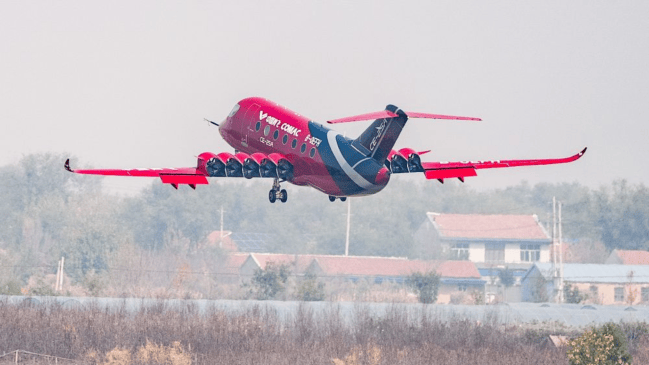
China’s Commercial Aircraft Corporation of China (COMAC) has completed the first crewed flight of its CE-25A electric commercial aircraft, a 10-ton-class design intended for short intercity routes. The aircraft carried two pilots and a flight test engineer during the flight in Shandong Province, with all systems operating normally and performance indicators meeting expectations. The milestone advances the development of an aircraft designed to carry up to 19 passengers using an electric propulsion system. The CE-25A previously completed its first autonomous unmanned flight at the beginning of February and has since undergone 19 autonomous flight tests. Jointly developed by COMAC, the China Academy of Launch Vehicle Technology (CALT) and Shanghai Jiao Tong University, the aircraft is now moving toward the regulatory certification process. China’s Civil Aviation Administration has accepted its application for type certification, although this does not mean the aircraft has received approval to enter commercial service. 19-seat aircraft targets short intercity routes The CE-25A has a maximum takeoff weight of approximately 22,046 pounds and is designed to carry 19 passengers. Its reported cruising speed is 186 mph, while its cruising altitude reaches approximately 7,874 feet. The aircraft has a stated range of around 249 miles, placing it in the category of short-distance regional transportation rather than conventional long-haul commercial aviation, Chinese media reported. Its configuration is intended to support intercity connections, potentially serving routes where smaller passenger aircraft can provide an alternative to longer ground journeys. However, COMAC has not disclosed details about the aircraft’s battery capacity, electric motor configuration, charging requirements or energy consumption. Those specifications will be important for evaluating its operational potential, particularly because battery weight and energy density remain major constraints for electric aviation. Furthermore, a 19-passenger aircraft with a maximum takeoff weight of around 22,000 pounds represents a considerably different engineering challenge from smaller electric training aircraft and air taxis. Autonomous flight testing precedes crewed milestone The first crewed flight follows an earlier development milestone on February 2, when the CE-25A completed its first intelligent unmanned flight. According to Xinhua, the aircraft has since completed 19 autonomous unmanned flight tests. The latest flight introduced a human crew, with two pilots and a flight test engineer onboard to assess the aircraft’s performance under crewed operating conditions. The progression from autonomous testing to a crewed flight is an important step in the aircraft’s development. It allows engineers to evaluate flight characteristics and onboard systems with personnel aboard, while building the test data required for the certification process.Furthermore, regulators must also assess propulsion reliability, battery safety, thermal management, electrical systems, emergency procedures and performance across different operating conditions. While the project combines aircraft development, aerospace engineering and academic research, its commercial viability will depend on factors such as usable range with a full passenger load, charging infrastructure, maintenance requirements and operating costs.Get the latest in engineering, tech, space & science - delivered daily to your inbox.Bojan Stojkovski is a freelance journalist based in Skopje, North Macedonia, covering foreign policy and technology for more than a decade. His work has appeared in Foreign Policy, ZDNet, and Nature.
China’s 22,000-pound electric aircraft completes major flight test milestone
Full Article
Original Source
Read the full article at Interestingengineering →KhanList aggregates and links to publicly available news content. We do not host full articles from third-party sources. Always verify important information with original sources.