
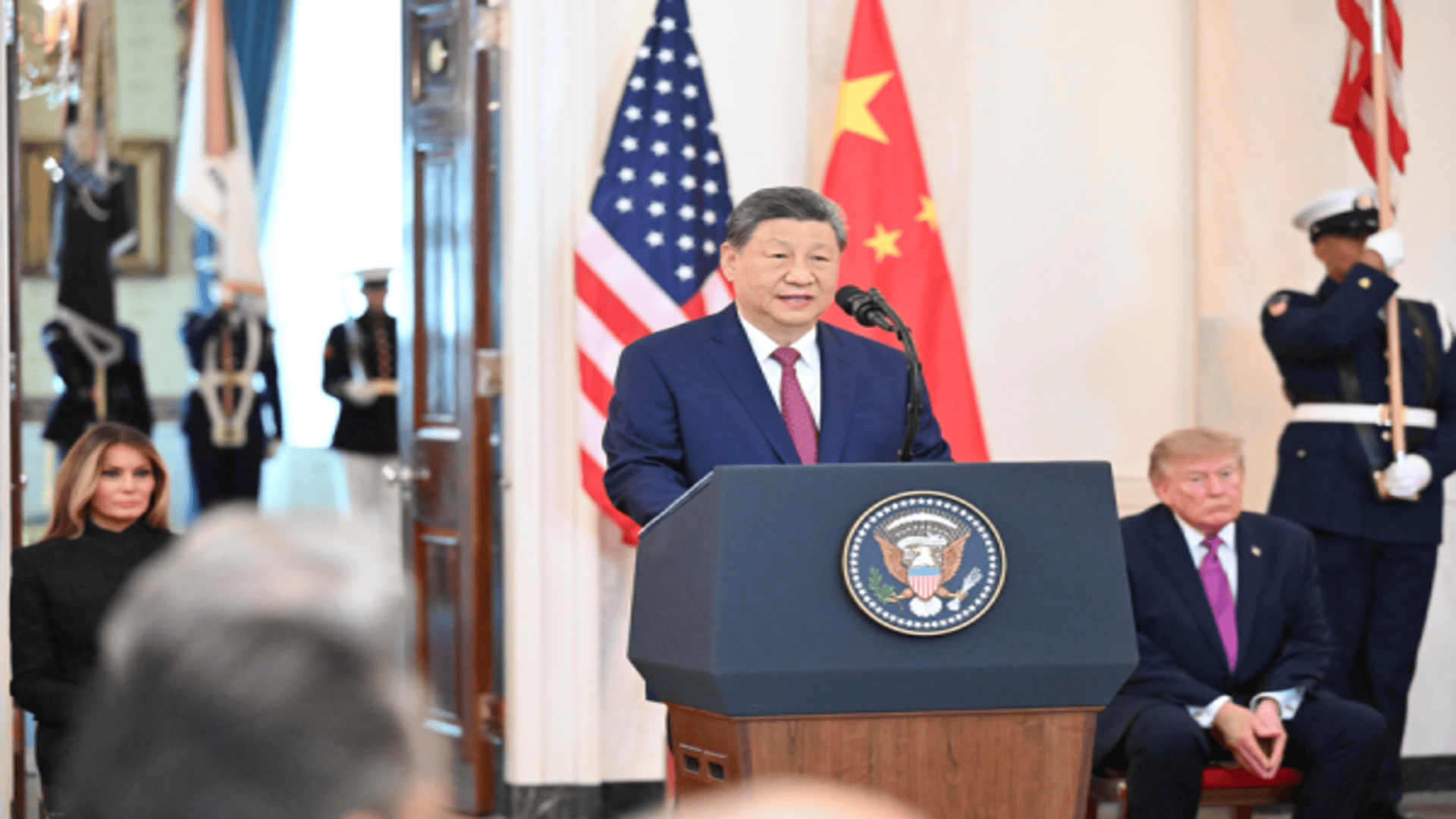
China and the United States have agreed to pursue a new military crisis-communication agreement after President Xi Jinping’s three-day state visit to Washington from September 23 to 25. Military officials closely watched the discussions leading up to and during the summit between Washington and Beijing, South China Morning Post (SCMP) reported. One official described the public dialogue between Washington and Beijing as a “confidence builder for everybody.” Another U.S. military official said that “the US’ goal is to enable both strategic stability and deterrence by denial, and I believe respectful and professional communication with China does not preclude that.” During Xi’s three-day visit, he and President Donald Trump discussed strategic stability and major international and regional issues. China’s Foreign Ministry said the talks produced eight other “deliverables and understandings,” including trade, artificial intelligence, and counternarcotics cooperation. The Chinese and U.S. militaries agreed to conclude a memorandum of understanding on crisis communication and prevention “as soon as possible,” and to continue the search for missing service members in China, according to a September 26 readout from China’s Foreign Ministry. Details of the military mechanism remain unclear The two sides were preparing measures to activate additional military communication channels and strengthen existing ones, SCMP reported ahead of the summit. But the two militaries already have consultation arrangements and senior communication channels. Beijing’s announcement did not explain whether the proposed memorandum would establish a new hotline, create procedures for using existing connections, or define which incidents would trigger crisis consultations. Nevertheless, during his visit, Xi noted that military communication between the two countries needed improvement. “Our two militaries should maintain regular dialogue, and improve mechanisms for crisis communication and prevention,” Xi said at the Arrival Ceremony, as published by China’s Foreign Ministry. Xi linked military communication to his broader call to avoid confrontation between the two countries. “…we can certainly find the right path for our two great countries to get along on this planet we both call home,” Xi said. US and Chinese commanders resume contact The proposed memorandum follows renewed contact between senior U.S. and Chinese military commanders. Admiral Samuel Paparo, the senior U.S. commander in the Indo-Pacific, met General Yang Zhibin, commander of the People’s Liberation Army’s Eastern Theatre Command, during a defense conference in Victoria, British Columbia, in late August, according to the South China Morning Post. The SCMP reported that this first meeting ended a two-year interruption in theater-level contact between the two countries. Paparo and Yang discussed maintaining communication among senior leaders to reduce the risk of miscalculation and encourage safe and professional conduct by their forces. The military agreement was announced separately from the eight other summit deliverables listed by China’s Foreign Ministry. Among them, the two countries agreed to establish the China-U.S. AI Dialogue to exchange views on AI risks and benefits, with another exchange scheduled for November 2026. “China and the U.S. also agree to establish a bilateral communication channel for AI incidents,” the Foreign Ministry statement said in a September 26 release. On the military relationship, Beijing’s next step is to conclude the memorandum. But China has not provided a specific deadline, saying the two militaries had agreed to conclude the agreement “as soon as possible.” Get the latest in engineering, tech, space & science - delivered daily to your inbox.Originally from LA, Maria Mocerino has been published in Business Insider, The Irish Examiner, The Rogue Mag, Chacruna Institute for Psychedelic Plant Medicines, and now Interesting Engineering.
China, US agree to pursue military crisis communication pact to prevent escalation
Full Article
Original Source
Read the full article at Interestingengineering →KhanList aggregates and links to publicly available news content. We do not host full articles from third-party sources. Always verify important information with original sources.