
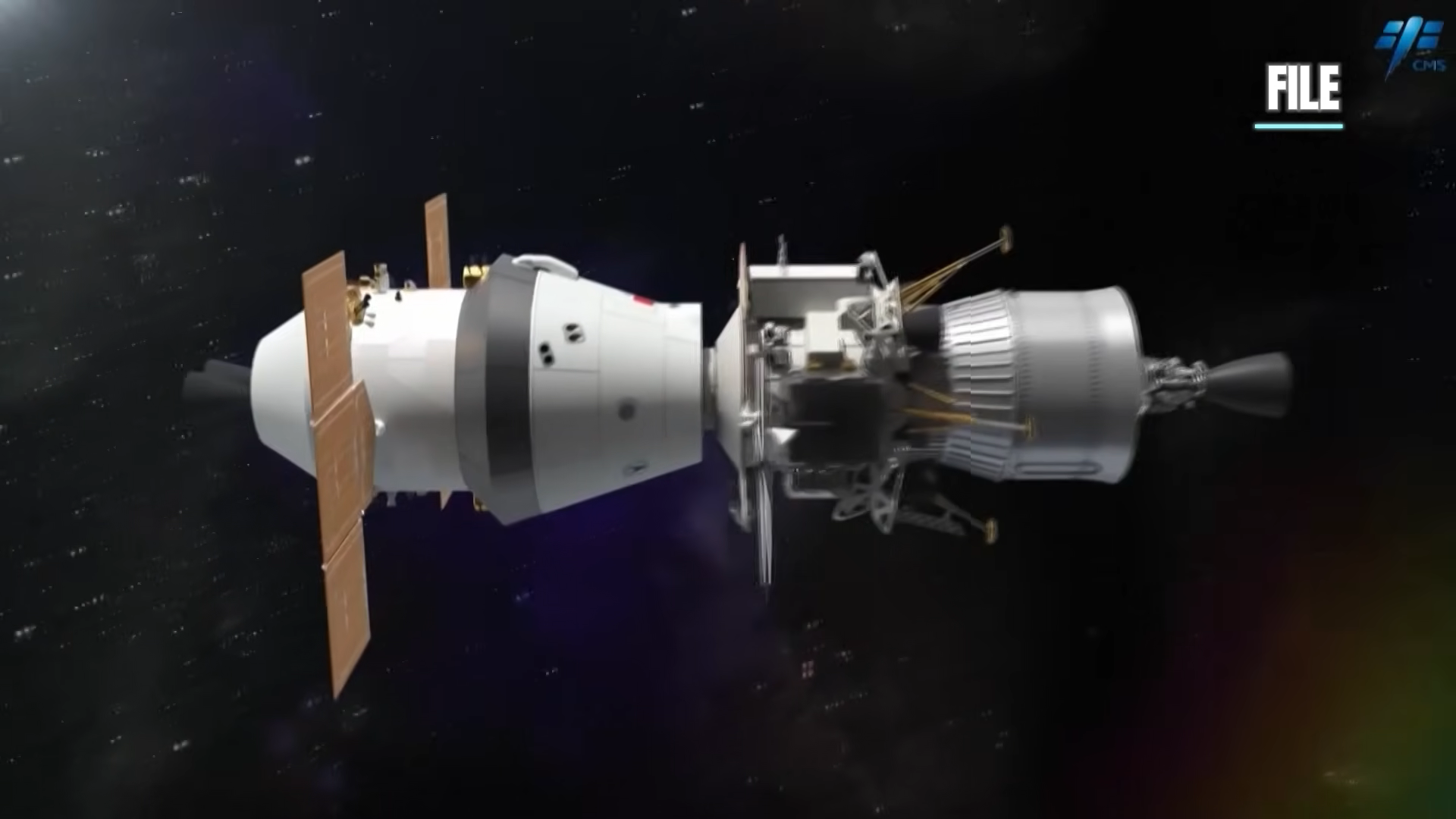
Yesterday, on November 3rd, the deputy chief designer of China's crewed space program and chief designer of the lunar exploration program (Wang Xiang) unveiled an official statement detailing its plans for a crewed mission to the Moon. Under the proposed architecture, China will conduct two launches using the Long March 10 rocket, sending the Lanyue lunar lander and the Mengzhou crewed spaceship to the Moon, where they will rendezvous in orbit. Of the three taikonaut crew, two will then transfer from the spaceship to the lander and descend to the surface to conduct science operations. The plans were outlined in a keynote speech Wang delivered at the 7th Manned Space Symposium, held from Oct. 31st to Nov.1st at Beihang University in Beijing. This year's theme was "Gathering Wisdom for the Galaxy: Digital and Intelligent Empowerment for High-Quality Development of Manned Spaceflight," and saw more than 800 experts and scholars from fields related to crewed spaceflight convene to discuss strategies, technologies, and the hurdles China's space program will face. These plans echo the preliminary plan statements made at the 9th China (International) Commercial Aerospace Forum in July 2023. As Deputy chief engineer Zhang Hailian of the China Manned Space Engineering (CMSE) office said at the time, two Long March-10 rockets would launch the elements to the Moon separately. Zhang's slideshow also included a rendering of a lander depicted on a mural inside China's Manned Lunar Deep Exploration Project Office. The CMSE unveiled the lander design to the world in September 2023 and officially named it Lanyue ("embracing the Moon") in early 2024. Since then, development of the Long March 10, Mengzhou spacecraft, and Lanyue lander has proceeded apace and reached several key milestones. This included a tethered test of the lander last year, which successfully simulated descent, guidance, control, and engine shutdown. The Mengzhou spacecraft also successfully completed a series of zero-height abort and maximum dynamic pressure escape tests in June 2025 while the Long March-10 successfully completed a low-altitude demonstration and validation test earlier this year. These developmental milestones place China on track to complete a crewed lunar mission by 2030. In an interview with China's state-controlled media company, CCTV, Wang said that their planning approach follows two principles and will consist of using different vehicle variants for different stages. To prepare for rendezvous in lunar orbit, China will use the Tiangong space station in Low Earth Orbit (LEO) to validate the rockets, lander and space capsule. An uncrewed flight mission of the Lanyue lander will also happen before a crew landing is attempted, which will gather critical environmental data on the luanr surface. In addition, Wang highlighted how in preparation for crewed missions, the mission components will all be tested in an uncrewed state first: We will use the near-Earth version of the Long March 10 to launch the near-Earth version of the Mengzhou spacecraft to perform space station missions in Low-Earth Orbit, validating the rocket's basic technologies and the critical re-entry and return phases of the spacecraft. Then we will use the lunar version of the Long March 10 to launch the lunar version of the Mengzhou spacecraft to execute the lunar landing mission. This is the validation process for the rocket: near-Earth first, then the Moon. Artist's recreation of the two Chinese spacecraft that will put 'taikonauts' on the Moon. Credit: CSM For the near-Earth phase of the plan, the Long March 10A (CZ 10A) will be used, a single stick variant with only two stages and no boosters. For the lunar mission, the standard, three-stage variant with additional boosters will be used, which has a payload capacity of 27 metric tons (~30 U.S. tons). This process is virtually identical to what NASA has been pursuing with its Artemis Program. Initially, NASA hoped to use the Block 2 variant of the Space Launch System (SLS) to deliver crew and payloads to the lunar surface (which has since been cancelled). China's incremental "near-Earth first, then the Moon" approach is also very similar to the NASA's current launch plans. Before a crewed Orion spacecraft flew four astronauts around the Moon with Artemis II, NASA launched the uncrewed Artemis I capsule on a circumlunar flight to validate all the key systems. China's stated plans for an orbital rendezvous is also similar to NASA's revised plans for the Artemis III mission scheduled for next year, involving the seperate launch and an Orion spacecraft with a yet-to-be-determined Human Landing System (HLS). "In an uncrewed state, we will validate many key technologies of the entire crewed process as possible, including launch, orbiting the Moon, docking with the Mengzhou spacecraft, landing and staying on the lunar surface, taking off again, and re-docking with the Mengzhou spacecraft," Wang added. "This is to ensure that the crewed flight is safe and reliable." Wang further indicated that the program has established system plans, technical standards and quality requirements under a single development framework. China's long-term vision includes the creation of an International Lunar Research Station, the construction of which is currently planned to commence in 2031 using the super heavy-lift Long March 9 rockets. Roscosmo's involvement in the project is unclear at this time due to Russia's ongoing war in Ukraine and the way this has led to record lows in terms of annual launches and delays in the super-heavy Yenisei rocket. The details of this base are sitll somewhat vague, with the stated description claiming it will be located on the surface or in orbit. Further Reading: CASC, Beihang University
China Unveils Their Plan for a Crewed Moon Landing
Full Article
Original Source
Read the full article at Universetoday →KhanList aggregates and links to publicly available news content. We do not host full articles from third-party sources. Always verify important information with original sources.