
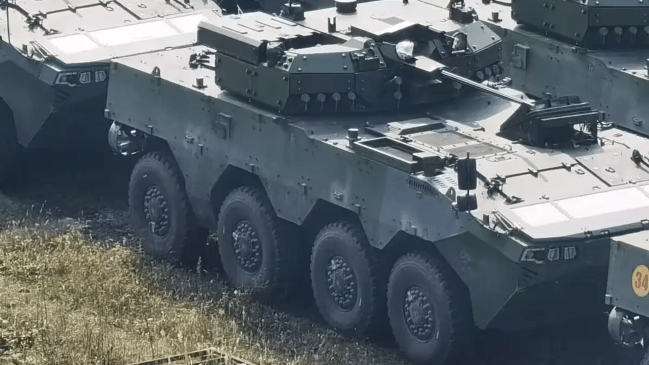
China may be developing a new version of its Type 19 amphibious 8×8 combat vehicle designed to protect frontline troops from the growing threat posed by drones. Unverified images that appeared on Chinese social media in late August show a Type 19 variant fitted with a turret-mounted laser weapon, additional sensors and its standard autocannon. The vehicle could be particularly relevant to a potential Taiwan conflict, where PLA amphibious forces would face extensive use of drones for surveillance, targeting and direct attacks. If the modified vehicle retains the Type 19’s amphibious capability, it could provide counter-drone protection while accompanying mechanised units during a landing operation, although the impact of the new equipment on its weight, power requirements and ability to operate in water remains unclear. Laser added to an amphibious combat vehicle The Type 19 family is associated with China’s amphibious forces, and vehicles from the family were reported to have entered service with the 73rd Group Army under the PLA’s Eastern Theatre Command. That command would have a central role in any potential military operation against Taiwan, the South China Morning Post (SCMP) reported. The new variant appears to combine the vehicle’s existing weaponry with a directed-energy system and additional sensors. The arrangement suggests the laser is intended primarily for counter-drone missions, potentially allowing individual armoured vehicles to detect and engage small uncrewed aircraft without relying exclusively on larger air-defense systems. Timothy Heath, founder of defense consultancy Perceptum and a former senior China analyst at RAND and the US military, told SCMP it is difficult to determine from available imagery whether the modifications have affected the vehicle’s amphibious performance. Operating the laser while the vehicle is afloat “should be possible,” although the additional weight and the need to protect the equipment from salt water would have to be addressed, he added. One possible solution could involve reducing the crew or removing other equipment to compensate for the added weight. If those engineering challenges can be overcome, Heath noted the system could be “very useful in a Taiwan conflict”, particularly if Taiwanese forces use drone swarms against PLA vehicles attempting to establish a beachhead. Taiwan is building a larger drone force The potential role of the Type 19 variant comes as Taiwan rapidly expands its own use of uncrewed systems. Taiwan’s cabinet has proposed a $4.6 billion supplementary defense budget that includes more than 600 coastal surveillance and reconnaissance drones and more than 40,000 coastal attack drones. The proposal still requires legislative approval, while lawmakers have also approved a separate $7.6 billion, six-year framework for domestically produced drones. The island has reorganized parts of its military around drone warfare, including the creation of army drone battalions across three operational combat zones. During the Han Kuang 42 exercise in August, Taiwanese units used drones for battlefield surveillance, reconnaissance, intelligence transmission and attack missions. For a PLA force attempting to establish a foothold, drones could be useful not only for attacking vehicles but also for identifying troop positions and movements and directing artillery, missiles and other weapons toward forces operating in exposed areas. That makes vehicle-level counter-drone systems increasingly attractive. The Russia-Ukraine war has demonstrated how inexpensive drones can threaten tanks, artillery and other frontline systems, while the Armenia-Azerbaijan conflict in 2020 showed how uncrewed aircraft can exploit gaps in conventional air defenses.Get the latest in engineering, tech, space & science - delivered daily to your inbox.Bojan Stojkovski is a freelance journalist based in Skopje, North Macedonia, covering foreign policy and technology for more than a decade. His work has appeared in Foreign Policy, ZDNet, and Nature.
China turns Type 19 vehicle into potential mobile laser defense system for drone warfare
Full Article
Original Source
Read the full article at Interestingengineering →KhanList aggregates and links to publicly available news content. We do not host full articles from third-party sources. Always verify important information with original sources.