
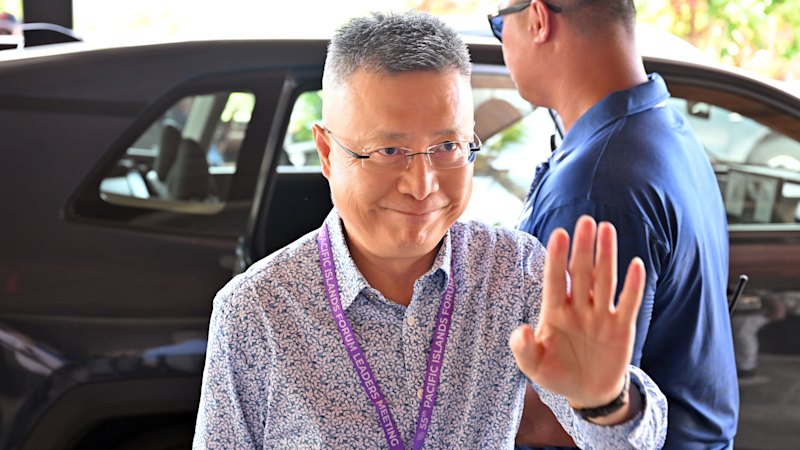
September 4, 2026 — 12:02pmKoror City, Palau: A whole suckling pig, freshly cooked and ready for carving. Traditional dancers in hemp skirts. Uplifting speeches about Pacific unity. The opening ceremony of this year’s Pacific Islands Forum, held in Palau’s national gymnasium, was a convivial, relaxed affair. China’s special envoy for Pacific Qian Bo, however, was not enjoying the festivities. In fact, he was seething. A reason: sitting only a few chairs away from him was Taiwan’s foreign minister.As he emerged from the gym on Monday night into the humid tropical air, a group of Australian reporters asked Qian how he felt about Taiwan’s strong presence at the gathering. The envoy took a breath and let rip. Qian said he had “serious concerns” about the level of access granted to Taiwan, a self-governing island that has never been under Chinese Communist Party control but is considered an integral part of its territory by Beijing. Ominously, the envoy warned “there will always be consequences” when China is unhappy.China’s special envoy for the Pacific Qian Bo made it clear how unhappy Beijing was that Taiwan was invited to the forum.AAPA few days earlier, China’s tourism ministry had issued a notice urging potential visitors to be wary of travelling to the tourism-dependent nation because of robberies. Anyone who has visited Palau, even briefly, knows how laughable such a warning is. The most dangerous prospect for most tourists on the tiny island nation, which boasts spectacular beaches, is sunburn and sweat patches. Prime Minister Anthony Albanese, who holidayed in Palau before his wedding last year, described the island as “a paradise” this week. Palau’s President Surangel Whipps Jnr jokes that his nation’s sharks are vegetarian, its jellyfish don’t sting, and even its crocodiles are friendly.Palau is a Pacific island with beautiful oceans - and little crime despite China’s warnings.APThe driving force behind China’s tourism warning was not a fear of travellers being mugged, but anger at Palau’s close relationship with Taiwan. Walk down Main Street in Koror City, where most residents live, and the depth of the ties is instantly clear. Plaques outside the airport, high school and cultural centre (the site of the Pacific Island Forum leader meetings) proudly proclaim that they were built thanks to grants from Taiwan. So were Palau’s fleet of electric buses. The flow of cash reflects the fact Palau is just one of 12 countries left in the world that officially recognise Taiwan rather than China. That is why this minuscule country of less than 20,000 people – around the same as an inner-city Australian suburb – is such an annoyance to the emerging superpower.“I think they wanted to give Palau, and especially President Whipps, a black eye because of the closeness of the relationship with Taiwan. He’s been very clear Palau will decide who its friends are,” says John Hennessey-Niland, who served as the US ambassador to Palau from 2020 to 2022.Palau capital Koror from the air.iStockAfter Qian’s intervention on the forum’s opening night, attendees were bracing for more feisty comments when he addressed the gathering on Tuesday. His speech turned out to be a fizzer; besides a perfunctory reference to the “One China policy”, there was no mention of Taiwan and no sign of the foreshadowed consequences. Taiwan’s decades-long status as a PIF development partner remained unchanged, and it is set to be included at next year’s forum in New Zealand.Asked how successful China’s efforts to exert its influence over the PIF had been, Hennessey-Niland says: “I think it’s fallen flat ... I think Qian was surprised by how unified the Pacific leaders were. Perhaps the pushback made the special envoy realise the wolf warrior approach wasn’t going to work.”China received another setback on the final day of the forum, when 16 of the 18 member nations agreed to voice concern about its July test-firing of a long-range ballistic missile and call for at least 24 hours notice for such tests in the future. The statement was stronger than expected, undercutting Beijing’s insistence that the test was “a routine arrangement of China’s annual military training” and rebutting claims it was little different to American missile testing. There was not total agreement, however. Nauru dissented and Kiribati did not show up for the negotiations, reflecting their deepening ties with Beijing.Meanwhile, United States Deputy Secretary of State Christopher Landau was also in Palau as part of a tour of four Pacific nations. The Trump administration has been widely criticised for being missing in action in the Pacific, but Landau showed up with cash – specifically US$50 million ($69 million) to fund an upgrade of a port in the Cook Islands in partnership with New Zealand. Last year the Cook Islands government signed a comprehensive strategic partnership with China, alarming both Wellington and Washington.Anna Powles, an associate professor at Massey University’s Centre for Defence and Security Studies in New Zealand, laments the fact that so much of the forum’s time and energy is taken up by non-members like Taiwan, China, the US and France. Their presence, she says, is a distraction from the Pacific’s core priorities, like climate change. Rather than a safe space from external influence, the forum has become a vehicle for outside players to try to shape the Pacific to suit their agenda.Climate Change Minister Chris Bowen, left, standing alongside Prime Minister Anthony Albanese and Pacific Island Affairs Minister Pat Conroy earlier this week in Palau.AAP“What’s very clear is that when the forum was held in Honiara last year, and dialogue partners were not invited, it reduced the temperature in the room,” Powles says. “There was a real sense that Pacific Island nations could focus on Pacific Island issues.”Oliver Nobetau, the Lowy Institute’s Pacific Islands program director, disagrees, saying Pacific Island nations cannot tackle the big problems of our age alone. “At a time when Pacific countries are facing the effects of El Niño and the energy pinch from the Iran War, development support is welcome and needed.”Australia, for its part, is a fully-fledged member of the forum. Since coming to power in 2022, Albanese has prioritised it as a way to advance Australia’s influence in the region and hold Beijing at bay. This year’s main pledge was a $600 million package to help fund a new anti-drug smuggling initiative called Waqa Moana, which includes increased aerial surveillance and intelligence sharing. The funding responds to a request for help from Pacific leaders who are struggling to cope with a surge in transnational crime driven in large part by Australians’ expensive cocaine habit.A glaring absence from this year’s forum was Solomon Islands Prime Minister Matthew Wale, one of Albanese’s closest allies in the region and one of five national leaders not to attend the forum.Wale was forced to suddenly return home when three of his cabinet ministers resigned and announced a no-confidence motion against him. Since coming to power in May, Wale has transformed the Solomons’ foreign relations, shifting closer to Canberra and away from Beijing.Moving with rapid speed, Wale vowed to review a 2022 security pact between the Solomon Islands and China while aiming to strike a new comprehensive treaty with Australia by the end of the year. On top of that, he has proposed an ambitious Pacific-wide security pact that would shut out China. Australian officials detect Beijing’s hand behind the push to oust him, and the decision to strike while he was preparing for the PIF.Solomon Islands Prime Minister Matthew Wale with Prime Minister Anthony Albanese earlier this year.Alex EllinghausenA more pliant leader in Honiara would be a triumph for China and a blow for Albanese. “In the same way that Wale was a breath of fresh air for the bilateral relationship with Australia, a new Beijing-friendly PM could turn that ship around just as quickly,” Nobetau says.The no-confidence motion against Wale is set to be tabled on Monday, meaning he could have just days left in the job if his slender majority crumbles under the weight of more defections. This week was a largely good one for Australia in the Pacific, and an underwhelming one for China. Next week may be an entirely different story.Cut through the noise of federal politics with news, views and expert analysis. Subscribers can sign up to our weekly Inside Politics newsletter.From our partners
China suffered Pacific setbacks this week. Next week it could be celebrating
Full Article
Original Source
Read the full article at Smh →KhanList aggregates and links to publicly available news content. We do not host full articles from third-party sources. Always verify important information with original sources.