
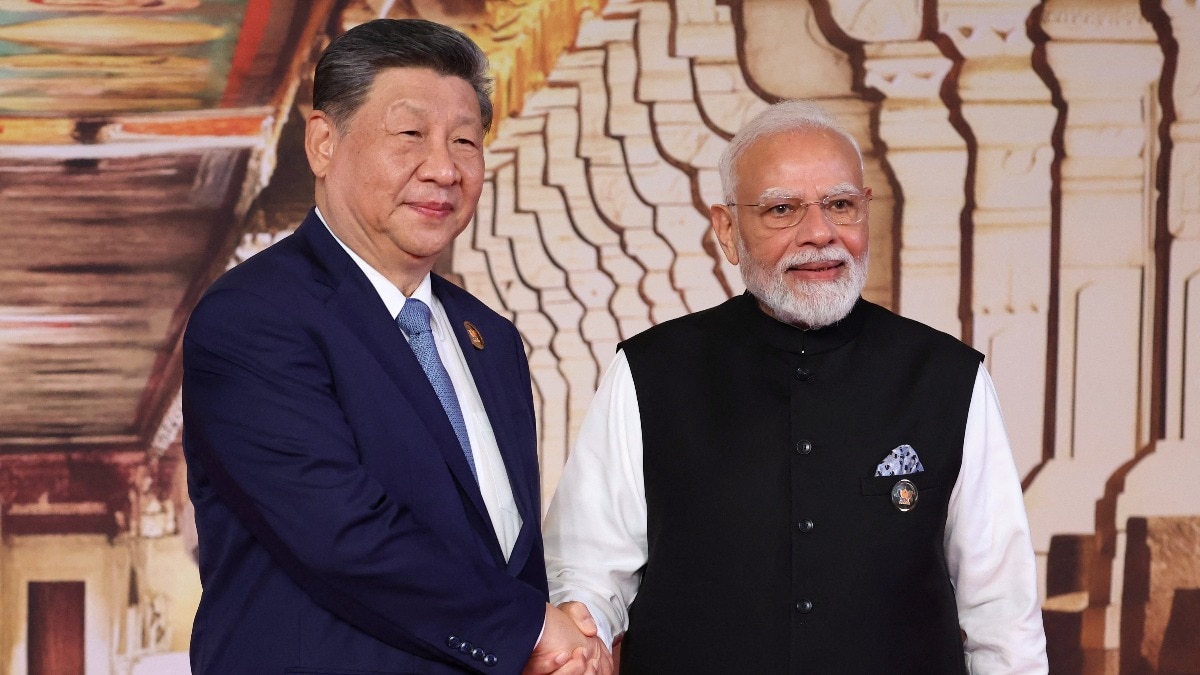
India's faster growth has not come close to closing the gap with China. It has, however, meant that India's economy has grown somewhat faster relative to China's over the past five years.Prime Minister Narendra Modi welcomes Chinese President Xi Jinping at the BRICS summit in Delhi. (Photo: Reuters)Economist Surjit Bhalla's latest analysis of BRICS has put the spotlight on how much of the group's economic rise is actually coming from China.Bhalla's calculations show that BRICS' share of global income increased from 21.9% in 2011 to 28.9% in 2025. But if China is removed, the share of the other 10 members fell from 11.9% to 11.5%. China alone accounted for 72% of the increase in BRICS' income over the period, according to his analysis.His numbers also show China's growing weight within the group. China's share of BRICS income rose from 45.6% in 2011 to 60.2% in 2025. Among the five long-standing members, its share increased from 54.1% to 68.9%.But look at the more recent five-year period, and the picture changes somewhat. India has grown faster than China on the same income measure Bhalla uses, even though China's economy remains far larger.INDIA'S INCOME HAS GROWN FASTERBhalla uses the World Bank's GNI per capita, Atlas method. GNI, or gross national income, measures the total income earned by a country's residents and businesses, including income from abroad. It differs from GDP, which measures economic activity within a country's borders. For his calculation, Bhalla multiplies GNI per capita by population to arrive at aggregate income.On that basis, India's GNI was about $2.67 trillion in 2020. By 2025, it had risen to around $4.04 trillion. That is an increase of about 52% in five years.China's GNI, using the same measure, increased from about $15.15 trillion in 2020 to $20.02 trillion in 2025. That works out to growth of roughly 32%.So, between 2020 and 2025, India's aggregate GNI grew about 20 percentage points faster than China's.This is not the same as saying India's economy is now close to China's.China's GNI was still almost five times India's in 2025.And because China started from a much larger base, it added much more to its income in absolute terms. China's GNI increased by about $4.86 trillion between 2020 and 2025, compared with roughly $1.37 trillion for India.So the distinction is important. India has grown faster, but China remains the much larger contributor in absolute terms.INDIA HAS NARROWED THE GAP, BUT ONLY SLIGHTLYThe relative gap has nevertheless changed.In 2020, India's aggregate GNI was around 18% of China's. By 2025, it was about 20%.That is a small shift, but it offers a useful way of looking at the changing economic balance inside BRICS.India's faster growth has not come close to closing the gap with China. It has, however, meant that India's economy has grown somewhat faster relative to China's over the past five years.That recent performance also adds context to Bhalla's longer-term assessment.Bhalla describes India as the second-best performer among the five long-standing BRICS members over 2011-25, with annual income growth of 5.2%. India's share of global income rose from 2.5% in 2011 to 3.5% in 2025.The latest five-year numbers show that India's pace has been stronger than China's when measured through the same aggregate GNI measure.CHINA STILL ACCOUNTS FOR THE BIGGER ECONOMIC WEIGHTThe numbers do not overturn Bhalla's central argument about China's importance to BRICS. They add another layer to it.China remains the dominant economy in the grouping. It has contributed far more in absolute dollar terms to the increase in aggregate income over the past five years.India's contribution is smaller because its starting point is much lower. But its growth rate has been higher.That distinction matters when looking at what BRICS could look like in the years ahead. A smaller economy can grow considerably faster than a larger one without necessarily adding more to the bloc's overall economic size.The trade picture also remains a challenge for India.Bhalla's analysis found that BRICS' share of global goods exports rose from 23% in 2011 to 25% in 2023. But excluding China, the share fell from 12.4% to 10.1%. He calculated that China accounted for 94% of the increase in BRICS goods exports over that period.India's share of global goods exports, meanwhile, increased from 1.71% in 2011 to 1.88% in 2023. Vietnam's share rose much faster, from 0.52% to 1.50% during the same period.So there is a difference between India's faster recent income growth and its relatively modest improvement in global trade share.For now, the numbers point to a BRICS economy still dominated by China, but with India becoming a more significant growth engine of its own.China remains the giant inside BRICS. India is growing faster. The question is how long that faster pace can be sustained, and whether it eventually translates into a much larger share of the bloc's economic and trade weight.Note: The five-year comparison uses GNI under the World Bank's Atlas method, following the methodology used by Bhalla. This is a current-dollar measure and should not be treated as the same thing as real GDP growth.- EndsPublished On: Sep 14, 2026 10:29 IST
China still dominates BRICS growth, but India has grown faster in past five years
Full Article
Original Source
Read the full article at Indiatoday →KhanList aggregates and links to publicly available news content. We do not host full articles from third-party sources. Always verify important information with original sources.