
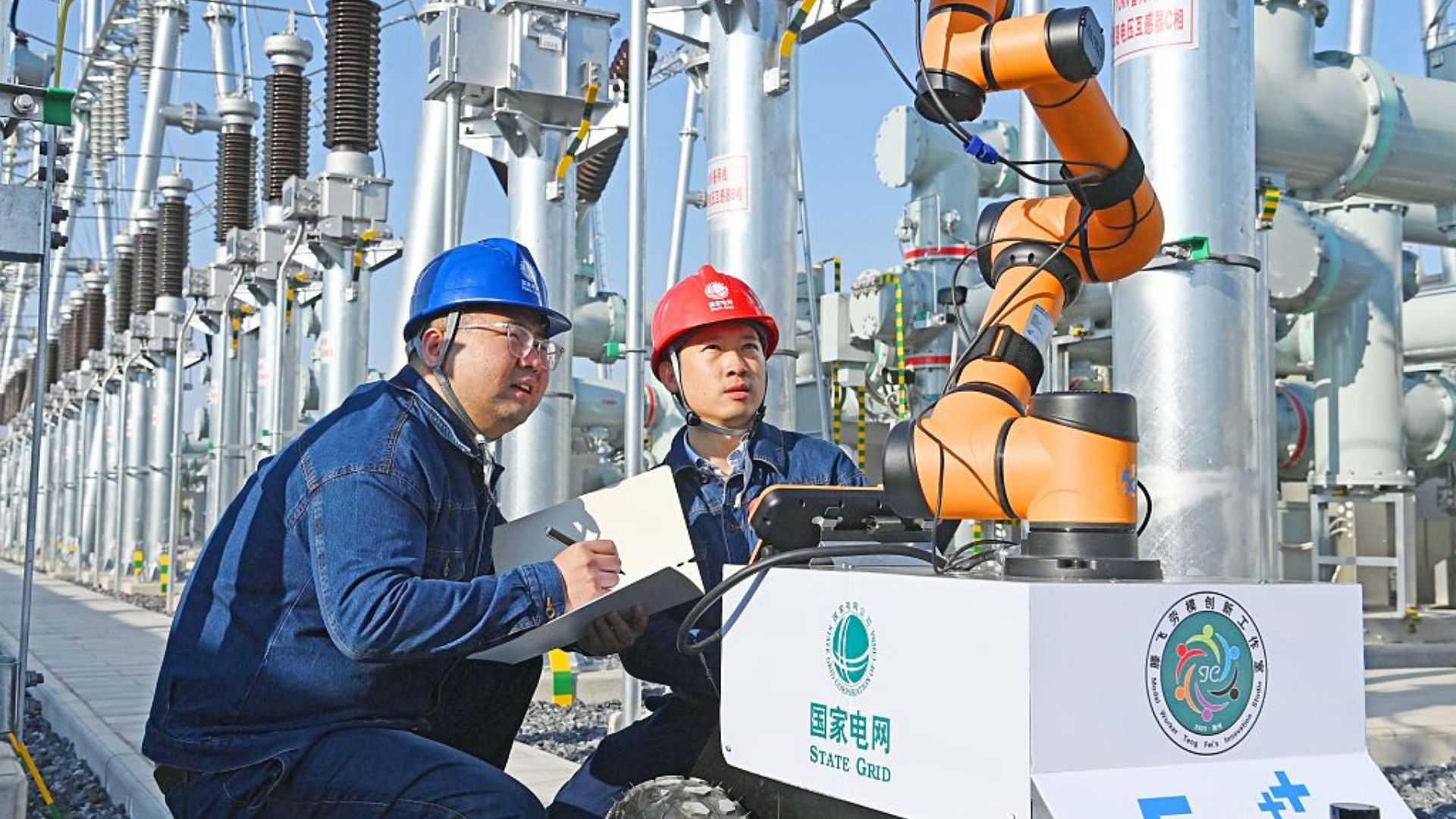
Humans climbing up electric poles to carry out repair work could soon be a thing of the past in China. That shift may be closer than expected, thanks to robots developed by the state-owned power supply company in Jiangsu province. State Grid Changzhou Power Supply Company recently demonstrated the technology, in which robots placed insulating material on live overhead power lines without turning off the electricity. By allowing maintenance to be carried out while the grid remained energized, the installation did not require shutting down the power supply, providing residents with seamless electricity as the upgrade work was ongoing. Safely sleeving power lines According to the company, the newly developed robots, which weigh a little more than 65 pounds (less than 30 kilograms), completed the task of sleeving a 30-meter power line in just 15 minutes. The Chinese power supplier said the robots could be adapted to upgrade power distribution networks of 35 kilovolts (kV) and below, potentially extending the technology to a wider range of maintenance projects. To carry out the task, the robot can automatically access power lines, position itself using its machine vision feature, and accurately move and position the insulating sleeve before installation using its servo motors. At the same time, the machine is well protected from the strong electromagnetic environment, steering clear of any electrical shock. Human operator aids deployment Although the robot performs most of the physical work on its own, it does not operate entirely without human involvement. A human operator remains on the ground and controls or supervises the robot using a remote-control device, computer, or control console. Once remotely deployed by an operator, the robot autonomously travels along energized power lines, installs insulating sleeves with precise alignment, and uses onboard sensors to verify installation quality in real time. According to the company, the pilot was conducted safely without affecting electricity use for consumers. Moreover, a later on-site inspection of the power lines showed that the sleeves were installed securely and met the required docking accuracy, meaning each sleeve was correctly connected, the company said in its press statement. Edge over manual maintenance The successful demonstration also highlighted the broader advantages of replacing conventional maintenance methods with robotic systems. The company said the exercise shows the equipment effectively avoids the safety risks of high-altitude work while preventing power outages, suggesting a shift away from traditional insulation upgrades that rely heavily on manual pole climbing and bucket truck operations. Moreover, such conventional methods are often unsuitable for residential areas with narrow alleys and also pose additional safety risks. Building on those results, the company advocated the use of these automated robots at construction sites where bucket trucks may have difficulty reaching, allowing maintenance work to be completed more safely and efficiently without interrupting electricity supply. Earlier this year, power utilities in southwestern China deployed robotic snakes to inspect power lines and help ensure a stable electricity supply. The snake-like robots wrap around power lines and use onboard cameras and sensors to detect hazards such as damaged wires, worn components, and abnormal temperatures. According to online media reports, these robots inspected more than 80 miles (130 kilometers) of distribution lines serving exam sites near airport no-fly zones. Get the latest in engineering, tech, space & science - delivered daily to your inbox.
China deploys 65-pound robot to insulate nearly 100-foot live power line in 15 minutes
Full Article
Original Source
Read the full article at Interestingengineering →KhanList aggregates and links to publicly available news content. We do not host full articles from third-party sources. Always verify important information with original sources.