
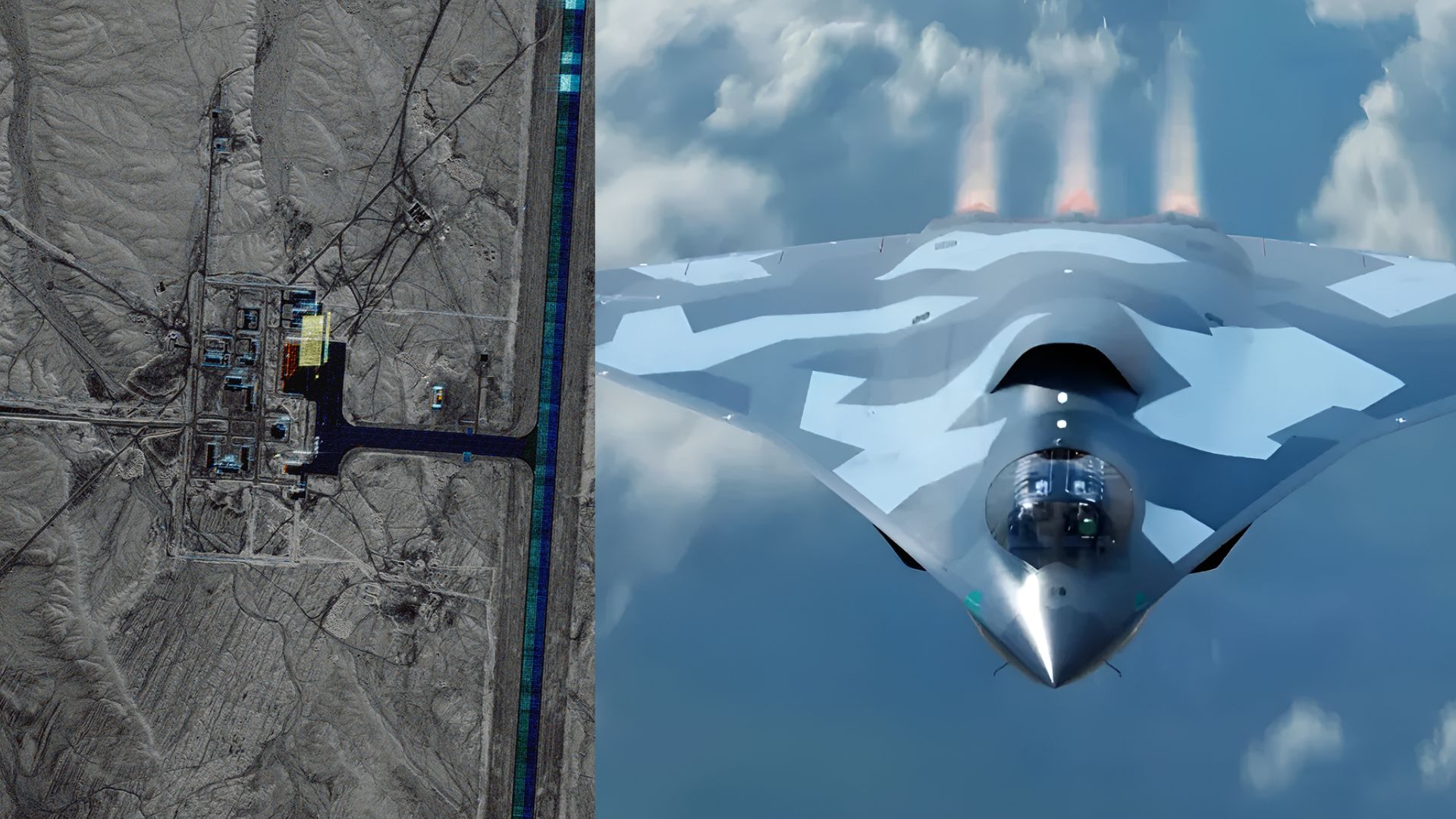
China is rapidly reshaping a remote desert airfield into a major test center for its most advanced military aircraft. New satellite imagery shows a growing complex near Lop Nur, where China’s nuclear testing history now intersects with its push for next-generation airpower. The expansion includes new hangars, taxiway construction, and additional support infrastructure. The site already has a roughly 16,400-foot runway, giving China considerable room to operate large experimental aircraft. The changes could give the People’s Liberation Army (PLA) more space to test multiple aircraft programs away from populated areas. They also suggest Beijing wants to increase the pace of flight testing as its military aviation ambitions expand. Desert hub takes shape Satellite imagery first reported by The War Zone and captured on August 27 shows several major additions across the installation. Four large hangars now dominate parts of the expanding facility. Three hangars on the southern apron measure roughly 262 by 131 feet. Their size could accommodate aircraft across the PLA inventory, including the H-6 strategic bomber. The proportions also leave room for aircraft with larger wingspans. That matters as China develops unconventional designs that differ sharply from its existing fighter fleet. A new taxiway is also nearing completion south of the runway. It will connect the runway with the central apron and main hangar area. That layout could allow aircraft to move without repeatedly occupying the runway. Such changes become increasingly important when a test center handles frequent and complex flight operations. Other construction includes a circular area that may support engine runs or aircraft turnaround operations. Imagery also points to possible fuel-storage infrastructure. Next-gen aircraft focus The location carries unusual significance because of its proximity to China’s Lop Nur nuclear test complex. Beijing conducted its first nuclear test there in 1964. Its isolation now offers another advantage. Experimental aircraft can operate far from dense civilian populations and routine aviation activity. Experts have linked the latest construction to the arrival of China’s J-36 program. The tailless aircraft appeared at the site around August 2025. Another advanced design, commonly called the J-XDS or J-50, appeared there just 17 days later. Those sightings suggest the facility has already played a role in testing China’s emerging combat-aircraft designs. Aviation analysts believe Lop Nur could become the PLA’s new center for high-end next-generation aircraft. Another expert urged caution until construction finishes. The expansion could eventually let China run separate flight-test programs simultaneously. That would reduce scheduling bottlenecks at existing facilities and potentially increase testing frequency. China also operates another secretive test site near Malan. That facility has attracted attention for its work involving advanced unmanned aircraft. Lop Nur appears more closely associated with crewed platforms. That distinction has fueled speculation about another highly sensitive program. China has yet to publicly reveal its H-20 stealth bomber. If flight testing eventually moves to Lop Nur, the expanded hangars could provide an unusually remote environment for the aircraft. There is no confirmation that the H-20 will use the facility. Still, the scale of the construction shows that Lop Nur is becoming much more than an isolated desert airstrip.Get the latest in engineering, tech, space & science - delivered daily to your inbox.Aamir is a seasoned tech journalist with experience at Exhibit Magazine, Republic World, and PR Newswire. With a deep love for all things tech and science, he has spent years decoding the latest innovations and exploring how they shape industries, lifestyles, and the future of humanity.
China builds giant desert hangars at secretive Lop Nur base for J-36, stealth bombers
Full Article
Original Source
Read the full article at Interestingengineering →KhanList aggregates and links to publicly available news content. We do not host full articles from third-party sources. Always verify important information with original sources.