
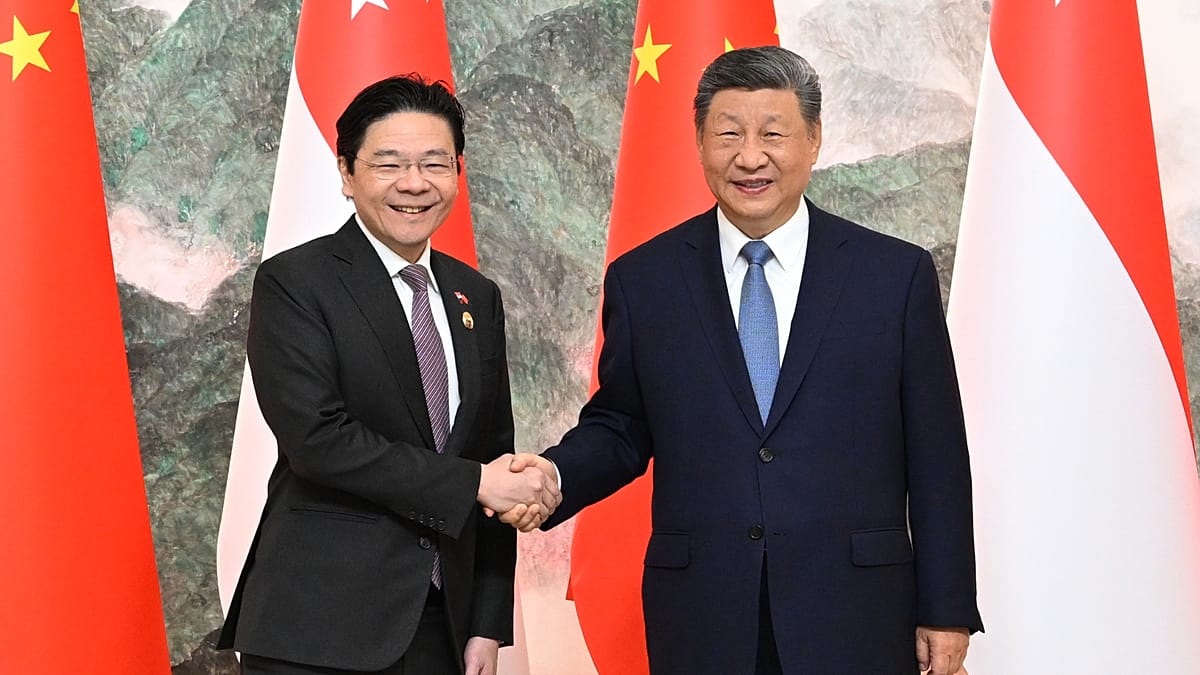
By Dogyu Lee & Euronews Doha bureau Published on 24 November 2026 - 14:04 GMT+1 China and Singapore have agreed to expand yuan financing for businesses, including funding for trade involving other countries, as Beijing seeks wider international use of its currency. ADVERTISEMENT ADVERTISEMENT The measures were announced on Monday at the Joint Council for Bilateral Cooperation meeting in Singapore, co-chaired by Singapore’s Deputy Prime Minister Gan Kim Yong and Chinese Vice Premier Ding Xuexiang. They form part of 29 agreements and cooperation initiatives covering areas including finance, trade, technology and healthcare. The package includes new agreements, renewals of existing arrangements and proposals for further work. Singapore’s central bank, the Monetary Authority of Singapore (MAS), and the People’s Bank of China will restructure an existing yuan funding scheme backed by an agreement between the two central banks to exchange currencies. One programme will allow eligible financial institutions to obtain yuan for a wider range of business lending, including trade involving other countries, daily operating costs and investment. Funding will be available for one, three or six months. A second programme will continue to provide backup yuan funding to financial institutions in Singapore. The range of assets accepted as security for borrowing will also expand, while accepting Chinese government bonds remains under discussion. The central banks are also exploring a link between their fast payment systems for small transfers between the two countries. MAS did not announce an increase in the total funding available. China’s push for wider yuan use The changes come as China encourages more businesses to use the yuan, also known as the renminbi, for international trade and investment. An August analysis by the Reserve Bank of Australia said wider use could help China reduce the financial and geopolitical risks associated with reliance on the US dollar. The share of China’s trade settled in yuan had risen from below 20% in 2021 to around 35%, the analysis found. However, there was little evidence of widespread yuan use in trade that did not involve China. The currency also accounted for less than 2% of global foreign exchange reserves, well behind the dollar and euro. Restrictions on moving money across China’s borders and its less developed financial markets remain obstacles to wider use, the Australian central bank said. The financial measures build on existing links. DBS has begun yuan clearing services, helping banks process payments in the currency. Singapore and China also plan to support companies seeking stock market listings and funding in each other’s markets. Beyond finance, the countries announced plans for an economic corridor linking Singapore, Tianjin Eco-City and Xiong’an New Area in northern China. Singapore’s National Development Minister Chee Hong Tat said the aim was to help companies from the Tianjin region use Singapore as a base for expansion into Southeast Asia, while opening opportunities in China for Singaporean businesses. The meeting followed Friday’s announcement of negotiations to upgrade the China–Singapore free trade agreement. Those talks will cover the digital economy and government procurement, with Singapore also seeking to make cross-border data transfers easier.
China and Singapore expand yuan financing as Beijing pushes currency’s global use
Full Article
Original Source
Read the full article at Euronews →KhanList aggregates and links to publicly available news content. We do not host full articles from third-party sources. Always verify important information with original sources.