
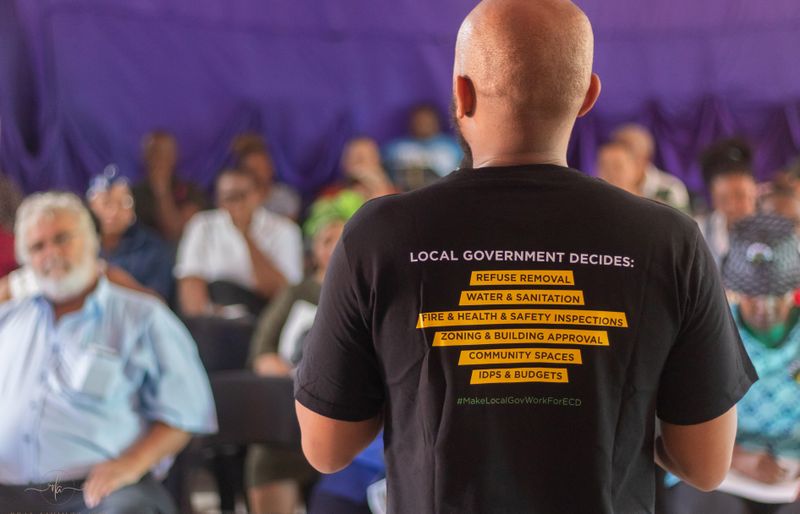
In the lead-up to the 2026 local government elections, the Real Reform for Early Childhood Development (ECD) movement has been working to get early learning issues on municipal agendas, hosting imbizos in communities across the country where mayoral and councillor candidates have been asked to make public commitments to addressing the needs of ECD centres and practitioners.While the Department of Basic Education (DBE) aims to achieve universal access to quality early learning by 2030, many centres still encounter barriers to silver- and gold-level registration within their municipalities. Without this approval, practitioners cannot access the ECD subsidy of R24 per child per day.“It’s all good and well to have national legislation, but it really means nothing when local government is not made aware of their responsibilities, and when they are not actively supporting early childhood development centres, particularly around barriers to registration,” said Tshepo Mantjé, ECD coordinator with the Equality Collective and Real Reform for ECD.Tshepo Mantjé, ECD coordinator with the Equality Collective and Real Reform for ECD, addresses the imbizo on making local government work for ECD centres in Gqeberha, Eastern Cape, on 3 September 2026. (Photo: Supplied / Real Reform for ECD) Pushing for public commitmentsDuring the first and second quarters of 2026, Real Reform for ECD held “listening tours” in 20 municipalities across the country’s nine provinces, leveraging its relationship with community partners and NGOs to gather early learning practitioners and hear their concerns.Among the areas visited were Nkomazi in Mpumalanga; Pongola in northern KwaZulu-Natal, Gqeberha and Mbhashe in the Eastern Cape, Worcester in the Western Cape, Upington in the Northern Cape, Viljoenskroon in the Free State and Rustenburg in North West.Three key issues that emerged across all communities were unreliable water access, delayed environmental health inspections and infrastructure problems, including land use and zoning challenges for centres, according to Mantjé.In the second phase of Real Reform for ECD’s campaign, the feedback from the listening tours was used to create manifestos specific to each municipality. These were handed over to local government candidates at imbizos hosted in 12 of the municipalities, and sent to office-seekers in those communities where physical gatherings were not held.“Phase three is around making sure that these promises are actually implemented by those who have made commitments to them, and this will include ... engaging those who are elected after the elections [and] sending them ECD packs that familiarise them with the issues,” said Mantjé.Voters across South Africa can take their own steps to ensure ECD is prioritised within municipal budgets and planning.Early childhood development practitioners attend Real Reform for ECD’s imbizo in eThekwini, KwaZulu-Natal, on 6 October 2026. (Photo: Supplied / Real Reform for ECD) Is ECD prioritised in your municipality’s Integrated Development Plan?Integrated Development Plans (IDPs) are mandatory five-year strategic planning documents used by South African municipalities to guide all local management, budgeting, land use and development decisions. In Real Reform for ECD’s advocacy toolkit, it notes that people can access their municipality’s current IDP by:Searching online for their municipality’s name and “Integrated Development Plan”;Requesting a copy from their municipal office or councillor; orFinding their ward councillor by sending their ID number via SMS to 32245 (R1 per SMS) and asking about IDP access and participation.Nobukhosi Zulu, senior law and policy specialist at Ilifa Labantwana, noted that many municipalities did not have ECD as a priority within their IDPs, but said action was being taken to change this.“Cogta [the Department of Cooperative Governance and Traditional Affairs], in partnership with the DBE ... has developed these municipal guidelines, and within these ... are ECD IDP indicators that have been developed and approved at the national level, to be rolled out. Obviously, municipalities have a choice whether they accept them or not. It’s our Constitution. But it serves as a guide to help them see how they prioritise ECD in their IDPs,” she said.People were often unaware of the opportunity to take part in the public participation process for their municipality’s IDP, she continued, but the Real Reform for ECD movement had been working with ECD practitioners to help them submit concerns and requests during the consultation periods.Real Reform for ECD leads early childhood development practitioners in handing over a manifesto on making local government work for early learning centres to candidate councillors at the Johannesburg imbizo on 15 October 2026. (Photo: Supplied / Real Reform for ECD) Mantjé highlighted that Real Reform’s next round of IDP mobilisation would take place in the first quarter of 2027, when municipalities would be developing draft IDPs for the next five-year cycle, spanning 2027 to 2032.IDPs are reviewed annually. During the public participation period, community members can provide oral submissions at meetings held by the municipality, or submit written submissions.Real Reform for ECD has encouraged community members to use the IDP public participation process to demand that municipalities use data to identify access gaps and challenges in ECD services, set clear targets for building and upgrading ECD centres, allocate funding specifically for ECD infrastructure and programmes and simplify registration processes for centres.Zulu told Daily Maverick that each municipality should identify an official to serve as a dedicated “ECD champion”, with the responsibility of acting as an intermediary between early learning practitioners and the municipality, and creating an enabling environment for centres. Children gather for lunch at Phaphamani Preschool in Xhorha Mouth, Eastern Cape. (Photo: Felix Dlangamandla) What can you do to ensure your municipality is prioritising ECD?Beyond engaging with their municipality’s IDP, community members could get involved in ECD advocacy by getting to know their ward councillor and asking questions about the prioritisation of early learning on the council’s agenda, said Mantjé.“If the councillor feels inaccessible... go through ward committee members and engage them ... [by] asking to make a presentation at the ward committee meeting that can be taken up to council. That interface is quite important in how people engage with their local government structure,” he said.Residents had a right of access to minutes of council meetings, he added, to check whether the issues they had raised were addressed.“Organising in our communities is really a lost art that we need to work on and bring back... Within early childhood development, we have the benefit of ECD forums. We are also working on parent forums ... [and] how we can bring in faith communities,” said Mantjé.“How do we organise other groups within our communities?” Mantjé asked, “because the collective voice really is the one that can shift things within our local context... It creates a mandate.”What’s happening at a national government level?At the Bana Pele Leadership Summit on 19 October, which brought together stakeholders working towards universal access to quality learning by 2030, Cogta Deputy Minister Dr Namane Masemola said the department, through municipalities, should provide children with basic services, including water, electricity, improved sanitation systems, motorable roads and appropriate infrastructure.Masemola said Cogta and the South African Local Government Association had developed ECD “red tape reduction guidelines” for municipalities, which were awaiting approval from the Cogta minister.“When Integrated Development Plans of municipalities are developed, these aspects of community development through the lens of ECDs will have to be very supreme and prime to all that we’re doing,” he said.“We remain committed as Cogta to this process of national importance, and we’d like to invite all South Africans to be part of the district development models approach that brings all government role players, including state organs, together to plan and positively impact the various district spaces ... throughout the country.” DM
CHILDREN FIRST: How you can put early childhood learning needs on municipal agendas
Full Article
Original Source
Read the full article at Dailymaverick →KhanList aggregates and links to publicly available news content. We do not host full articles from third-party sources. Always verify important information with original sources.