
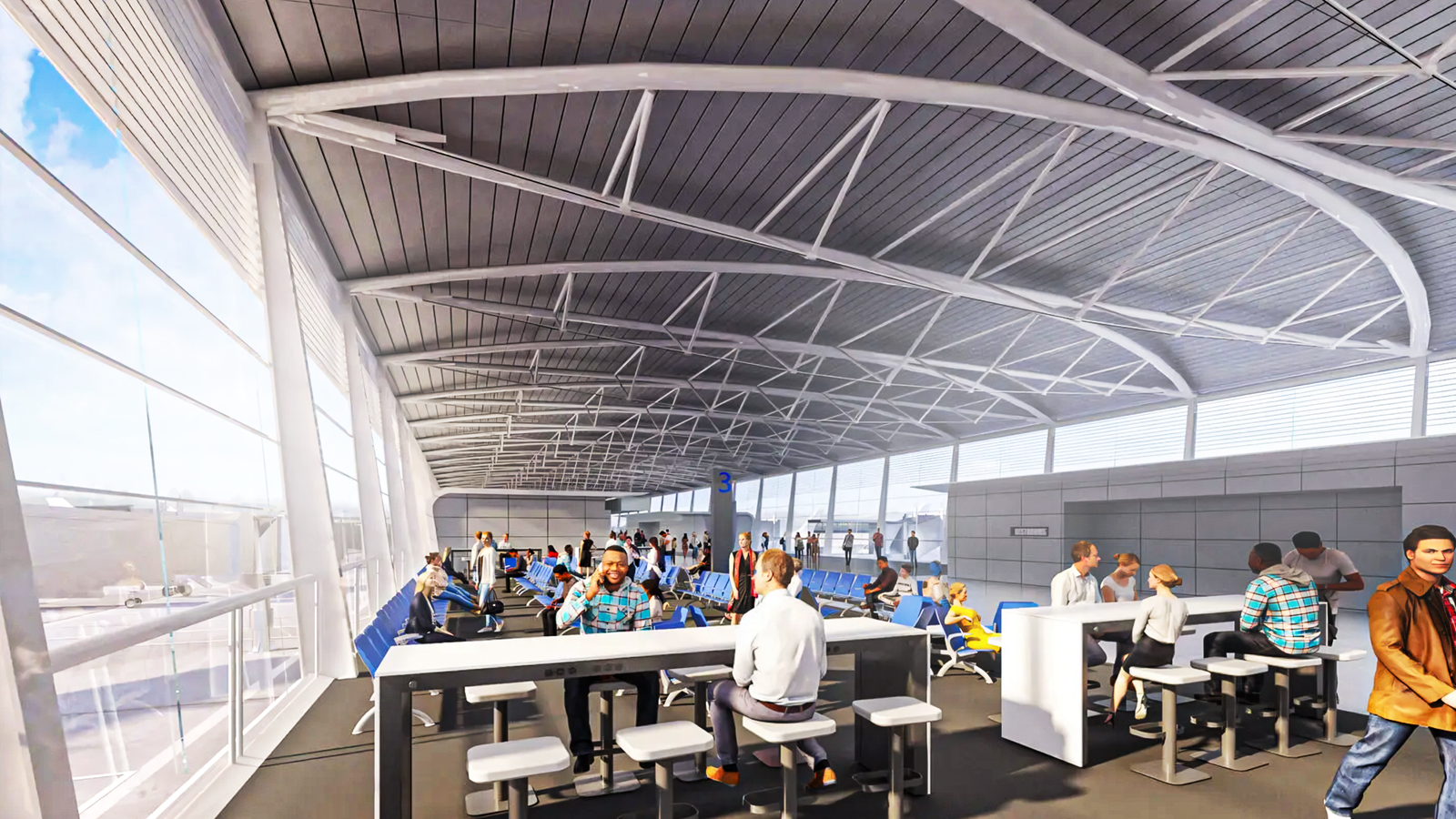
Published Oct 2, 2026, 5:00 PM EDT Journalist - Steven has a varied background in communications, and it was this passion for writing combined with his in-depth knowledge of the aviation industry that led him to Simple Flying. A keen linguist, he also has experience in translation and interpreting. Based in Palma, Spain Chicago O'Hare International Airport's (ORD) long-awaited Global Terminal has now moved toward a 2033 completion, extending the timeline for one of the largest airport redevelopment projects in the US. That delay matters beyond the construction schedule because Illinois is simultaneously advancing plans for another commercial airport roughly 35 miles (56 km) south of downtown Chicago, creating an unusual window in which a greenfield airport could develop while ORD remains in a prolonged transition. The proposed South Suburban Airport (also known as Peotone Airport) is still in procurement rather than construction, but the state of Illinois is actively seeking a private development partner through a Public-Private Partnership structure. The combination of a delayed Global Terminal, additional O'Hare capacity arriving in stages, and a proposed cargo-focused airport in Will County gives the Chicago region two very different aviation projects that could develop alongside each other through much of the 2030s. O'Hare's Biggest Project Is Taking Longer Than Planned Credit: Chicago O'Hare International Airport O'Hare 21 modernization program has evolved considerably since it was first announced, with the current program combining a new Global Terminal, additional concourses, terminal improvements, and other infrastructure intended to increase capacity across the airport. Earlier plans envisioned the Global Terminal arriving sooner, but the revised sequence now places significant emphasis on creating additional gate capacity before the replacement for Terminal 2 can be completed. The Global Terminal itself is planned at approximately 2.2 million square feet (0.2 million square meters) and will replace the existing Terminal 2, creating a facility designed to bring domestic and international operations closer together. The Studio ORD concept, led by Jeanne Gang, was selected for the project, while the broader modernization program is intended to increase O'Hare's gate capacity by around 25%, giving its two major hub airlines additional room to develop their networks. The timing is particularly significant because O'Hare is not simply adding a conventional terminal. The project is intended to reshape how passengers and airlines use the central part of the airport, while construction itself has to proceed around an exceptionally busy operating environment. For United Airlines and American Airlines, the airport's two dominant hub carriers, the phasing therefore affects both long-term capacity and the practical question of where additional flights can be accommodated during construction. Credit: Kenishirotie | Shutterstock Chicago O'Hare International Airport's revised strategy puts a new Concourse E near the front of the queue, with the first phase expected to break ground in late 2026 and provide 14 gates. The planned completion in 2030 is important because those gates are intended to create capacity that can support the subsequent development of the Global Terminal, rather than forcing every major construction activity into the same constrained period. That sequencing reflects the difficulty of rebuilding an airport while keeping one of the country's most important hubs operating. O'Hare's modernization program has already involved years of planning, design changes, and negotiations over costs, with the broader investment commonly described as an $8.5 billion-plus program, although estimates can be higher when additional infrastructure and escalated costs are included. Both United Airlines and American Airlines reached an agreement with the City of Chicago in May 2024 after months of disagreement over the project's cost and scope. Both carriers subsequently supported a phasing plan that prioritized the Global Terminal and Satellite 1 as mission-critical elements, underscoring how closely the airport's construction timetable is linked to the carriers' long-term hub strategies. Peotone Is Finally Entering Procurement Credit: EQRoy | Shutterstock The concept of South Suburban Airport has been discussed for decades, but its current development process has moved beyond the conceptual stage. The Illinois Department of Transportation is now conducting a Request for Qualifications (RFQ) process to identify a private developer capable of designing, building, financing, operating, and maintaining the proposed airport under a Public-Private Partnership arrangement. An important RFQ addendum was issued on May 7, 2026, adding detail to the ongoing procurement. The proposed airport would be located in the Peotone and Monee area of Will County, approximately 35 miles (56 km) south of downtown Chicago. Illinois describes it as a supplemental commercial service airfield intended to serve the wider Chicago region, with potential roles for passenger service, cargo, corporate aviation, and general aviation. Its position also places it near the expanding logistics activity of Chicago's southern suburbs and northwest Indiana. There is still a substantial difference between procurement and an operating airport. South Suburban Airport remains subject to the planning, environmental, design, and financing processes required before construction can proceed, and the Illinois Department of Transportation's project documentation identifies the current delivery method as a P3 procurement. That means the coming years will determine whether private-sector interest can translate the state's long-running airport proposal into an investable project. A Cargo-First Airport Could Fill A Different Role Credit: HASAN AKBAS | Shutterstock The most important distinction between the two airports is that South Suburban Airport does not necessarily need to replicate O'Hare to become commercially relevant. Illinois' stated vision allows for passenger and cargo operations, while regional economic-development research has particularly emphasized a cargo-focused model that would complement, rather than directly replace, Chicago O'Hare International Airport and Midway International Airport (MDW). The latter is a major hub for Southwest Airlines, where data from the US Bureau of Transportation Statistics show that the low-cost carrier commands an impressive 91.1% market share, ahead of Frontier Airlines: Ranking Airline Market Share 1 Southwest Airlines 91.1% 2 Frontier Airlines 3.0% 3 Delta Air Lines 2.8% 4 Volaris 2.3% 5 Allegiant Air 0.5% A study cited by the South Suburban Mayors and Managers Association estimated that a cargo-centric South Suburban Airport could create approximately 6,300 jobs and generate around $1 billion in regional economic activity. The same analysis calculated an economic multiplier of $2.01 for every dollar invested, illustrating why the airport is being discussed as part of a broader logistics and industrial-development strategy rather than solely as a passenger facility. That model could make the airport attractive to freight operators, logistics companies, and airlines seeking additional space away from Chicago O'Hare International Airport's increasingly valuable central airfield capacity. The southern suburbs also have established highway, rail and warehouse infrastructure, while Illinois has continued advancing the land and infrastructure planning surrounding the proposed airport. The commercial case would ultimately depend on infrastructure costs, private financing, cargo demand and the ability to attract operators. The Airline Question Is More Complicated Credit: Santiparp Wattanaporn | Shutterstock For passenger airlines, the existence of another airport does not automatically mean that traffic will move away from Chicago O'Hare International Airport. United Airlines and American Airlines have built extensive hub networks around the airport, where connecting passengers, international flights, domestic feeder routes and airline facilities are integrated into a large operating system. The busiest international destinations from the facility last year are outlined in the table below: Ranking Destination Passengers 1 London Heathrow 1,047,000 2 Toronto 875,000 3 Cancun 798,000 4 Mexico City 768,000 5 Frankfurt 713,000 A new airport would have to offer a compelling operational or economic proposition before either hub carrier would have a reason to restructure that model. South Suburban Airport could instead become more relevant to airlines that do not require a traditional connecting hub. Low-cost and ultra-low-cost carriers could use additional airport capacity to serve the south suburbs directly, particularly if airport costs and passenger access are competitive. Cargo operators could have an even stronger reason to consider the facility if dedicated freight infrastructure provides room for warehouses, aircraft parking, and logistics development that is difficult to create within an established airport. This is where the decade-long overlap becomes significant. Chicago O'Hare International Airport is building toward a larger and more integrated future, but its transformation will continue through the same period in which South Suburban Airport could move from procurement into development. Rather than creating a simple rivalry, the two facilities could develop different customer bases, with O'Hare retaining its role as a major passenger hub while Peotone targets cargo, regional demand and carriers seeking alternative operating space. Illinois Is Effectively Building A Two-Airport Strategy Credit: Ian Dewar Photography | Shutterstock Chicago already has two commercial airports, with O'Hare International Airport handling a broad mix of domestic, international, hub and cargo operations and Midway International Airport serving a more concentrated short-haul and low-cost market. Adding South Suburban Airport would therefore create a three-airport commercial system, although its eventual role would depend heavily on how the private developer, airlines and freight operators shape the project. The arrangement would have similarities to other major metropolitan areas where multiple airports serve different markets, although Chicago's geography and airline structure would make any comparison imperfect. London's airport system, including London Heathrow Airport (LHR) and London Gatwick Airport (LGW) and New York's multiple-airport network, including New York John F. Kennedy International Airport (JFK) and Newark Liberty International Airport (EWR), show how passenger and cargo demand can be distributed among facilities, but Chicago's exceptionally strong hub presence at O'Hare International Airport means that a new southern airport would enter a market where connecting traffic is already heavily concentrated. For Chicago O'Hare International Airport, the 2033 Global Terminal date therefore does more than move an architectural milestone further into the future. It creates a period in which Illinois can test whether another airport can be financed and developed while O'Hare adds capacity in stages. If South Suburban Airport progresses through procurement, environmental work, financing, and construction, the 2030s could see Illinois operating an increasingly sophisticated O'Hare hub alongside a new southern aviation complex designed around a different commercial purpose.
Chicago O'Hare's Global Terminal Just Slipped To 2033, Opening A Decade For A Rival Illinois Airport
Full Article
Original Source
Read the full article at Simpleflying →KhanList aggregates and links to publicly available news content. We do not host full articles from third-party sources. Always verify important information with original sources.