
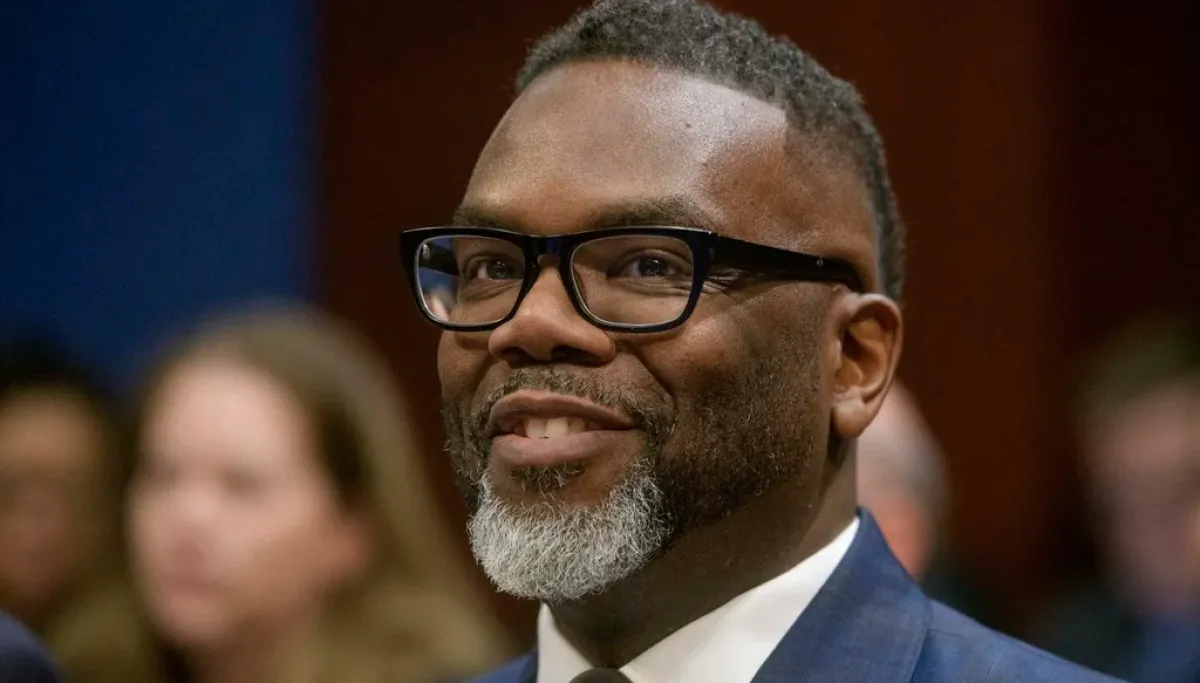
A bloc of Chicago City Council members is demanding that Mayor Brandon Johnson pursue spending cuts and other permanent savings before raising taxes or relying on unapproved state revenue to close the city’s projected $882.4 million budget gap.The aldermen, who call themselves the City Council Budget Accountability Coalition, laid out their demands in a letter to Johnson on Monday as the city begins preparing its fiscal 2027 budget.“Chicago begins the FY2027 budget process confronting a projected $882.4 million deficit,” the aldermen wrote. “That figure is lower than earlier forecasts, but it remains a fiscal challenge of the first order — one that will demand hard and honest choices from the administration and the City Council alike.” The projected deficit is down from the roughly $1.2 billion shortfall the city faced last year, but it remains one of the largest gaps in Chicago’s recent history. Johnson has said his administration will pursue “progressive” revenue measures to address the city’s fiscal problems while protecting essential services. The coalition established three lines it says must guide the budget negotiations: no property tax increase, no corporate “head tax” or other tax on job growth, and no reliance on revenue from Springfield that has not yet been approved.“Chicago’s homeowners, renters and businesses already shoulder a heavy property tax burden,” the aldermen wrote. “Adding to it is not the way to close this gap.”Johnson proposed a per-employee tax on large corporations last year, but the city council rejected the measure as it took control of the 2026 budget process. Instead, the aldermen are calling on Johnson to pursue savings identified in a 2025 report his administration commissioned from consulting firm EY. According to the letter, the report identified more than $1 billion in possible savings through measures, including eliminating long-vacant positions, reducing management overhead, reforming procurement, limiting overtime, selling surplus fleet and real estate, and eliminating duplicative or ineffective programs.The aldermen emphasized that those savings must translate into actual reductions rather than accounting changes.“These must be real savings, not savings on paper,” they wrote. “If the budget claims an efficiency, Council and the public should be able to name the position, contract or program that was actually cut.”The coalition also called on the administration to distinguish between one-time expenses and the city’s structural imbalance.Johnson’s administration has identified roughly $400 million in police misconduct settlements, $90 million in additional pension costs, and $70 million in higher debt-service costs among the factors driving the projected deficit. The forecast also accounts for cost-of-living adjustments and inflation.The aldermen argued that one-time expenses, such as settlements, should not be used to justify permanent tax increases, while recurring pension and debt costs require structural solutions.“One-time money must not paper over a permanent problem,” the letter states. “Borrowing, refinancing, reserves and asset sales have no business underwriting recurring operations.”The coalition said it would consider “reasonable, locally controlled revenue options” if the city first identifies meaningful recurring savings. It said those efforts should begin with collecting money already owed to the city, recovering costs, and modernizing existing revenue sources.“Reduce the cost of government. Protect essential services. Collect what is already owed. Determine the true remaining structural deficit. Then, and only then, decide what new revenue, if any, is truly necessary,” the aldermen wrote.HOW MS. RACHEL WENT FROM BELOVED CHILDREN’S STREAMING SENSATION TO ‘MOUTHPIECE FOR HAMAS’The Johnson administration pushed back on the coalition’s demands, saying the group should offer concrete proposals for closing the deficit rather than simply listing measures it opposes.“We welcome and appreciate good faith engagement from alderpeople and all other stakeholders as we begin the FY2027 budget process,” the mayor’s office wrote Monday. The administration said Johnson’s first three budgets had implemented more than $740 million in cost savings and efficiencies while maintaining critical services.
Chicago City Council demands Brandon Johnson make ‘real savings,’ not tax tricks in city budget
Full Article
Original Source
Read the full article at Washingtonexaminer →KhanList aggregates and links to publicly available news content. We do not host full articles from third-party sources. Always verify important information with original sources.