
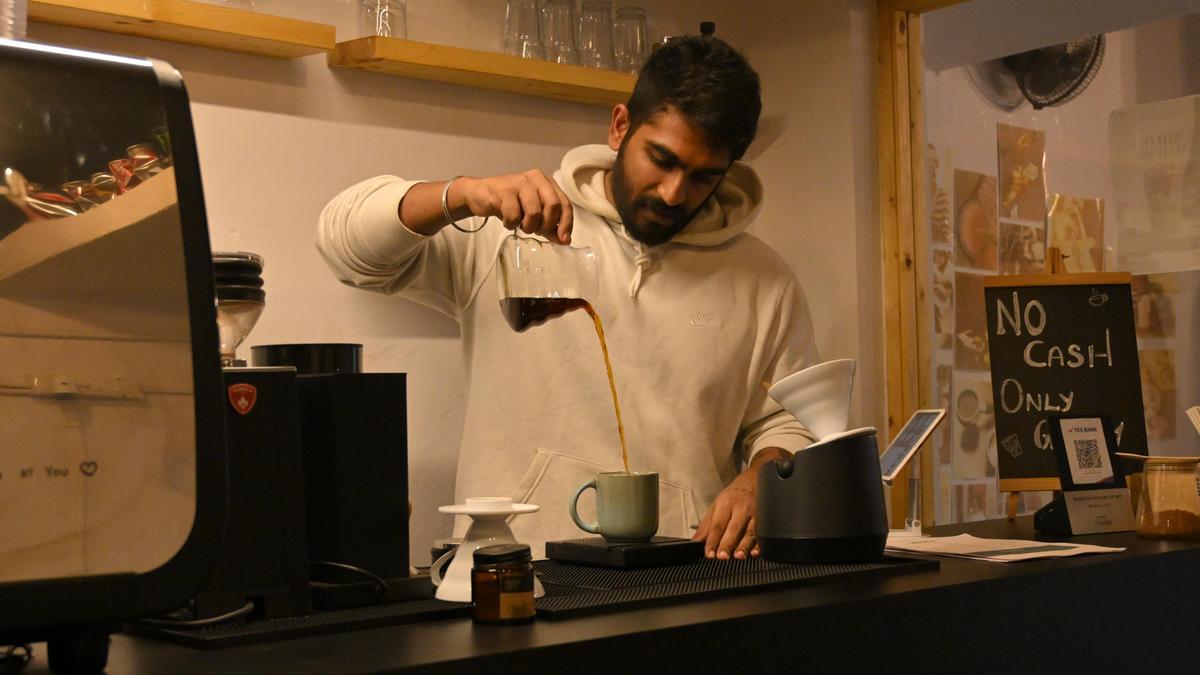
How many times, after a tough week at work, have you called your best friend and said, “Let’s just open a cafe”?For most corporate workers and creatives alike in Chennai, the thought usually dies somewhere between late-night, post-drink optimism and the sobering look at commercial real estate listings.But a growing crop of entrepreneurs seems to have found a way around that particular reality check. Instead of starting with sprawling spaces, elaborate interiors and kitchens capable of turning out an entire menu, they are starting with just a counter or kiosk and a focussed offering.Gokul Ganesan, who started Origins Coffee in Anna Nagar with a roughly 100-square-foot space, wanted to make speciality coffee more accessible without compromising on quality. “To break the myth that coffee is a luxury, you have to bring down the cost. The first step is to make it grab-and-go. You don’t spend as much on infrastructure or interiors, and you don’t provide seating,” he says. Koncrete Coffee Shop in Chennai. | Photo Credit: UMESH KUMAR V At Origins, a latte costs ₹125 and a shot of espresso ₹75, and they also have ’ speciality offerings including a sugarcane cold-brew and a salted latte priced between ₹180 to ₹200 which at a larger, more conventional cafe can cost anywhere between ₹300 and ₹400. While Origins does not offer online delivery services, grab-and go is a much popular choice. There are two standing tables, and a couple of high chairs at the counter. “My idea was also to build on the fact that people are becoming more interested in coffee. They want to understand the product, and there are so many different things you can do with it,” he says.For Gokul, most of his regulars are college-goers or young professionals whose taste range anywhere from black coffee to a sweet Milo milkshake. “We get a lot of customer who come by just for a cup of filter coffee. We offer that as well because we have to keep up with the demands of our location,” says the former model and corporate worker. Culinary consultant Shabnam Banu, who works with brands Mo’Joe house in Coimbatore, Coffee Sangam in Hyderabad and more across South India, says smaller formats are attracting first-time entrepreneurs looking to enter the food and beverage business without making a large initial investment. She estimates a takeaway-led coffee kiosk to cost between ₹10 lakh and ₹15 lakh to set up, depending on the location as opposed to a medium size cafe for which set-up costs start at ₹50 lakhs. Equipment can cost anywhere between ₹2 lakhs and ₹20 lakhs. These include coffee machines from La Carimali, La Marzocco, La Spaziale and other professional cafe grade equipment.Three years ago, when Chennai’s speciality coffee scene was only a handful of spaces, Raghav Ethan started Blue Bean Coffee, a five to six seater coffee shop in Anna Nagar . “It was my pet project after I came back from the US. I had worked at Starbucks, learnt how to brew and got into speciality coffee. I spent around ₹10 lakhs to open that cafe,” he says, adding that when he found a space in Alwarpet, he expanded to open Koncrete Coffee in 2025, which is a slow-bar compact coffee shop where manual pour-overs are served in an un-rushed format. “I have always wanted to create multiple brands, and I realised that I had a niche in setting up these compact coffee shops. I invested around five to eight lakhs and was able to break even in eight months to a year with both Blue Bean and Koncrete,” says Raghav, adding that he spends around ₹15,000 a month on beans alone which are sourced from Chikkamagaluru andf Yercaud. “The total operational costs to run a compact cafe can be anywhere between ₹35,000 and ₹45,000 and include beans, raw ingredients like milk, sugar etc, electricity, rent and more,” he says. The operational costs per month for a larger cafe include ingredients and produce for the food menu, salaries for the chefs and staff, fuel, rent, electricity and more, over and above the coffee and the barista programme. “To break even, a good benchmark for recovery is 36 months,” says experienced restauranteer Sandesh Reddy. Koncrete Coffee Shop in Chennai. | Photo Credit: UMESH KUMAR V “This is a Vietnamese-style cafe. Concrete, bare walls, casual seating with low tables and a pet-friendly space. But it took some time for people to understand what we were trying to do,” he says, adding that currently he has a community of regular customers who do quick take-aways before work. Pour-overs, Spanish lattes, and even a dirty Coke (diet Coke with a shot of espresso) are popular choices.But starting small does not necessarily insulate a business from failure. Bhavesh Surana S, an architect who runs Ratio Coffee in Anna Nagar, learnt this with his first venture, Den, a takeaway cafe in Besant Nagar. Origins coffee | Photo Credit: Special Arrangement “That first year cost me around ₹15–20 lakh in losses. I had no formal training. Chennai wasn’t entirely ready for that format then, but when I think about it now, that was my learning period. If I hadn’t gone through that, I wouldn’t be here today,” he says recalling how he would spend days perfecting espresso, learning to make drinks, and educating himself on the ins and outs of what it takes to run a cafe successfully, big or small. “I also have friends who owned successful coffee shops in the city and having them to go to for advice helped a lot.” he says.Sandesh, who own cafes like Delifina and Chã Japanese Cafe, says that there is a business idea behind these smaller spaces as long as it is executed well. “New cafe owners end up trying to do too many things at once, and try to be trendy. Not focussing on the coffee is the most common mistake they make,” he says.“There is a market for these and we have seen this in many parts of India and even Asia. Coffee is largely an on-the-go beverage and not a dine-in thing. As more people are adopting coffee on the go, you start to realise that there is a business in these smaller cafes, once the trend starts moving,” he says. Ratio coffee | Photo Credit: Special Arrangement Despite the initial stumble, Bhavesh realised that the micro-format, once the operational numbers align, holds a financial edge over larger, sprawling spaces. “When you have a larger space, the rent is higher, and you need more people to work there. With a smaller space, I only have two people working, and I know how to make coffee myself. My overhead costs are lower,” he says, serving up a coastal coffee with tender coconut water and a heady shot of espresso. Smaller spaces also encourage more conversation, a definite advantage at a time when so many people are looking for community. Suresh S, who was a barista at Anna Nagar’s Halt, deliberately chose a small kiosk for his own venture, Exist Cafe, in Kilpauk. He runs a compact operation that does not offer manual pour-overs and speciality drinks, but they do a 18-hour cold brew that can hold its own. He sources his beans from Chikkamagaluru because he says the cooler climate and higher altitude provide a better quality of bean. “Our most popular beverages are the salted Vietnamese coffee and anything with Milo in it,” he says. Coffee at Ratio | Photo Credit: Special Arrangement For Gnaneswar Ch, a Chennai-based home brewer and speciality coffee enthusiast, the appeal of an open-counter kiosk over a sprawling cafe comes down to the possibility of a real conversation. “In most larger places, you simply order and receive a drink. The open counters allow for actual interaction. You can ask whether the beans are in good shape, talk about what they’re brewing, and customise your drink. You’re having a dialogue with someone who actually understands the coffee,” he says. The draw, he says, is the familiarity and rhythm of going to a coffee shop, picking your beans, seeing the cup of coffee made right in front of you. “After a couple of visits, the person behind the bar knows how you take your cup, and you know what you like there. That kind of routine is grounding,” he adds. For decades, the city’s true social engine has been the standing-only street corner shop. Stepping out for a 15-minute breather, standing around parked scooters, leaning against car bonnets, and striking up spontaneous banter was just how it operated. If Chennai’s second coffee wave was defined by the air-conditioned lounges of Café Coffee Day in the 2000s, and its third by speciality roasters tucked behind glass doors, this latest shift could signal a new phase in the city’s coffee culture. High-quality, artisanal brews are moving out of high-rent cafés and back to street corners, where smaller counters and accessible pricing offer less space to linger but more room for conversation.
Chennai’s speciality coffee kiosks reshape the city’s café culture
Full Article
Original Source
Read the full article at Thehindu →KhanList aggregates and links to publicly available news content. We do not host full articles from third-party sources. Always verify important information with original sources.