
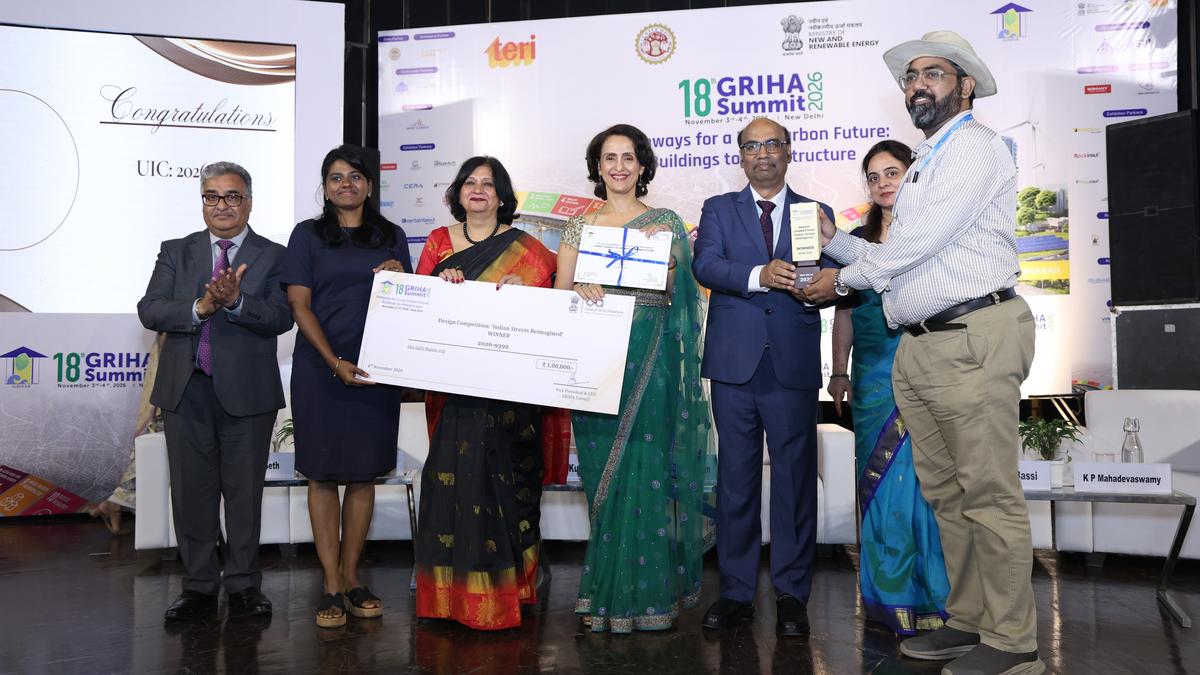
At the prize distribution function held during the 18th Griha Summit 2026. What if underutilised spaces below the MRTS line near Wallajah Road were revamped to have a pickleball court? What if dedicated lanes for pedestrians with seating areas under tree canopies were created at Wallajah Road? What if the Quaid-e-Millath Road-Wallajah Road junction had art elements inspired by Kolam patterns and Islamic architecture?Five architecture academicians from MEASI Academy of Architecture sifted through such “what-ifs” centred on Wallajah Road for a national-level competition, and they won the first prize and a cash prize of ₹ one lakh.The competition was conducted by GRIHA (Green Rating for Integrated Habitat Assessment) in association with CoA (Council of Architecture) as part of the 18th Griha Summit 2026 held in India Habitat Centre on November 3 and 4, 2026. ‘Indian Streets Reimagined Design’, as the competition was titled, required teams to select a stretch of a street that presents clear opportunities to rethink the distribution of space among people, vehicles, commerce, landscape, and public amenities while responding to the local climate, urban context, cultural identity, and character of the selected Indian street.The five — Muzakkir G. M. Bijli, Silivinus Clisson Pragash, Anusree, Anjana Lakshmi and Sangamithra — looked at interventions to make Wallajah Road more pedestrian-friendly, accessible and sustainable.“Irrespective of whether we won or not, we were planning to take our design ideas either to Greater Chennai Corporation or CMDA. The victory gives us a leverage,” says Muzakkir G. M. Bijli, associate professor with the architecture college.Although Wallajah Road is a wide thoroughfare, it is usually underutilised. The team observed that it comes to life only during IPL matches or any other event, so they suggested design ideas based on three factors to activate the street: activity, ecology and mobility.A pickleball court or some sporting activity in an unused space below MRTS was conceived as Wallajah Road is known for its sports shops. Bachelors in the mansions of Triplicane would be drawn to sports activities.“With respect to ecology, we attempted to bring in patch corridor matrix by working on a bio-swale on both sides of the road and on the median. This sort of planting is a small attempt at mitigating the urban heat island effect. The design also included a composite swale-cum-stormwater drain section considering the short-term high-intensity rains in Chennai,” says Bijli, a resident of Nerkundram.The design involved provision for dedicated lanes for pedestrians with seating areas under tree canopies. It also included a dedicated cycle track which runs on both sides. Space for vendors in designated zones was also proposed.The proposal envisioned Wallajah Road as more than a transit corridor connecting important parts of Chennai. Our proposal aimed to demonstrate how an existing urban thoroughfare could be reimagined as an inclusive, vibrant, climate-responsive and people-oriented public space, say the architects. Published - November 07, 2026 06:44 pm IST
Chennai architecture academicians win prize at GRIHA
Full Article
Original Source
Read the full article at Thehindu →KhanList aggregates and links to publicly available news content. We do not host full articles from third-party sources. Always verify important information with original sources.