
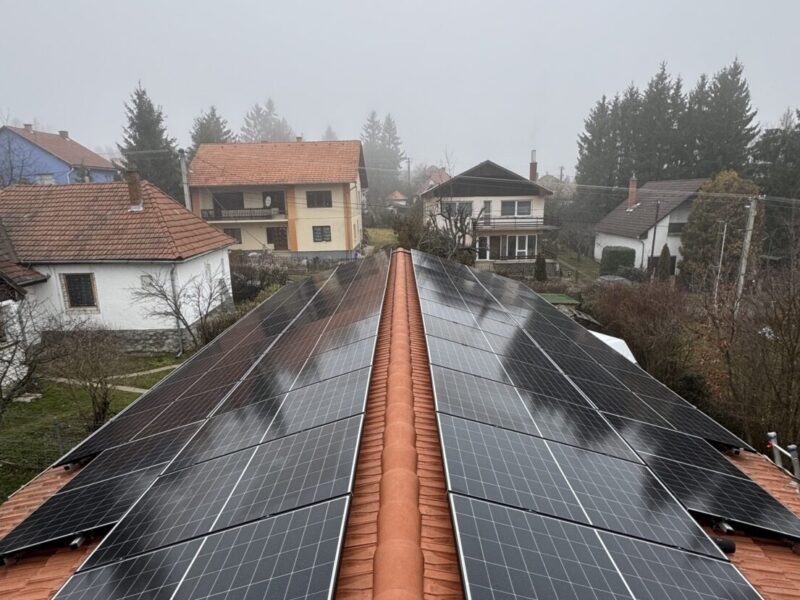
BUDAPEST, Hungary (CN) — Once a high school for girls, this giant neo-Gothic building on Jurányi Street in central Budapest morphed into a contemporary arts center after the school closed in 2005.These days, it’s also a source of solar power and a symbol of a quiet renewable energy revolution taking place across the former Iron Curtain.Installed two years ago, a fleet of 132 panels on the roof now provide roughly 60% of the building’s energy needs. During the day when the building’s use is lower, these panels can also supply the city grid.“We are a sunny country, so we have solar power,” green energy expert Agnes Szalkai-Lőrincz said.An organizer with the nonprofit National Society of Conservationists and Friends of the Earth Hungary, Szalkai-Lőrincz played a key role in getting these panels here.On a partly sunny day in April, she climbed the main stairwell inside the 19th-century building. The place hummed with activity as actors, dancers, crews and writers rehearsed for upcoming performances.As Szalkai-Lőrincz reached the top of the building where the panels are, she opened a balcony door.Down below, people sat at outdoor tables talking, eating and reading. The sounds of children playing reverberated from a daycare at the back of the old school.People chat in a hallway of No. 1 Jurányi Street, a former high school in Budapest that was turned into an arts incubation center. Solar panels now provide it with 60% of its energy needs. (Cain Burdeau/Courthouse News)In former Soviet bloc countries like Hungary, grids have long relied on dirty sources of power. But that’s changing quickly, with big implications for Europe.The surge of renewables here could help the European Union meet its goal of net-zero emissions by 2050, as required by the 2015 Paris climate agreement and other EU laws. It could also help improve quality of life in the former Iron Curtain, which has long suffered from higher rates of air pollution.The numbers are striking. In just the last six years, solar production in Eastern bloc countries like Poland, Hungary, Bulgaria and Romania has ballooned a whooping 450% on average, said László Török, a Hungarian renewable energy expert at the University of Debrecen in eastern Hungary.In 2016, Hungary produced just 244 gigawatt-hours of solar power. Today, it creates 9200 GWh, accounting for almost 25% of its energy needs.The result is “an extremely rapid solar revolution,” Török said. It’s “noticeably transforming the energy structure and indirectly the economy,” helping to close the renewable energy gap between Western and Eastern Europe.“Ten years ago, the German, Spanish and Italian markets dominated,” he said. “Today, Poland and Hungary are among the fastest-growing solar markets in Europe.”There are many causes for this shift, from war and technological advancement to increasing urgency about the climate crisis.Regardless, the results are clear. For the first time last year, the EU produced more electricity from renewable energy sources than fossil fuels. It now produces 367 gigawatt-hours of solar power, the equivalent of around 1.5 million acres of solar panels. That’s an area about the size of Delaware.An undated photo shows solar panels atop No. 1 Jurányi Street in Budapest, Hungary. (National Society of Conservationists/Friends of the Earth Hungary via Courthouse News)In Hungary, solar panels are sprouting up all over: factories, homes, carports, businesses, public buildings and even sports fields. And also, at this former girls’ high school turned arts center.Looking out from this grand sandstone**** building on Jurányi Street, Szalkai-Lőrincz admired an array of panels fastened to the tiled roof. “These are normal bifacial solar panels,” she gushed. “Really great.”Renewable energy is booming worldwide, as mass-produced solar technologies, especially from China, are increasingly making green energy more affordable than dirtier sources.Europe is a major customer. Over the past decade, the EU has imported a staggering $94 billion worth of solar panels from the country. Last year alone, it bought 91 gigawatts worth of Chinese solar modules, enough to meet the peak electricity needs of a large U.S. state.There’s many reasons for Europe’s swift transition to renewables.One is the Ukraine War. In 2022, the EU cut Russian energy imports, closing off what had once been a major supply of dirty power and forcing Europeans leaders to rethink energy security. Another is coronavirus relief funds, which have offered billions in grants and loans to help homeowners and businesses go green.There’s also the simple urgency of this project. Europe is the world’s fastest-warming continent, a fact evidenced this year by brutal heat waves and wildfires.Electric wires over neighborhoods in the western outskirts of Budapest, Hungary, seen here in April 2026. (Cain Burdeau/Courthouse News)A swath of EU policies are pushing the bloc to go green. “Fit for 55” aims for a 55% reduction in 1990-level emissions by 2030. “REPowerEU” incentivizes building out green power sources and moving away from Russian energy.“It’s mainly EU money and EU policies driving this,” Michael LaBelle, head of environmental sciences and policy at the Central European University in Vienna and Budapest, said of Central and Eastern Europe’s build-out of green power.Hungary might not be known for sunny days in the way that, say, Spain is. But there are still plenty of them to provide ample power, LaBelle said.“November, December, January, it’s grim, but the rest of the year, there’s definitely sun,” he said. “Hungary’s ideal: 200 days a year or so, just sunshine.”Other former Eastern bloc countries are even further along in the transition. Although it still relies on coal, Poland on its sunniest days can now meet around 60% of its energy needs with solar power.“We have millions of people who have installed photovoltaic on their roofs,” said Miroslaw Janik, a Polish energy expert with the group CleanTech for CEE who helps homeowners and businesses navigate the solar market. CEE is an acronym for Central and Eastern Europe, exactly the part of the continent where renewables are now booming.“This first phase of solar is almost done in Poland,” Janik beamed. “It’s a moment to make people understand that the future is not gas.”An International Energy Agency graphic shows the soaring use of solar in Hungary in recent years. (International Energy Agency via Courthouse News)In Hungary, the EU in recent years has spent about $1 billion to help about 260,000 homes and businesses install solar panels. Still, critics say renewable energy funds were poorly managed under the longtime rule of former Prime Minister Viktor Orbán, who finally lost power in April after 16 years.One top Hungarian renewable energy expert, who asked to remain anonymous to speak candidly about the former prime minister, said that Orbán — a longtime ally of President Donald Trump — had parroted Trump’s claims that wind energy is ineffective and a blight on the landscape.“It was definitely a huge mistake,” the expert said. “We now have significant overproduction in the [solar] sector” and not enough wind power generation to match.Hungary needs a comprehensive green energy plan, the expert said — something they said Orbán failed to do over his 16 years in power.“There was no real debate,” they said. Instead, “there was a group of people connected somehow to the government.” They hoped that Prime Minister Péter Magyar, who assumed office in May, would help the country develop a real roadmap to a 100% renewable-energy system.As renewable energy becomes cheaper and more popular, even cronyism and government mismanagement could not fully slow its advance here.Back at former school on Jurányi Street, Szalkai-Lőrincz took out her smartphone. An app connected to the inverters lets her check how much power the panels are producing. At the moment, the building was producing around 10 kilowatts but only using around 4 kilowatts of it, feeding the extra 6.1 kilowatts into the grid.Agnes Szalkai-Lőrincz reads a meter reading the output from solar panels atop a former high school in Budapest. (Cain Burdeau/Courthouse News)Even with only partial sun, the solar array here was still running at a surplus — at least for now. “The activity of the building is lower during the daytime,” she explained. “The huge consumption is during the night because they have shows.”Szalkai-Lőrincz sees huge potential for renewable energy in Budapest. As solar power generation gets cheaper than ever, going green simply makes financial sense.“They are saving energy with our solar systems and getting money from the surplus energy,” she said. “The plan is to use the surplus energy to heat water in a hybrid boiler."Courthouse News reporter Cain Burdeau is based in the European Union.Subscribe to our free newslettersOur weekly newsletter Closing Arguments offers the latest about ongoing trials, major litigation and rulings in courthouses around the U.S. and the world, while the monthly Under the Lights dishes the legal dirt from Hollywood, sports, Big Tech and the arts.Additional Reads
Central, Eastern Europe gain ground in race to go green
Full Article
Original Source
Read the full article at Courthousenews →KhanList aggregates and links to publicly available news content. We do not host full articles from third-party sources. Always verify important information with original sources.