
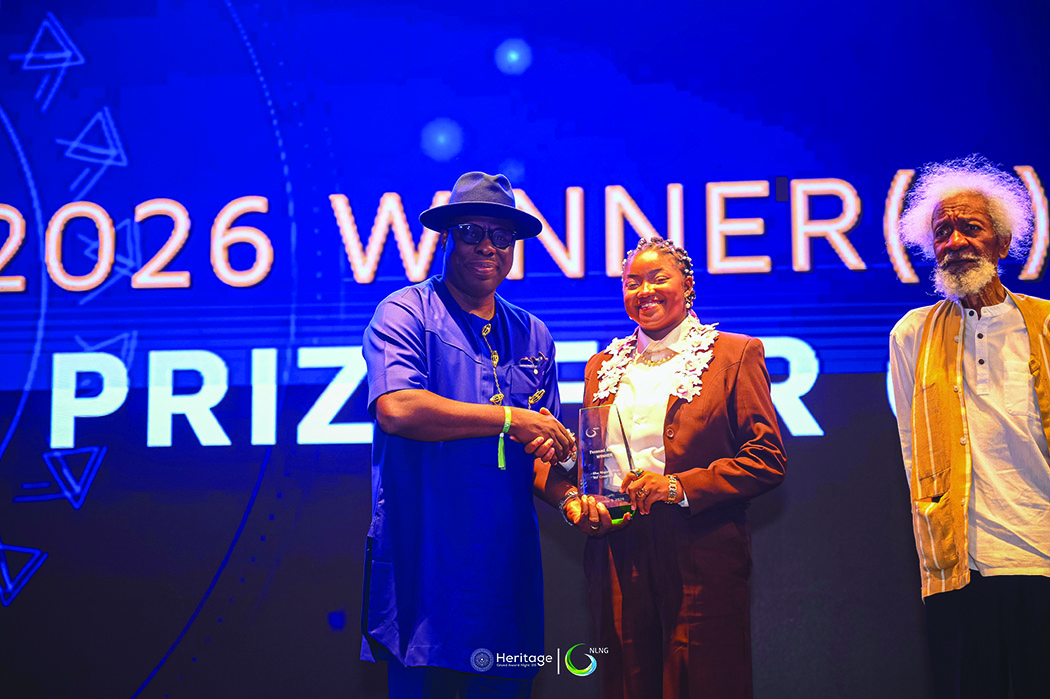
With a collection confronting religious fanaticism, political violence and the abuse of power, poet and human rights lawyer Ogaga Ifowodo has won this year’s Nigeria Prize for Literature. Yinka Olatunbosun reports The air inside the Grand Ballroom, Eko Hotel and Suites, Victoria Island Lagos was thick with anticipation—a vibrant mix of nervous excitement and the soft hum of eager chatter. A tradition for the literati, the Nigeria Prize for Literature and the Prize for Literary Criticism is arguably the most prestigious event celebrating Nigerian resilience, imagination, and scholarly rigour. With a life-changing prize $100,000 for the flagship literature award, alongside the prestigious $10,000 literary criticism prize and the acclaimed science and creative arts honour, the night represented the absolute pinnacle of recognition for the nation’s creative and scientific minds. When the envelope was unsealed by Professor Akachi Adimora-Ezeigbo, Chairperson of the Prize’s Advisory Board, one name resonated across the hall to thunderous applause: Ogaga Ifowodo. A renowned poet, human rights lawyer, and scholar, Ifowodo was declared winner for his masterful poetry collection, Why Does God Need a Gun? edging out fellow finalists James Ngwu Eze (Unbind Me Now) and Tares Oburumu (Flora’s Love Colony). The 2026 Grand Finale marked a monumental milestone for African letters, reaffirming the indispensable role of creative expression in framing socio-political consciousness. The evening drew together an extraordinary cross-section of Nigeria’s intellectual elite including Prof. Wole Soyinka as well as other celebrated authors, corporate leaders, and young literary enthusiasts eager to witness history in the making. Throughout the ceremony, dramatic readings and musical interludes breathed physical life into the nominated texts. Excerpts from the shortlisted poetry collections echoed through the hall, demonstrating the depth, rhythmic beauty, and moral urgency of contemporary Nigerian verse. Professor Adimora-Ezeigbo, who read the citation for the winning text, lauded Why Does God Need a Gun? for its daring allegorical structure, profound moral inquiry, and lyrical craftsmanship. The daring collection confronts the paradoxes of religious fanaticism, systemic violence, state accountability, and the human condition in modern Nigeria. “Ogaga Ifowodo’s work explores religious and political violence using a rich allegorical style,” noted the Advisory Board. “It serves not only as a fiery indictment of terror and impunity but also as a tender hymn for the vanished and the waiting—for every child whose laughter was silenced and every parent who keeps a place at the table.” Ifowodo, whose previous celebrated works include Homeland and Other Poems, Madiba, The Oil Lamp, and A Good Mourning, has long been recognised as one of the most vital voices in African poetry. His victory represents the culmination of decades dedicated to pushing the boundaries of political verse and humanitarian activism. It was quite emotional too for him having been famously detained by the military regime of General Sani Abacha from November 1997 to April 1998. In October 1997, Ifowodo traveled to Edinburgh, Scotland, to attend the Commonwealth Heads of Government Meeting. Operating on behalf of the Civil Liberties Organisation (CLO), he and other activists actively campaigned for the international community to impose stricter sanctions against the Abacha dictatorship. He was arrested by state security agents immediately upon his return to Nigeria around November 6, 1997. He was held incommunicado in solitary confinement without official acknowledgment of his arrest, medical access, or formal legal charges. Fast-forward to 2026, he received the award to a standing ovation. An emotional Ifowodo expressed gratitude to NLNG, the judges, and his fellow nominees. He emphasised that poetry remains a vital mirror through which a society must inspect its conscience. “Poetry is not merely an ornament of language; it is a weapon of truth and a sanctuary for hope,” Ifowodo stated in his acceptance speech. “To receive this honour among such extraordinary colleagues is humbling. This award belongs to every Nigerian who continues to seek light through the dark corridors of our shared history.” Prior to this night of honour, Ifowodo had appealed to the organisers to give thoughtful consideration to extending some appreciation prize money to the runners-up as against the winner-takes-it-all approach to the highly coveted prize. Ofowodo had previously made the shortlist in 2018 when his work A Good Mourning was listed for the prize. In a pre-prize interview session held in Lagos, Ofowodo revealed the inspiration behind the book and its title. “Why does God need a gun? is a rhetorical question. The answer is even evident in the question itself. God, the almighty, all powerful, who according to the Abrahamic religions, molded us human beings out of clay. And then, some of his creations who, again, were made out of mere clay, suddenly think that they are more powerful than their creator, than the omnipotent, omniscient, and omnipresent God. And how to defend him, how to protect him, turn ourselves literally into God’s guardians. So the question is, why would God need a gun wielded on his behalf by his weaklings, mere creations?” Ifowodo advised that an aspiring writer or would-be poet must first read voraciously, especially the great masters, and then learn to imitate them. “Now, by learning to imitate, some people might think you should be original. No. Actually, there’s no such thing as originality. If you will be original, you are going to have to give birth to yourself from your own head, you know, then you can be original. You are going to form a totally new language nobody has spoken before. So, imitation does not mean mere copying. Imitation means learning from the example of those who have come before you.” Later, he promised to institute a prize at his alma mater, Federal Government College, Warri for poetry with his prize money. From the point of view of the judging panel, the selection process was one of the most challenging in the prize’s history, given the sheer volume and quality of submissions. From over a hundred entries, the longlist was narrowed to 11, and ultimately to the final three. The runner-up works—James Ngwu Eze’s Unbind Me Now and Tares Oburumu’s Flora’s Love Colony—were praised by the jury for their immense technical craft, emotional vulnerability, and stylistic innovation. In a warm display of literary camaraderie, finalists embraced on stage, embodying a shared commitment to elevating Nigerian literature globally. Filmmakers Peter Oghenetega Oke and Feranmi Abiola won the inaugural Nigeria Prize for Creative Arts ($20,000) as joint winners. Oke won for his documentary, Beyond Tarkwa Bay while Abiola won for his documentary, Mara Mania. Both creators shared the $20,000 cash prize, which focused on young Nigerian documentary filmmakers exploring themes of community and identity. During the award presentation, NLNG’s Managing Director and Chief Executive Officer, Adeleye Falade, presented the trophy and $100,000 cheque to Ifowodo. Falade emphasized the critical role that arts and creative expression play alongside science in driving sustainable national development. “Through the Nigeria Prize for Literature, NLNG reaffirms its unwavering commitment to recognizing artistic excellence, amplifying creative voices, and inspiring a sustainable future for our nation,” Falade stated The evening concluded with a gala dinner and performance, as writers, critics, publishers, and arts patrons toasted to a new chapter in African literature. Through the visionary stewardship of NLNG and the unyielding passion of its writers, the nation’s stories will continue to provoke, heal, and inspire audiences around the globe.
Celebration of Words, Creativity and Intellectual Rigour at NPL 2026 Grand Finale
Full Article
Original Source
Read the full article at Thisdaylive →KhanList aggregates and links to publicly available news content. We do not host full articles from third-party sources. Always verify important information with original sources.