
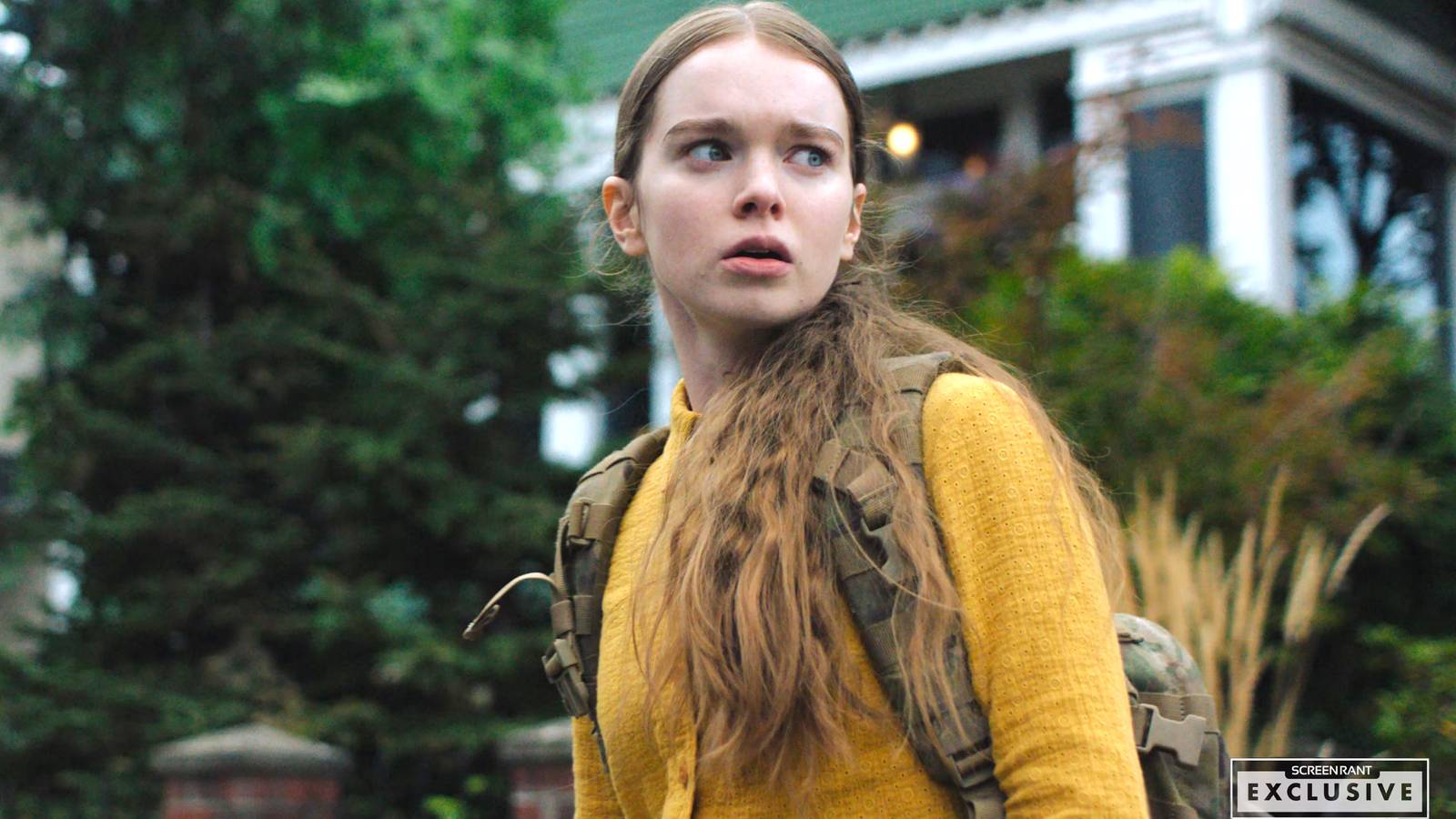
Published Oct 7, 2026, 6:51 PM EDT Sign in to your ScreenRant account Warning: Major SPOILERS lie ahead for Carrie!Mike Flanagan just took a very big swing with his Carrie ending, and it's very much aimed at future seasons. The latest adaptation of Stephen King's 1974 novel brings its troubled young teen into the modern day, with the sudden death of her father leading to the world learning of her existence after being homeschooled and prevented from leaving by her parents. Despite reservations from her mother, Margaret, Carrie quickly becomes embroiled in the highs and lows of public high school, including becoming the target of a series of bullying incidents spearheaded by the rebellious Chris Hargensen. After proving victorious in overcoming her pseudo-cold war between them, in which the latter is expelled, the Carrie ending sees the eponymous character attending her first-ever prom, with the kind-hearted Tommy Norris as her date, and the pair winning Prom King and Queen. However, after a final prank from Chris involving a pouring of pig's blood on her, Carrie goes on a rampage, killing almost everyone at the event and almost completely wiping out her hometown, with Thalia Dudek's Emaline arriving to take Carrie out of town after surviving her mother's attempt to murder her. Ahead of the show's premiere, ScreenRant's Liam Crowley and Grant Hermanns interviewed Summer H. Howell, Mike Flanagan and Amber Midthunder to discuss the Carrie ending. When asked about the group of unidentified women seen throughout the series, revealed in the finale to be led by Kate Siegel's mysterious Adelaide, Flanagan denoted that the existence of other powered characters is "one of the things the book does hint at," particularly by showcasing the titular character is "part of this longer legacy." Draft 1 · Bangor, Maine How Well Do You Know Stephen King? “They all float down here.” 🎈ITYou'll float too 🪓ShiningAll work and no play 🔨MiseryI'm your number one fan 🏰Dark TowerThe gunslinger followed ⛓ShawshankGet busy living OPEN THE BOOK → 01 King was a high school English teacher in Hampden, Maine, living in a trailer with no phone, when Doubleday paid him a $2,500 advance for his first hardcover novel in 1973. He'd thrown the opening pages in the trash; his wife Tabitha fished them out and told him to keep going. What was the book? AThe Shining B'Salem's Lot CCarrie DThe Stand ✓ Correct! Carrie. Doubleday paid a $2,500 hardcover advance in 1973, and the paperback rights sold to Signet for $400,000 — King's half ($200,000) let him quit teaching. He always credits Tabitha with saving the manuscript from the trash. Brian De Palma's 1976 film adaptation with Sissy Spacek and Piper Laurie earned two Oscar nominations and cemented King as a screen-adaptation goldmine from day one. ✗ Wrong page. The answer is Carrie, published April 5, 1974. 'Salem's Lot came next in 1975, The Shining in 1977, The Stand in 1978. Tabitha King rescued the Carrie opening from the trash, insisted he finish it, and the $400,000 Signet paperback deal that followed — split 50/50 with Doubleday — is what finally let him leave teaching. NEXT → 02 In the late 1970s, publishers believed no author could release more than one book a year without saturating the market. So King invented a pseudonym and published five novels under it — including The Long Walk, The Running Man, and Thinner — before a Washington bookstore clerk outed him in 1985. What was the pen name? AJohn Swithen BRichard Bachman CGordon Lachance DPeter Straub ✓ Correct! Richard Bachman. King took the first name from Richard Stark (Donald Westlake's pseudonym) and the last from Bachman-Turner Overdrive playing on the car stereo. Steve Brown, a Washington D.C. bookstore clerk, cross-checked copyright filings at the Library of Congress and phoned King. Rather than deny it, King wrote a mock obituary declaring Bachman had died of “cancer of the pseudonym.” ✗ Wrong byline. The answer is Richard Bachman — a pseudonym King used for Rage, The Long Walk, Roadwork, The Running Man and Thinner between 1977 and 1985. Peter Straub is a real author and King's co-writer on The Talisman and Black House. John Swithen was a one-off alias for a 1972 short story. Gordon Lachance is the narrator character in The Body (filmed as Stand By Me). NEXT → 03 King wrote The Shining (1977) after a one-night stay at the then-closing Stanley Hotel in Estes Park, Colorado, in the fall of 1974. He and Tabitha were the only guests, and a dream about his son being chased down a corridor gave him the entire novel. The fictional haunted hotel is called... AThe Overlook BThe Bates CThe Dolphin DThe Stanley ✓ Correct! The Overlook Hotel. The Kings checked into room 217 on the last night of the Stanley's 1974 season; Tabitha fell asleep and Stephen dreamed about his three-year-old son Joe being pursued by a fire hose. He woke up with most of the novel in his head. The Stanley has been milking the connection ever since — and in 1997 King adapted his own novel for a TV miniseries filmed there, as a partial corrective to Kubrick's film. ✗ Wrong floor. The answer is The Overlook. The real-world Stanley Hotel in Estes Park inspired it — King stayed in room 217 on the last night of the 1974 season and had the fire-hose nightmare that became the book. The Dolphin is a later King hotel (1408). The Bates Motel is Psycho. The Stanley itself is the real place, not the fictional one, though it's leaned into the association ever since. NEXT → 04 In IT (1986), the shape-shifting entity the Losers' Club calls Pennywise the Dancing Clown emerges from the sewers every 27 years to feed on children. The novel — and Andy Muschietti's 2017/2019 films — are set in a fictional Maine town that also shows up in Insomnia, Dreamcatcher, and 11/22/63. Name it. ACastle Rock BJerusalem's Lot CDerry DChester's Mill ✓ Correct! Derry. Loosely modeled on Bangor, Maine, where King lives. Derry recurs across IT, Insomnia, Dreamcatcher, 11/22/63 and parts of the Dark Tower series. Castle Rock is King's other signature Maine town (The Dead Zone, Cujo, Needful Things). Jerusalem's Lot is from 'Salem's Lot. Chester's Mill is the setting of Under the Dome. ✗ Wrong sewer. The answer is Derry — King's Bangor-coded fictional town, the setting of IT (1986), Insomnia (1994), Dreamcatcher (2001) and 11/22/63 (2011). Castle Rock is a different King town (Cujo, The Dead Zone, Needful Things) and Jerusalem's Lot is where the vampires show up. But Pennywise's home is always Derry. NEXT → 05 The 1990 film of Misery, adapted by William Goldman and directed by Rob Reiner, won its lead actress the Best Actress Oscar for playing obsessed “number one fan” Annie Wilkes — still the only acting Oscar ever won for a Stephen King adaptation. Who was it? AKathy Bates BSissy Spacek CJessica Lange DPiper Laurie ✓ Correct! Kathy Bates — winning Best Actress at the March 1991 Oscars for Misery. Bates later came back for King adaptations Dolores Claiborne (1995) and The Stand (1994 miniseries). It remains the only Academy Award for acting in any screen adaptation of a Stephen King book; Sissy Spacek and Piper Laurie both got nominations for Carrie, but neither won. ✗ Wrong fan. The answer is Kathy Bates, who won Best Actress at the 1991 Academy Awards for Misery. Sissy Spacek and Piper Laurie were both nominated for Carrie in 1977 but lost. Jessica Lange has been nominated and won for other films, but not for any King adaptation. Bates's hobbling scene with the sledgehammer is still routinely voted one of the most terrifying moments in horror cinema. NEXT → 06 The Shawshank Redemption (1994) — regularly voted the greatest film of all time on IMDb — is adapted from a King novella called “Rita Hayworth and Shawshank Redemption.” The same 1982 collection also contains the novellas that became Stand By Me and Apt Pupil. What is the collection called? ASkeleton Crew BDifferent Seasons CNight Shift DFour Past Midnight ✓ Correct! Different Seasons (1982) — four novellas, three of them adapted into major films: Rita Hayworth and Shawshank Redemption became The Shawshank Redemption (1994), The Body became Stand By Me (1986), and Apt Pupil became the 1998 Bryan Singer film. The fourth, The Breathing Method, is the only one never filmed. Different Seasons is the most-adapted single King book in Hollywood history. ✗ Wrong shelf. The answer is Different Seasons (1982). Night Shift (1978) is an earlier horror-story collection. Skeleton Crew (1985) contains The Mist and The Jaunt. Four Past Midnight (1990) has The Langoliers and Secret Window. But three of the four novellas in Different Seasons — Shawshank, Stand By Me, Apt Pupil — all became celebrated films, making it arguably the single most cinematically influential King book. NEXT → 07 King started writing his sprawling magnum opus in 1970 as a college student and finally published the eighth and final volume in 2012. The first line — “The man in black fled across the desert, and the gunslinger followed” — introduces a hero inspired by Clint Eastwood's Man with No Name. What's the gunslinger's name? AFlagg BRoland Deschain CJake Chambers DTed Brautigan ✓ Correct! Roland Deschain of Gilead, last of his line. The Dark Tower series — eight novels plus The Wind Through the Keyhole — is King's spine work, connecting dozens of his other books (The Stand, Salem's Lot, Insomnia, Hearts in Atlantis, IT) into one multiverse. Randall Flagg is the series' recurring villain, Jake Chambers is the boy Roland meets, and Ted Brautigan is a Low Men minor character. ✗ Wrong ka-tet. The answer is Roland Deschain. Randall Flagg is the recurring King villain who crosses from The Stand into the Dark Tower (he's the “man in black” fleeing across the desert in the famous opening). Jake Chambers is the young boy Roland picks up in The Gunslinger. Ted Brautigan is a minor Breaker in Hearts in Atlantis. Roland alone is the king of Gilead's son. NEXT → 08 King has three children. His daughter Naomi is a Unitarian minister. His younger son Owen is a novelist. His older son is a bestselling horror writer in his own right — author of Heart-Shaped Box, Horns, NOS4A2, and The Fireman — and spent his early career using a pseudonym to hide the family connection. What name does he publish under? AJoe Hill BPaul Tremblay CJosh Malerman DGrady Hendrix ✓ Correct! Joe Hill — a shortening of his real name, Joseph Hillström King. He used the pseudonym for a decade so his work would be judged on its own merits and not marketed as “son-of.” His 2004 short-story collection 20th Century Ghosts and 2007 debut novel Heart-Shaped Box made his reputation before the family connection became public. He and his father have also co-written a handful of novellas including In the Tall Grass. ✗ Wrong branch. The answer is Joe Hill — pen name of Joseph Hillström King. Paul Tremblay (A Head Full of Ghosts, The Cabin at the End of the World) is a separate contemporary horror novelist. Josh Malerman wrote Bird Box. Grady Hendrix wrote Horrorstor and My Best Friend's Exorcism. Joe Hill hid the King connection for about a decade so his career would stand on its own. REVEAL MY SCORE → Final Draft · Put Down the Pen Your Constant Reader Status ✍ / 8 Constant Reader — or still stuck in Derry? ⤴ START OVER However, despite there being a lot of groundwork in King's original novel, Flanagan points out that no prior version of Carrie has the character "live long enough" beyond the ending to "learn that she's not alone in the world." It subsequently became "one of the first things I was really excited about" when the creator went about putting together his version of the series, as well as King himself when he pitched it to the author as "he loves when those worlds expand": Mike Flanagan: As far as whether it could lead to something else down the line, my priority was always to get to the last frame of this season and honor the character and honor the arc and show the tip of the iceberg of that bigger world. I do think there's a ton of potential for more, especially with those characters. I think there are so many of those women who we meet, especially in 7 and 8, who I would love to know a lot more about. So I hope so, but I'm just worried about surviving season 1. We'll see how it's received. Though acknowledging that her character's fate "wasn't up to me," Howell did remark that she was "super happy when I got to the end" and "saw the potential of more" for Carrie after the season 1 ending. The rising star further expressed her excitement at the way Flanagan explored "the TK gene and all these powerful women" who embody it throughout the world and remained hopeful there will be a future for the series: Summer H. Howell: That'll be fun for the viewers and me to just get to see so many more women represented, and these powers are fun to play with. I hope she can also come back to the lighter version of herself, how she went into school with her openness and her eagerness for the world and exploring. We leave off season one; she's quite traumatized, and I think it'll take a while to get back, if she can even get back to those good memories and feelings, but I hope she has a fun journey in the future. Howell subsequently turned to discussing the reveal that Emaline, who initially appeared to her as a friend before being believed to be imaginary after her classmates recorded her speaking to open air, is actually another powered individual. In a further twist from King's novel, Carrie's ending sees Emaline take control of the titular teen's body to push her to kill those at her prom in revenge for the prank and all of the torment she was put through prior. Howell beamed as she recalled her time collaborating with Dudek, saying she "loved" the experience and that she "bonded really closely with them," making their friendship feel "natural" as it evolved. However, she teased that "there's always got to be underlying motives" to keep Carrie's story moving, and that should season 2 be picked up by Prime Video, she hopes the characters "can remain friends" should their motives differentiate. Another major change to come from Carrie's ending is that of the death of Amber Midthunder's Ms. Rita Desjardin, who is actually one of the few survivors of the prom incident and subsequently retires over guilt for both her failure to help the young character and laughing in response to the pig blood prank. In Flanagan's series, Desjardin instead tries to prevent Katee Sackhoff's Judith Brigham from shooting and killing Carrie amidst the prom carnage, only to instead narrowly deflect the bullet through both of their arms, with Carrie responding by telekinetically throwing her teacher into the wall of flames on stage. When asked about learning of her fate, and becoming the second-ever iteration of the character to die after Betty Buckley in Brian De Palma's Carrie, Midthunder acknowledged that she "loved that about [Rita's] storyline," having had the chance to read all eight scripts before meeting with Flanagan for the series. The Prey alum even opined that Desjardin's death "feels like a mistake," given how much she aimed to protect Carrie throughout the show: Amber Midthunder: I thought it was very sad. I think in the way that Mike sets this up is that she is one of the people who just stays earnest and consistent in her support and affection for Carrie, and wanting to be a safe space for her. It's really sad. To me, at least, it felt like it spoke to the level at which Carrie's situation is so dire, to really — I like the term "prom-page" [chuckles] — to be on such a rampage and anybody who's in the path is scorched. I thought it was really sad. Midthunder went on to praise Flanagan for his ability to take the big ensemble casts in his shows and, regardless of the level of anyone's role, "really rounds everybody out with a really full personality and storyline," thus making Rita's death all the more heartbreaking in Carrie's ending: Amber Midthunder: I think that her storyline is really great, because you meet her, and she's a little bit aimless. She has all the best hopes and intentions, and as the show goes on, she's sort of unraveling and trying to find her place. And then, obviously, everything happens with Peist. And then you get to this point where she finally decides to come back to school, and she's really re-found her purpose and her direction, and then she gets thrown into a wall of flames. What a way to go, man! What a way to go! When asked about the possibility of an off-screen survival for Rita, as her character's body was not shown, nor her fate mentioned by other characters after the fact, Midthunder chuckled as she said it's "Mike Flanagan's business" whether Desjardin made it out alive of Carrie's ending. However, that hasn't stopped her from keeping her fingers crossed for her survival, as she shared that she "made a lot of jokes about it" and made it "a hobby" to pitch "the different ways in which she could have survived" to anyone who would listen. Courtesy of Prime Prior to the show's release, Flanagan frequently teased having made a variety of changes to King's novel, a point which has notably appeared to be a sticking point in some of Carrie's reviews. But the survival of its titular character and death of Midthunder's Desjardin aren't the only major ones to come from the ending, as it initially revealed Carrie's mother, Samantha Sloyan's Margaret, to have survived. In the book and previous adaptations, Margaret perishes following the events of the prom, albeit King's source material has Carrie using her powers to stop her mother's heart, while De Palma and Moretz's films had her impaled and the titular character destroying their house around her. Flanagan's series takes a similar path as the aforementioned films in Carrie destroying her home after being stabbed in the shoulder by Margaret, though with a big twist in that Margaret is shown having telekinetic powers of her own, using them to prevent a portion of the house from killing her. Even still, Carrie does ultimately end with Margaret, now a more humanized antagonist, dying, albeit at the hands of Siegel's Adelaide, who uses her own powers to vocally convince her heart to stop. Furthermore, she explains to her fellow mysterious powered women that Margaret will be found by police and presumed dead from shock and the fallout from her ordeal, while also aiming to track down Carrie and Emaline. With the show only having just premiered, Prime Video has not made any indication as to whether they're looking at giving Carrie more seasons. Flanagan has teased having a three-season plan for his latest King adaptation, and with it now all the more unclear whether Howell's titular character should trust Emaline, Adelaide, or no one, there is still plenty of room for the show's story to grow. Mike Flanagan acknowledging parallels between Carrie and Stranger Things' Eleven Summer H. Howell previewing Carrie's powers in the Prime Video series Our cover story interview with Carrie's Summer H. Howell Amber Midthunder addressing Naru's future in the Predator franchise Midthunder addressing the chances of returning for the Marvel Cinematic Universe's X-Men reboot after her role in Legion Carrie is now available to stream on Prime Video. Release Date 2026 - 2026-00-00 Network Prime Video Showrunner Mike Flanagan Cast Summer H. Howell Carrie White Samantha Sloyan Margaret White Alison Thornton Chris Hargensen In this new series adaptation of Stephen King's classic novel, Carrie White struggles through the daily torments of school life, her domineering mother, and a dormant set of telekinetic powers. Directors Mike Flanagan, Axelle Carolyn, Hiromi Kamata, Kate Siegel, Kyra Sedgwick Writers Mike Flanagan, Alexandra Magistro, Justina Ireland, Jamie Flanagan, Elan Gale, Rebecca Klingel, Elizabeth Padden, Dani Parker Main Genre Horror Creator(s) Mike Flanagan Executive Producer(s) Mike Flanagan, Stephen King, Trevor Macy Producers Justin Wagman, Rebecca Klingel, Dani Parker Seasons 1
Carrie Series' Stephen King Book Ending Changes & Season 2 Story Setup Clarified By Mike Flanagan And Cast
Full Article
Original Source
Read the full article at Screenrant →KhanList aggregates and links to publicly available news content. We do not host full articles from third-party sources. Always verify important information with original sources.