
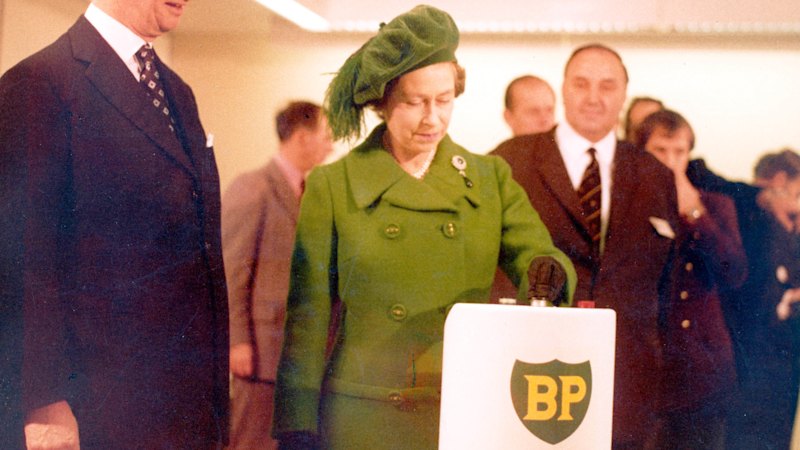
Lisa FriedmanSeptember 13, 2026 — 6:02pmAberdeen: The British North Sea, once a hub for oil and gas drilling, has faced a quarter-century of declining production, depriving communities along a foggy stretch of Scottish coastline of their economic core.Now applications for two new offshore drilling projects – a lifeline for the region – could be decided by the government in the coming days. Andy Burnham, Britain’s prime minister, faces a choice with complex economic and political ramifications, no matter what he does.He could approve the projects, known as Rosebank and Jackdaw, and face a potential revolt from powerful clean energy constituencies that strongly oppose more drilling.The BP Eastern Trough Area Project oil platform in the North Sea, about 160 kilometres east of Aberdeen, in 2014.Getty ImagesOr Burnham could stop new fossil fuel development in the North Sea and risk sealing the economic fate of the nation’s energy heartland.“It’s a tricky decision for the prime minister,” said Paul de Leeuw, director of the Energy Transition program at Robert Gordon University in Aberdeen, Scotland.The drilling plans have been delayed by policy shifts through successive governments, as well as lawsuits. Burnham has signalled that he may support one or both of the projects. The war in Iran has made imported energy more expensive, giving supporters a potent argument for increasing domestic production.Then there’s the Trump factor. President Donald Trump, who mocks climate change and is pushing his fossil fuel agenda on Europe, has pressured Burnham to open the North Sea. The decision by Burnham, who took office in July, could set the tone of his relationship with Trump.Prime Minister Andy Burnham leaving 10 Downing Street for parliament last week.AP Photo/Kin CheungTaylor Rogers, a spokesperson for Trump, said in a statement that new drilling would allow Britain to “restore its energy security and increase global supplies”.And yet, experts say, any new drilling can only buy time for Britain’s North Sea region. About 93 per cent of the basin’s oil and gas has already been extracted, and no amount of political momentum can change its physical limits.Last month, British oil giant BP, which has been operating in the North Sea for six decades, announced it would put its business there up for sale.In Aberdeen, the epicentre of Britain’s drilling industry, the future of the North Sea is a constant topic of conversation. Local leaders acknowledged that the city might never be the energy powerhouse it once was. But, they argued, the government also shouldn’t push it into an early grave.“You’ve now got something called British Petroleum saying they can’t operate in Britain anymore because of British policy,” said Russell Borthwick, chief executive of the Aberdeen and Grampian Chamber of Commerce. “Talk about a message of deindustrialisation.”On a screen in front of him was a photo taken 51 years ago of Queen Elizabeth II inaugurating a BP oil field. In it, she is pressing a gold-plated button to start the flow of crude to a refinery in the town of Grangemouth in central Scotland.The late Queen Elizabeth II presses a button to start the flow of oil from the North Sea’s Forties Field in 1975.Associated PressRefining activities at Grangemouth stopped last year after years of financial losses.“The reality is, the peak of North Sea production has passed,” Borthwick said. But he added, ”the question is, how quickly do we want to end it?”Rosebank, off the Shetland coast, is Britain’s last major developed offshore oil site, with an estimated 300 million to 350 million barrels of recoverable oil. Jackdaw is a gas field east of Aberdeen with an estimated 200 million barrels of oil equivalent.Adura, a joint venture between Shell and the Norwegian energy company Equinor that wants to develop the fields, has said the gas from Jackdaw could supply about 6 per cent of Britain’s gas and heat roughly 1.4 million homes. Oil from the Rosebank field is expected to be shipped primarily to Europe for refining and sold on the international market.The fields were approved in 2022 and 2023 when the Conservative Party was in power. Environmental groups sued, and those approvals were later overturned.When the Labour Party, under Burnham’s predecessor, took power in 2024, it pledged a moratorium on new drilling licenses. That promise came after a landmark agreement signed by Britain and nearly 200 other nations to transition away from fossil fuels.“You cannot approve the UK’s largest undeveloped oil field and claim to be taking the climate seriously,” said Tessa Khan, the executive director of Uplift UK, an advocacy group.The burning of coal, oil and gas creates carbon dioxide emissions, the primary greenhouse gas contributing to climate change. Global temperatures have risen 1.4 degrees since the 19th century. The damage can be felt across the globe, from the intense heat waves that broiled Europe this summer to more intense wildfires and drought.The port of Aberdeen.PA Images via Getty ImagesChris Aylett, an environmental research fellow at Chatham House, a London think tank, said the amount of oil and gas to be drilled in the North Sea was not worth undermining Britain’s climate pledges.“Considering what’s left in the North Sea, it would do little for energy security,” Aylett said.Advocates for Rosebank and Jackdaw argue that the energy they produce would allow Britain to import less gas from Norway and less liquefied natural gas from the United States, Qatar and elsewhere.On Norway’s side of the North Sea, companies invested about $US24 billion ($33.5 billion) last year, according to David Whitehouse, chief executive of Offshore Energies UK, a trade association. Britain’s North Sea saw about $US5.5 billion in investment.“In reality, the basins are of similar age,” Whitehouse said. The difference, he said, is that the more prodrilling policies of Norway, one of the world’s largest gas producers, draw more money to explore and pump.Advocates for drilling blame Britain’s Energy Profits Levy, which in 2022 raised the tax rate on profits from oil and gas extracted in the country to nearly 80 per cent.Renewable energy is growing fast in Britain, but not fast enough. The local business chamber said Aberdeen was losing more than 1000 jobs in the oil and gas sector each month.Offshore wind farm near Aberdeen. Renewables are growing but not fast enough.Getty ImagesThe tension between the old fossil fuel economy and the renewable future can be seen at the Port of Aberdeen. Three years ago, the port completed a £420 million ($792.4 million) expansion — hoping it would become a hub for the transit of goods used in offshore wind.Instead, on a recent afternoon, the new harbour was nearly empty but for a giant load of timber heading to Germany and a rusty oil platform that was being decommissioned. Across the way, at the port’s original harbour, cranes were picking up containers of food, fuel, spare parts and other machinery coming and going from oil platforms.John Underhill, director of the energy transition at Aberdeen University, said communities around the North Sea were eager for a transition to renewable energy.“The North Sea oil and gas bonanza is behind us,” Underhill said. But, he said, new drilling “buys us time to get the transition right, which at the moment feels unmanaged, unjust and disorganised.”This article originally appeared in The New York Times.More:Fossil fuelsUKAndy BurnhamDonald TrumpClimate crisisGlobal warmingParis AgreementFrom our partners
‘Cannot claim to be taking climate seriously’: Pressure on UK to extract last North Sea oil
Full Article
Original Source
Read the full article at Smh →KhanList aggregates and links to publicly available news content. We do not host full articles from third-party sources. Always verify important information with original sources.